THE NATURE CONSERVANCY
Policy And Governance Response to COVID-19 in Eastern and Southern Africa
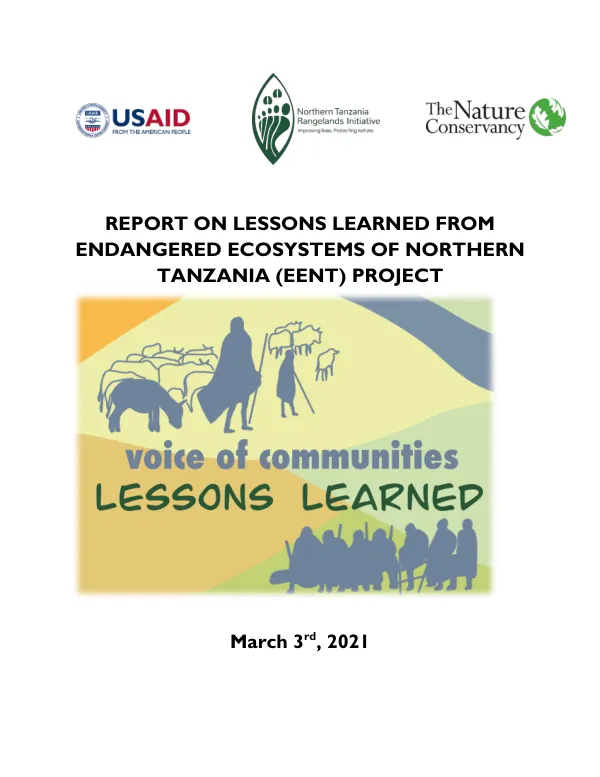
The Endangered Ecosystems of Northern Tanzania (EENT) Project was a collaborative effort between The Nature Conservancy, MS Training Centre for Development Cooperation, and In-Depth Consulting Ltd.
48 pages
Sign in to readA free account is required to download.
Abstract
The project aimed to contribute to the building of human and natural communities that would be more resilient, with a focus on empowering women and youth, promoting broad-based and inclusive economic growth, and enhancing democratic governance. The project was implemented in two phases, with Phase I focusing on building human and natural communities that would be more resilient. The ultimate outcome of the project was expected to be achieved through the attainment of four broad outcomes, referred to as intermediate results: (1) improved local governance; (2) improved wildlife protection and improved land and habitat management; (3) increased diversification of income and improved health outcomes; and (4) enhanced democratic governance. The EENT Project employed a multi-stakeholder engagement approach, involving various stakeholders, including local communities, government officials, civil society organizations, and non-governmental organizations. This approach facilitated collaboration and learning among stakeholders, enabling them to work together to address the complex challenges facing the northern Tanzania rangelands. One of the key lessons learned from the EENT Project was the importance of multi-stakeholder engagement in achieving project outcomes. The project demonstrated that effective collaboration among stakeholders can lead to better project outcomes, including improved local governance, wildlife protection, and land and habitat management. Another key lesson learned from the project was the need for collaboration at the root level. The project showed that collaboration among stakeholders at the local level is essential for achieving project outcomes, particularly in the context of the northern Tanzania rangelands. The EENT Project also highlighted the importance of partnership coordination in achieving project outcomes. The project demonstrated that effective partnership coordination among stakeholders can lead to better project outcomes, including improved local governance, wildlife protection, and land and habitat management. In terms of rangeland protection, the project demonstrated that a combination of community-based conservation approaches and government-led conservation efforts can be effective in protecting rangelands. The project also highlighted the importance of involving local communities in rangeland management and conservation efforts. The project also emphasized the need for rangeland governance and management to be integrated with other sectors, such as agriculture and water management. This integration can help to promote sustainable land use and management practices, and reduce conflicts between different land users. In terms of wildlife protection, the project demonstrated that community-based conservation approaches can be effective in protecting wildlife populations. The project also highlighted the importance of involving local communities in wildlife conservation efforts, and providing them with benefits and incentives for conserving wildlife. The EENT Project also highlighted the importance of diversification to increase resilience. The project demonstrated that diversifying income sources and promoting sustainable land use practices can help to increase the resilience of local communities to climate change and other shocks. Finally, the project emphasized the need for data to inform decision-making. The project demonstrated that data can be used to inform decision-making and improve project outcomes, particularly in the context of the northern Tanzania rangelands. Overall, the EENT Project provided valuable lessons on the importance of multi-stakeholder engagement, collaboration at the root level, partnership coordination, rangeland protection, rangeland governance and management, wildlife protection, diversification to increase resilience, and data to inform decision-making. These lessons can be applied to other conservation and development projects in the northern Tanzania rangelands and beyond.