FHI360
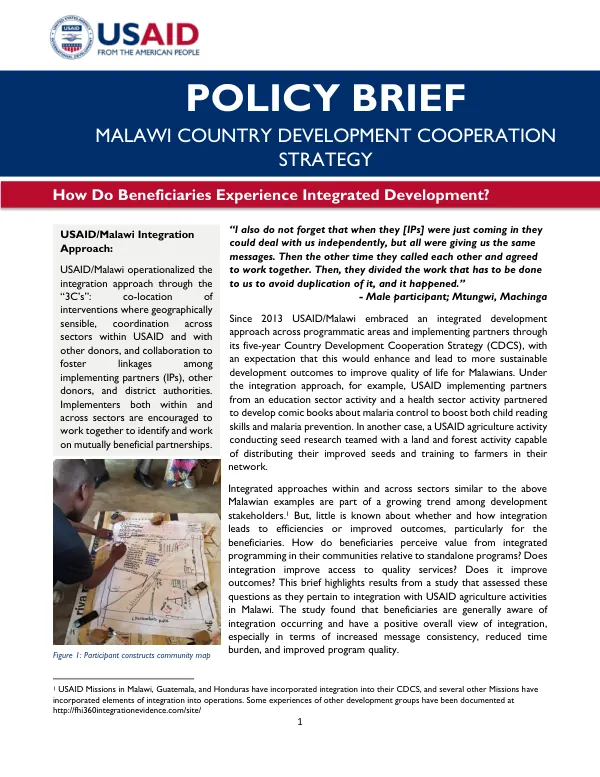
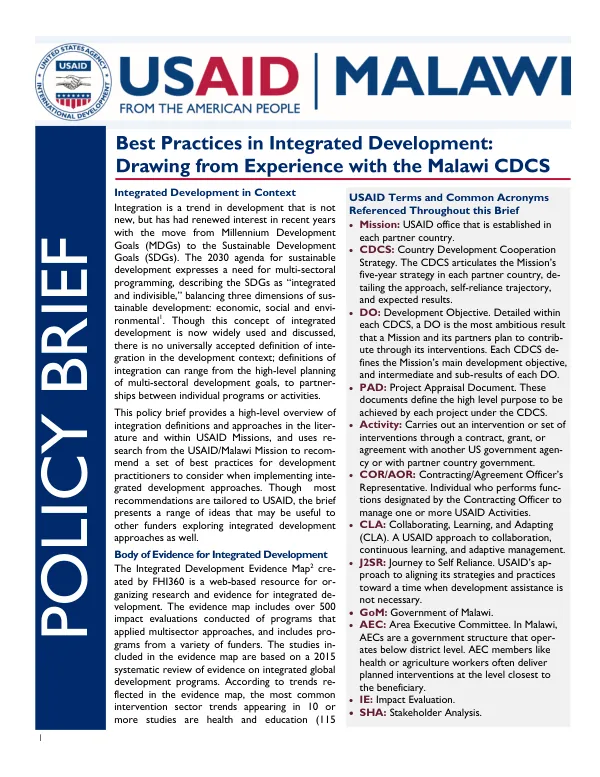
Policy Brief: Integrated Development in Context
Integrated development is a trend in development that has gained renewed interest in recent years with the transition from Millennium Development Goals (MDGs) to Sustainable Development Goals (SDGs).
2019 · 13 pages
Sign in to readA free account is required to download.
Abstract
The 2030 agenda for sustainable development emphasizes the need for multi-sectoral programming, describing the SDGs as "integrated and indivisible." This concept of integrated development is widely used and discussed, but there is no universally accepted definition of integration in the development context. Definitions of integration can range from high-level planning of multi-sectoral development goals to partnerships between individual programs or activities. The Integrated Development Evidence Map created by FHI360 is a web-based resource for organizing research and evidence on integrated development. The evidence map includes over 500 impact evaluations conducted of programs that applied multisector approaches, and includes programs from various funders. The most common intervention sector trends appearing in 10 or more studies are health and education, followed by economic development, education, health and nutrition, and education and nutrition. However, the lack of a consistent definition of integration used across studies makes it challenging to compare methods or synthesize results. The Millennium Villages Project and the IMAGE study in South Africa are two examples of distinctly different evaluation methodologies. The Millennium Villages Project is a retrospective, observational end-line evaluation that assessed the incremental effects of combining economic and health interventions. The IMAGE study in South Africa is a cluster randomized trial with pair-matched villages that evaluated the effects of co-located interventions in HIV, gender, and microfinance. The Malawi CDCS IE is a quasi-experimental impact evaluation using mixed methods that evaluated the effects of co-location, coordination, and collaboration of programs and activities across various sectors and multiple implementing partners. The Millennium Villages Project found favorable impacts on outcomes in all MDG areas, with greatest effects in agriculture and health. The project met one-third of its targets, and villages with microfinance-only interventions and microfinance/health interventions had higher levels of economic well-being than controls. The IMAGE study found that combined intervention was associated with a wider range of effects in relation to women's empowerment, reduced risk of intimate partner violence, and HIV protective behavior. USAID Missions other than Malawi have taken up integration as part of an integrated CDCS, including Honduras, Uganda, and Guatemala. USAID/Honduras developed an integrated development objective as part of their CDCS approved in 2014, which aimed to "extreme poverty sustainably reduced for vulnerable populations in western Honduras." The Mission created an integrated DO 2 team, comprised of support and technical office staff, to operationalize the integrated DO. USAID/Uganda took a creative approach to the development of their 2016-2021 CDCS, turning beneficiaries and local leaders into partners to define an integrated development agenda at the regional level. The Mission established a regional development forum with the goal to empower citizens in identifying their own needs and forming solutions. USAID/Uganda worked with implementing partner, Governance, Accountability, Participation, and Performance (GAPP), to support the development of a regional development plan. The evidence from these examples suggests that integrated development approaches can have positive impacts on outcomes in various sectors, including health, education, and economic development. However, the lack of a consistent definition of integration and the challenges associated with evaluating integration make it difficult to draw firm, generalizable conclusions from the existing body of research alone.