USAID DEC
Policy Bulletin: Weather Index Insurance for Smallholder Farmers
Weather index insurance protects farmers from losses due to extreme weather.
2016 · 12 pages
Sign in to readA free account is required to download.
Abstract
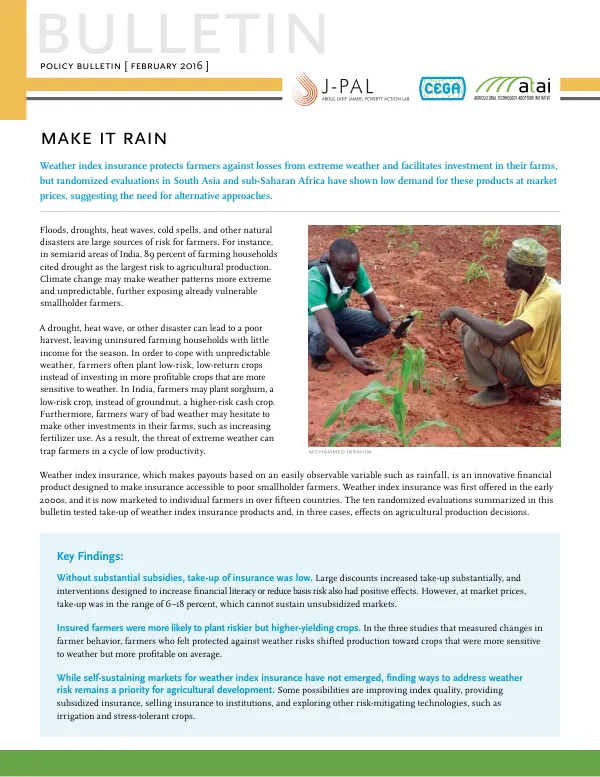
However, randomized evaluations in South Africa and sub-Saharan Africa have shown low demand for these products at market prices. This suggests the need for alternative approaches to increase take-up and make insurance more accessible to poor smallholder farmers. Substantial subsidies can increase take-up of insurance substantially. Interventions designed to increase financial literacy or reduce basis risk also have positive effects. However, at market prices, take-up is in the range of 6-38 percent, which cannot sustain unsubsidized markets. Insured farmers are more likely to plant riskier but higher-yielding crops. In the three studies that measured changes in farmer behavior, farmers who feel protected against weather risks shift production toward crops that are more sensitive to weather but more profitable on average. Floods, droughts, heat waves, and other natural disasters are large sources of risk for farmers. In semiarid areas of India, 89 percent of farming households cite drought as the largest risk to their production. Climate change may make weather patterns more extreme and unpredictable, further exposing vulnerable smallholder farmers. A drought, heat wave, or other disaster can lead to a poor harvest, leaving uninsured farming households with little income for the season. In order to cope with weather uncertainty, farmers often plant low-risk, low-return crops instead of investing in more profitable crops that are more sensitive to weather. Weather index insurance makes payouts based on an easily observable variable such as rainfall. This innovative financial product is designed to make insurance more accessible to poor smallholder farmers. Weather index insurance was first introduced in the early 2000s and is now marketed to individual farmers in over 15 countries. The ten randomized evaluations summarized in this bulletin tested take-up of weather index insurance products and their effects on agricultural production decisions. In low-income countries with small farmers, high monitoring costs, poor regulatory environments, and limited government support, indemnity-based insurance is typically infeasible. Weather index insurance offers several advantages over indemnity-based insurance, including lower monitoring costs, reduced moral hazard, and no adverse selection. Payouts are based on an easily measurable variable such as rainfall, which makes it possible to market to small farmers. However, weather index insurance has one major drawback: basis risk, which is the risk that the index does not reflect a farmer's losses. Featured evaluations were conducted in four countries: Ethiopia, Ghana, India, and Malawi. All of the evaluations studied rainfall-based index insurance, but there was variation in product and study design. Some products insured by unit of land, while others allowed farmers to choose how many policies to buy. Many evaluations tested the effect of different encouragements to buy insurance, including randomized prices, marketing, and training. In two cases, the insurance policy was bundled with a loan. Two evaluations offered free insurance policies for direct measurement of the insurance's effect on production decisions.