USAID DEC
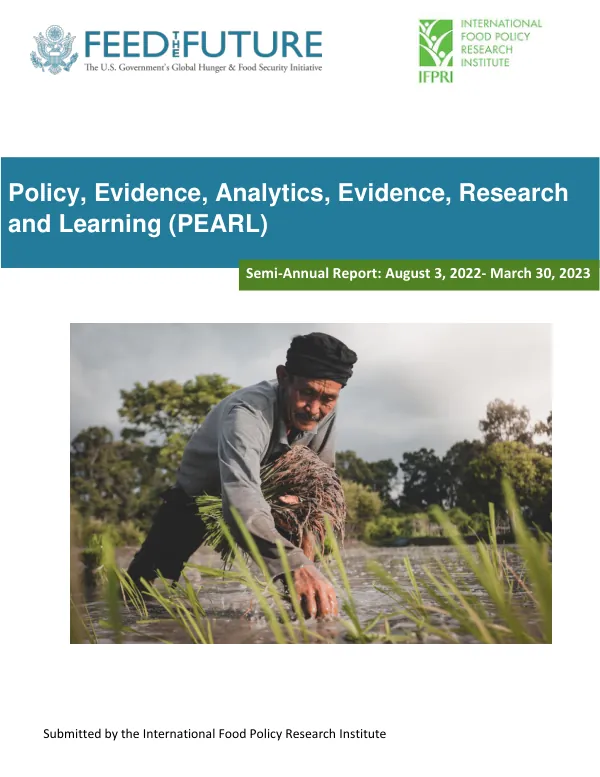
Policy, Evidence, Analytics, Evidence, Research and Learning (PEARL) Semi-Annual Report: August 3, 2022- March 30, 2023
Sign inINTERNATIONAL FOOD AND POLICY RESEARCH INSTITUTE
Policy, Evidence, Analytics, Evidence, Research and Learning (PEARL) Semi-Annual Report: August 3, 2022- March 30, 2023
The PEARL Semi-Annual Report for August 3, 2022, to March 30, 2023, highlights various activities and initiatives undertaken by the International Food Policy Research Institute (IFPRI).
2023 · 28 pages
Sign in to readA free account is required to download.
Abstract
The report focuses on generating analysis and developing analytical tools to support USAID's Food Security Program. IFPRI's Analytics and Modeling support to USAID has produced 2020 indicators and country briefs of agrifood system GDP (AgGDP+) and employment (AgEMP+) for the 20 GFSS focus countries. Country estimates for inclusion in the GFSS monitoring database were also developed. Additionally, a time series of AgGDP+ and AgEMP+ estimates for almost all countries in the world (approximately 200) for the period 2010-2019 was generated. This new database was made available to USAID as a possible input into the GFSS Graduation Scorecard process. An online dashboard and database will be launched in the second quarter of 2023. IFPRI also produced Agrifood System Diagnostics (AFSD) studies for 21 countries. The studies analyzed the current structure of each country's agrifood system and the drivers of its growth and transformation over the last decade. The studies included in-depth analysis of value chain development and economywide modeling of the potential contributions of value chains to inclusive agricultural transformation. Outputs to date include slide decks for all 21 countries and detailed reports for 2 countries (Kenya and Rwanda). Many of the diagnostics have been presented to Missions, donor groups, and/or government partners. In response to the needs for improved food crisis monitoring and analysis to understand the Ukraine war's ramifications for food security, IFPRI has developed and improved several trackers and dashboards, including the Food and Fertilizer Trade Restrictions Tracker, Fertilizer Market Dashboard, Vulnerability Analysis Dashboard, Food Production and Stocks Tracker, and the International Staple Food Market Volatility Early Warning System. Assessments of existing early warning systems for global food market shocks and those for acute food insecurity led to a key recommendation to seek closer alignment between the two systems, which is now being picked up by the G20 Agricultural Working Group. The report also highlights IFPRI's work on country modeling of impacts of Ukraine and global crises on poverty and food security. Building on previous USAID-funded studies, the RIAPA model was used to estimate the impacts of (1) COVID-19 and lockdown policies (2020-2021); (2) higher world fuel, food, and fertilizer prices associated with the Russia-Ukraine (2022); and a potential slowdown in the global economy (2023). These crises were examined separately and jointly in 20 case study countries selected in consultation with USAID's Bureau of Resilience and Food Security. The estimated impacts on poverty were used to inform the country allocation of USAID resources. In the area of Strengthening Policy Systems, IFPRI has made progress on strengthening trade in Africa by supporting the African Agricultural Trade Monitor (AATM) by working with Akademiya2063 in the construction of the database, starting from UN COMTRADE to get accurate estimates of trade in Africa. An IFPRI researcher also serves as co-editor for the 2023 edition and will contribute to a chapter on the impact of the Russia-Ukraine War on African agriculture, trade, and food systems. IFPRI's trade work has also supported the implementation of informal trade monitoring efforts in West Africa and supported CILSS to improve its methodology and the credibility of its dataset for researchers and policy analysts. The Comprehensive Action for Climate Change Initiative for Asia (CACCI-Asia) project aims to strengthen coordination between key stakeholders involved in Nationally Determined Contributions (NDC) implementation, enhance evidence-based policy processes, and develop tracking, measurement, and reporting systems to analyze the status and progress made on climate change interventions. In the reporting period, the focus was on outreach efforts to build a network of potential collaborators in several countries, including India, Nepal, Indonesia, and Fiji. Following on a launch event at COP27, ongoing collaboration with the Committee for Environmental Protection under the Government of the Republic of Tajikistan has been used to exemplify the possible impact of the work under CACCI-Asia. Together with Inter-American Institute for Cooperation on Agriculture (IICA) and University of Notre Dame, IFPRI's regional activity in LAC is coordinating Avanzar2030, calling for action to transform the Ministerial consensus into operational objectives and related policy interventions. IFPRI will participate in the Regional Dialogue on Innovation, Science, and Technology in Agri-food Systems of Latin America and the Caribbean. This dialogue focuses on the importance of innovation and technology to improve productivity and competitiveness of agri-food systems, as well as to ensure food security and environmental sustainability. AKADEMIYA2063 has maintained its support to CAADP, the Biennial Review (BR), and mutual accountability processes by reviewing BR technical guidelines and indicators, the eBR, scorecard methodology, training materials, and data sources. Regional BR brief