USAID DEC
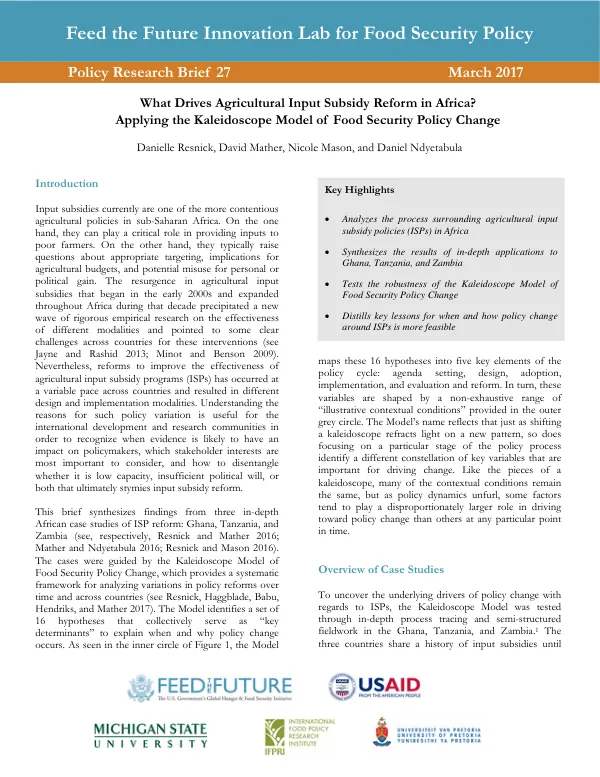
Policy Research Brief 27: What Drives Agricultural Input Subsidy Reform in Africa? Applying the Kaleidoscope Model of Food Security Policy Change
Sign inJOHNS HOPKINS UNIVERSITY
Policy Research Brief 27: What Drives Agricultural Input Subsidy Reform in Africa? Applying the Kaleidoscope Model of Food Security Policy Change
The Kaleidoscope Model of Food Security Policy Change was applied to three African case studies: Ghana, Tanzania, and Zambia.
2017 · 9 pages
Sign in to readA free account is required to download.
Abstract
These countries share a history of input subsidies until the 1990s, when they were ended due to structural adjustment programs. However, they returned to using input subsidies in the 2000s, with varying design features. Ghana's Fertilizer Subsidy Program (GFSP) was initiated in 2008 and initially began as a targeted voucher program. The program later transitioned to a waybill system, where private sector participants submitted receipts for subsidized fertilizer at each stage of the supply chain. The government's role involved approving the receipts and reimbursing the private sector accordingly. Tanzania's National Agricultural Input Voucher Scheme (NAIVS) was initiated in 2008 and was considered one of Africa's most private sector-friendly schemes. The program allowed the private sector to import, wholesale, and retail fertilizer at a subsidized price, with the government distributing vouchers to farmers. The number of targeted smallholder farmers fluctuated from around 730,000 to as many as 4 million. Zambia's Farmer Input Support Program (FISP) was initiated in 2002 and initially focused on fertilizer and maize seed. The program later expanded to a broader input scheme and introduced a flexible electronic voucher program in 2015. The program reached approximately one million farmers in 2015. The Kaleidoscope Model explains the initial emergence of input subsidy programs on each country's agricultural policy agenda. The recognized problem in all cases was low affordability and limited affordability of inorganic fertilizer on food staple crops during market liberalization. Focusing events, such as natural disasters and extreme price hikes, prompted policymakers to resort to input subsidies as a policy option with quick results. The Kaleidoscope Model identifies a set of 16 hypotheses that collectively serve as key determinants to explain when and why policy change occurs. These hypotheses are shaped by a non-exhaustive range of illustrative contextual conditions. The Model's name reflects that just as shifting a kaleidoscope refracts light on a new pattern, focusing on a particular stage of the policy process identifies a different constellation of key variables that drive change. The three case studies demonstrate the importance of understanding the reasons for policy variation in policy reforms. The Kaleidoscope Model provides a systematic framework for analyzing these reforms and identifying key lessons for when and how policy change around input subsidies is more feasible. The Model's application to the three case studies highlights the need for a nuanced understanding of the complex interactions between policy processes and contextual conditions. The case studies also demonstrate the importance of considering the role of the private sector in input subsidy programs. In Tanzania, the private sector played a significant role in the implementation of the National Agricultural Input Voucher Scheme. In Ghana, the private sector was involved in the waybill system, where they submitted receipts for subsidized fertilizer at each stage of the supply chain. The Kaleidoscope Model provides a useful framework for understanding the complex interactions between policy processes and contextual conditions. The Model's application to the three case studies highlights the need for a nuanced understanding of these interactions and the importance of considering the role of the private sector in input subsidy programs.
Related documents