USAID
Political Economy Analysis of the Dangote Sugar Company in Northeast Nigeria
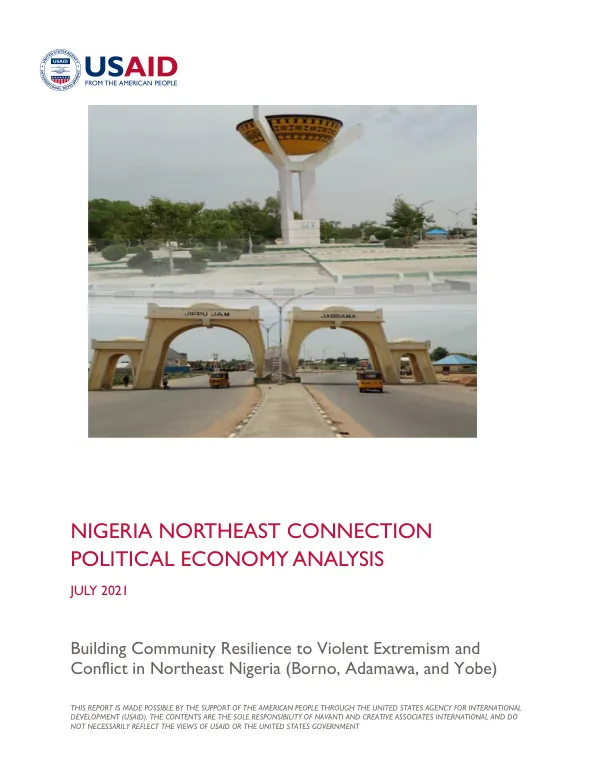
The Dangote Sugar Company (DSC), formerly the Savannah Sugar Company Limited (SSCL), has been at the center of conflict with its host communities in Lamurde local government area (LGA) of Adamawa state, Nigeria.
2023 · 25 pages
Sign in to readA free account is required to download.
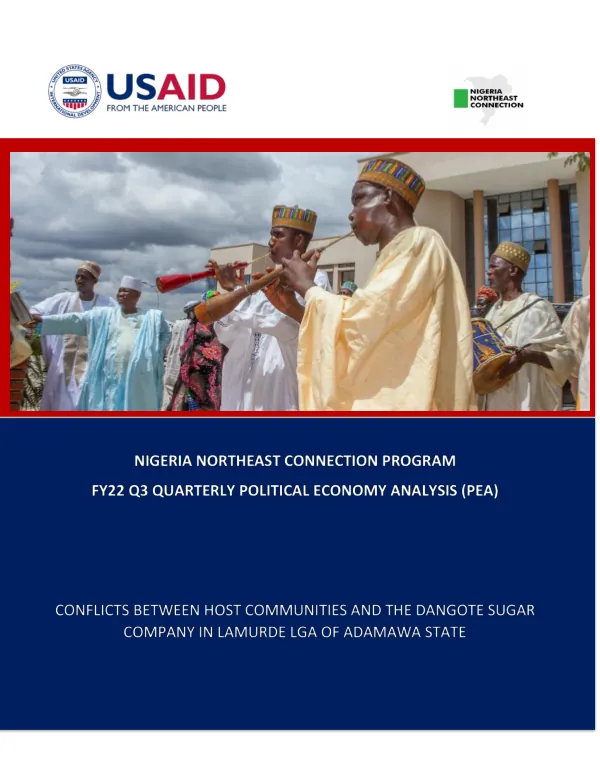
Abstract
The company's operations have led to environmental pollution and degradation, land grabbing, and exploitation of local resources, resulting in increased poverty and marginalization of the host communities. Community members have expressed strong opposition to the company's practices, citing inadequate compensation for land acquisition and exploitation of local resources. The Nigeria Northeast Connection Project (NE Connection), funded by the USAID, conducted a Political Economy Analysis (PEA) to examine the underlying drivers and tensions existing between the SSCL and host-community conflicts. The study adopted a qualitative research method, involving 33 key informant interviews (KII) and five Focus Group Discussions (FGDs) with relevant stakeholders in Lamurde and Gyawana communities. The respondents included representatives of state and local government officials, community leaders, religious leaders, NGO practitioners, local youth and women's groups, security actors, and everyday community members. The study found that community members hold strong positions against land grabbing and exploitation without adequate compensation by the DSC. The majority of the KII and FGD discussants acknowledged that some parts of the land were given to the federal government by the community when it first established the SSCL, but the sale of the company to DSC saw a massive expansion of the company's activities, allegedly causing it to acquire more land than was originally assigned. Community members also expressed concerns about the company's employment practices, citing the distribution of laborer positions along tribal and ethnic lines, with the Lunguda tribe being more favored and the Bachama ethnic group being more disadvantaged. The study also highlighted the role of government officials in exacerbating the conflict. Respondents noted that federal, state, and local government officials often opt to support short-term solutions to some of the drivers of conflict, but host communities question their commitment to participatory long-term conflict solutions. The communities query how adequately the government understands the magnitude and complexity of the conflict between both parties. The DSC staff contacted for this research refused to grant any interviews, expressing fears about how their responses would be treated, especially when their answers to the research questions may not reflect their company's position. The fear of DSC's staff participation in the research may not be dissociated from past victimization (and dismissal) of their colleagues who attempted to query the company's style of interacting with host communities. Youth from the host communities staged numerous protests against the activities and conduct of the DSC, with most of these protests being nonviolent. Respondents reported that the DSC often requested the deployment of the military and police, who attacked, injured, and dispersed protesters. The use of force by the army and the police was allegedly extended from protesters into the host community, attacking some community members and resulting in numerous casualties. The study presents only the perspectives of the host communities, as Dangote Sugar Company did not respond to requests to participate or interview. The findings of the study highlight the need for constructive relationships between host communities and multinational companies, recognizing their agencies' different capacities to influence change within the immediate environment. The study recommends community multi-stakeholder forums as an opportunity for conflict resolution and social cohesion in the areas where the SSCL operates.