USAID DEC
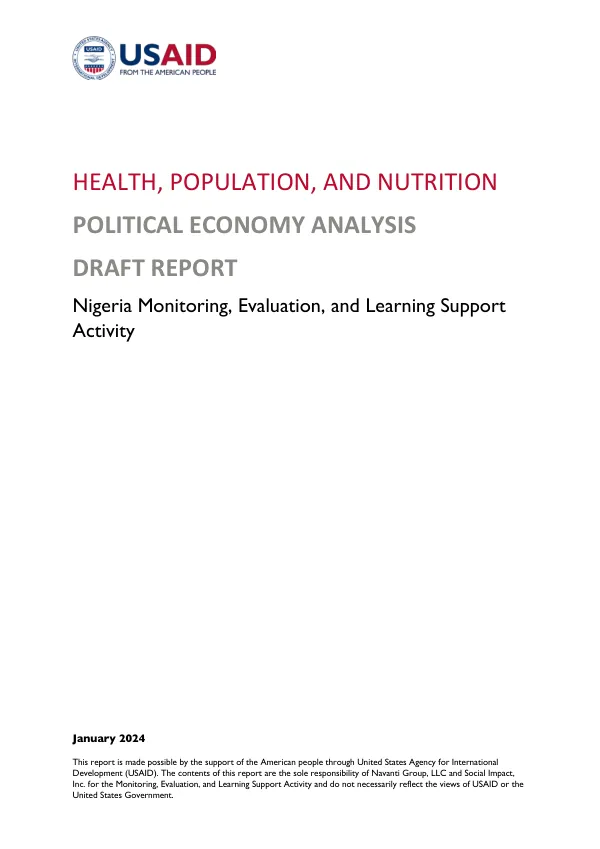
Political Economy Analysis of Health Financing, Human Resources for Health, and Transparency and Accountability in Nigeria
Sign inFEDERAL MINISTRY OF HEALTH
Political Economy Analysis of Health Financing, Human Resources for Health, and Transparency and Accountability in Nigeria
The health financing landscape in Nigeria was assessed from four focus areas: Budget Allocation, Budget Approval, Budget Release, and Budget Utilization.
2024 · 54 pages
Sign in to readA free account is required to download.
Abstract
Budget Allocation is dependent on government priorities, which are outlined in the Medium-Term Expenditure Framework (MTEF). The development phase of the MTEF is a critical period where external stakeholders can advocate for the inclusion of health as a government priority. However, the lack of data used in advocacy for health sector issues is a major challenge in pushing for governance reforms to improve health funding. One way to increase health funding and ensure effective implementation is to support the State Ministries of Health in building the capacity of their staff to generate and use data for effective advocacy. This can be achieved through training and technical assistance to help them develop and analyze data, identify trends, and identify areas for improvement. Additionally, supporting the development of a robust health financing system that is transparent, accountable, and transparent can also help to increase health funding. The assessment also found that Budget Approval typically involves the Federal Ministry of Finance, Budget, and National Planning (FMoFBNP) and the Federal Ministry of Health (MoH). The FMoFBNP is responsible for reviewing and approving the budget, while the MoH is responsible for ensuring that the budget is aligned with the health sector's priorities. However, the lack of coordination and communication between these two ministries can lead to delays and inefficiencies in the budget approval process. Budget Release is the process of releasing funds to the health sector, and it typically involves the Federal Ministry of Finance, Budget, and National Planning (FMoFBNP) and the Federal Ministry of Health (MoH). The FMoFBNP is responsible for releasing funds to the MoH, which then allocates the funds to the State Ministries of Health. However, the lack of transparency and accountability in the budget release process can lead to mismanagement of funds and inefficiencies in the delivery of health services. Budget Utilization refers to the use of funds allocated to the health sector. The assessment found that the utilization of funds is often poor, with many funds not being used effectively. This can be attributed to a lack of capacity and resources within the State Ministries of Health, as well as a lack of coordination and communication between the State Ministries of Health and the Federal Ministry of Health. Human Resources for Health (HRH) is a critical component of the health sector, and the assessment found that the HRH landscape in Nigeria is characterized by a shortage of skilled healthcare workers. The shortage of HRH is attributed to a lack of training and development opportunities, as well as a lack of incentives to retain healthcare workers in rural areas. The assessment also found that the HRH landscape in Nigeria is characterized by a lack of data on HRH, which makes it difficult to track and monitor HRH trends. The lack of data on HRH can lead to poor decision-making and inefficiencies in the delivery of health services. Transparency and Accountability are critical components of the health sector, and the assessment found that the transparency and accountability landscape in Nigeria is characterized by a lack of transparency and accountability in the health sector. The lack of transparency and accountability can lead to mismanagement of funds and inefficiencies in the delivery of health services. The assessment also found that the transparency and accountability landscape in Nigeria is characterized by a lack of data on transparency and accountability, which makes it difficult to track and monitor transparency and accountability trends. The lack of data on transparency and accountability can lead to poor decision-making and inefficiencies in the delivery of health services. The assessment recommends that the United States Agency for International Development (USAID) support the development of a robust health financing system that is transparent, accountable, and transparent. This can be achieved through technical assistance and training to help the State Ministries of Health develop and analyze data, identify trends, and identify areas for improvement. The assessment also recommends that USAID support the development of a robust HRH system that is transparent, accountable, and transparent. This can be achieved through technical assistance and training to help the State Ministries of Health develop and analyze data on HRH, identify trends, and identify areas for improvement. Finally, the assessment recommends that USAID support the development of a robust transparency and accountability system that is transparent, accountable, and transparent. This can be achieved through technical assistance and training to help the State Ministries of Health develop and analyze data on transparency and accountability, identify trends, and identify areas for improvement.