USAID
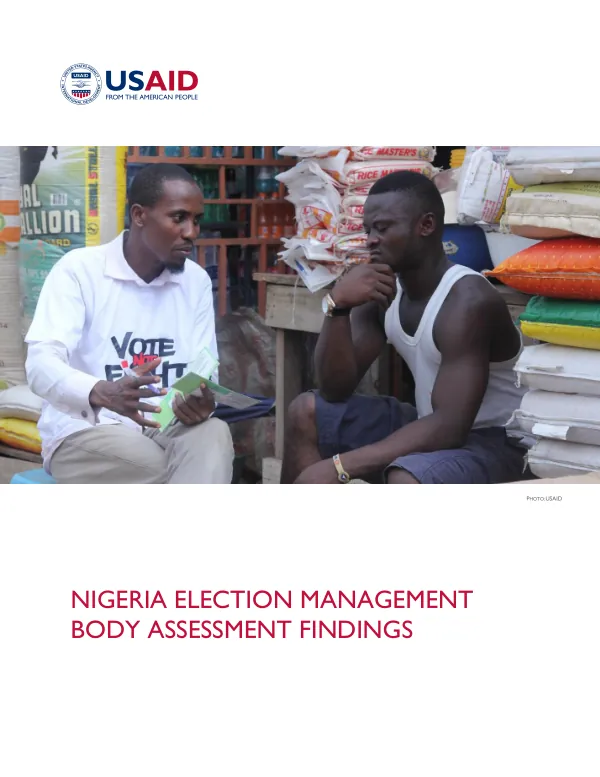
Women's Political Participation and Leadership Assessment: Nigeria
Women's political participation and leadership in Nigeria is a critical issue, with women underrepresented at all levels of government.
2023 · 2 pages
Sign in to readA free account is required to download.
Abstract
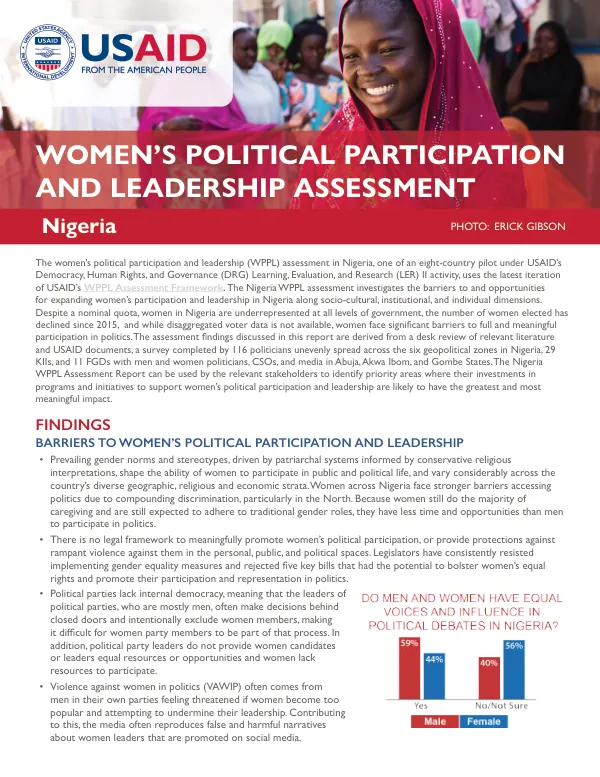
Despite a nominal quota, the number of women elected has declined since 2015. The assessment investigates the barriers to and opportunities for expanding women's participation and leadership in Nigeria along socio-cultural, institutional, and individual dimensions. Barriers to women's political participation and leadership in Nigeria are significant. Prevailing gender norms and stereotypes, driven by patriarchal systems informed by conservative religious interpretations, shape the ability of women to participate in public and political life. Women across Nigeria face stronger barriers accessing politics due to compounding discrimination, particularly in the North. The lack of a legal framework to promote women's political participation and provide protections against violence against them is also a major obstacle. Political parties lack internal democracy, and women party members often face exclusion and lack resources to participate. Violence against women in politics (VAWIP) is a significant challenge, with men in their own parties feeling threatened if women become too popular and attempting to undermine their leadership. The media often reproduces false and harmful narratives about women leaders that are promoted on social media. These barriers are compounded by the fact that women still do the majority of caregiving and are expected to adhere to traditional gender roles, leaving them with less time and opportunities than men to participate in politics. Despite these challenges, there are opportunities for women's political participation and leadership in Nigeria. The legal framework around women's political participation could be revisited now that national elections are completed, and there is a reasonable timeframe to manage a serious legislative reform process. The Independent National Electoral Commission (INEC) has a gender policy that could be used by election authorities to incentivize party reforms in the inter-election period. Women have developed a strong presence in civil society and have successfully advocated for legislation to promote women's political participation and leadership. Primary and secondary schools provide an important space for girls and boys to begin engaging in politics, although these institutions are not without similar challenges to political parties. Higher education is more accessible for women than ever before. There is also openness amongst some traditional and religious leaders on the benefits of women's participation and leadership and the demerits of women's exclusion from political spaces. To address these challenges and opportunities, several recommendations have been made. The Ministry of Education should support gender transformative education programs in primary and secondary schools. Donors and civil society organizations (CSOs) should develop programming that engages men gatekeepers and allies, including in political parties and INEC, to shift harmful views and behaviors. Donors should support locally-led women's political participation and leadership public information campaigns, rooted in cultural values, that name and take on patriarchal behavior. CSOs should train a diverse group of media workers to cover women's political participation, violence against women in politics, and gender-based violence to transform harmful gender norms and prevent gendered disinformation. Stakeholders in government and civil society should regroup and reignite advocacy efforts for the passage of gender equality bills, such as the quota bill that ensures that women constitute at least 35 percent of federal and state executive councils or ministerial and commissioner positions. INEC should act on its existing authority to advocate for gender equality in political parties, which are key to promoting women's political participation and leadership. International and local CSOs should provide consistent and proactive capacity building of women party members and support for existing young leaders, including campaigning, media engagement, and knowledge of the legal framework. Donors should design and implement a mentorship program for women politicians to teach them the formal and informal rules needed to deepen participation and leadership and deepen a peer network.