PEPFAR
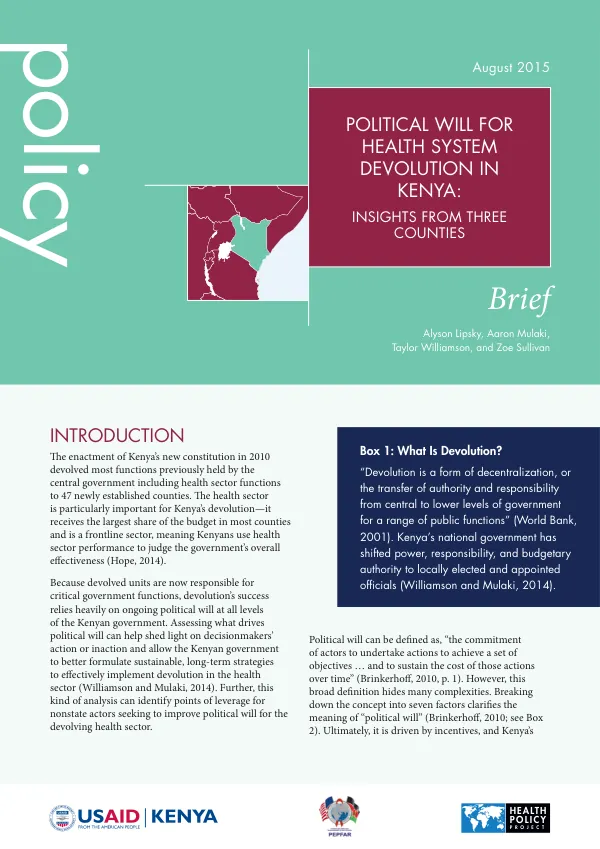
Political Will for Health System Devolution in Kenya: Insights from Three Counties
The devolution of Kenya's health sector began in 2013, following the implementation of the country's new constitution in 2010.
2015 · 6 pages
Sign in to readA free account is required to download.
Abstract
The health sector is a critical component of Kenya's devolution, receiving the largest share of the budget in most counties and serving as a frontline sector, with Kenyans using health sector performance to judge the government's overall effectiveness. The success of devolution relies heavily on ongoing political will at all levels of the Kenyan government. A country-led policy and program selection process that is technically sound is a dominant factor driving political will for health sector devolution. This process involves decision-making that is led by country-level actors, allowing for technical debates on policies and programs, and basing decisions on assessments of anticipated outcomes and benefits. In County A, senior health managers requested input from technical staff when making decisions or setting strategy, and the county developed a strategic plan that included input from different departments within the County Health Management Team. Stakeholder mobilization is another key factor driving political will for health sector devolution. This involves government actors consulting with, engaging, and galvanizing stakeholders to build constituencies that support health sector strategic plans and bring legitimacy to the idea that governments should respond to their populations' health needs. In County A, a technical committee comprised of representatives from sub-counties, the former Ministry of Public Health and Sanitation, the former Ministry of Medical Services, and all cadres of health workers oversaw the restructuring of the health system, involving all health worker cadres in the process. Public commitment and allocation of resources are also critical factors driving political will for health sector devolution. In County A, the County Health Management Team convinced the County Assembly to keep user fees within the health system by establishing a dedicated bank account for user fee revenue, ensuring a steady source of revenue for county health activities. In County C, the governor has pledged to increase access to health in the 2013 election, and the county is building delivery rooms at all health facilities and hiring new health workers to staff them, as a way to encourage women to deliver in facilities. The three counties in which interviews were conducted are identifying and experimenting with different methods for selecting health sector priorities. Despite the varied methods, there is no evidence that the counties sought input from either civil society organizations or citizens, nor that any CSOs or citizens were successful in reaching out to county health management teams to voice their concerns. The counties recognize the value of stakeholder mobilization to support counties' efforts to retain or increase funding, advocate for county objectives, gain insights on county health priorities, and influence spending decisions. The devolution of Kenya's health sector has created new incentives for national and subnational actors, and a greater understanding of the various factors that influence political will can help the national government take a leadership role to incentivize and encourage counties to make decisions for improving health outcomes and move devolution forward. The findings of this analysis can help identify points of leverage for nonstate actors seeking to improve political will for the devolving health sector.