PEPFAR
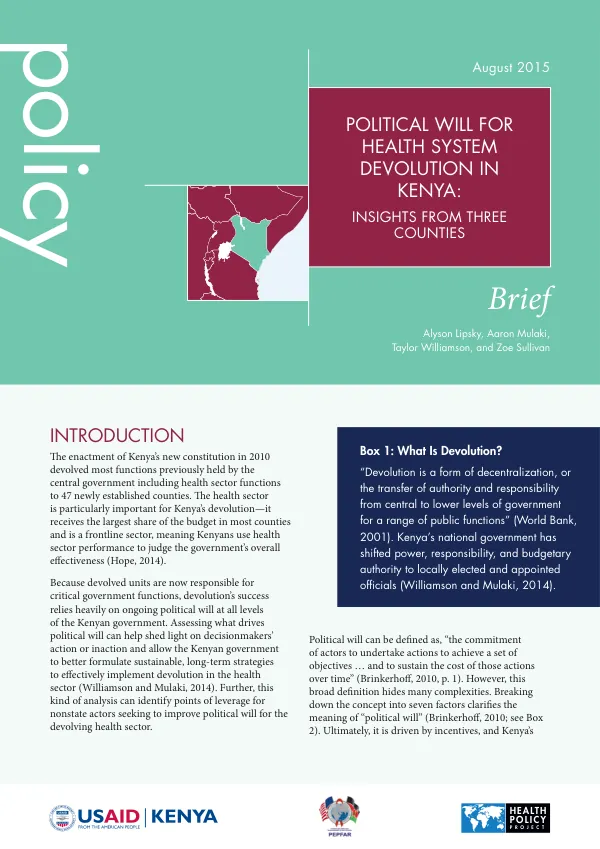
Political Will for Health System Devolution in Kenya: Insights from Three Counties
The devolution of health sector functions in Kenya began in 2013, following the enactment of the country's new constitution in 2010.
2015 · 6 pages
Sign in to readA free account is required to download.
Abstract
The health sector is a critical component of Kenya's devolution, receiving the largest share of the budget in most counties and serving as a frontline sector, with Kenyans using health sector performance to judge the government's overall effectiveness. Assessing the factors that drive political will in the health sector can help shed light on decisionmakers' actions and inaction, allowing the Kenyan government to formulate sustainable, long-term strategies to effectively implement devolution. Political will can be defined as the commitment of actors to undertake actions to achieve a set of objectives and sustain the cost of those actions over time. Breaking down the concept into seven factors clarifies its meaning: nature of government initiative, country-led policy and program selection process that is technically sound, stakeholder mobilization, public commitment and allocation of resources, application of accountability mechanisms, continuity of effort over time, and learning and adaptation. The devolution process has created new incentives for national and subnational actors, with the desire for improved health outcomes being one of the factors driving political will for health sector devolution. The Health Policy Project (HPP) conducted a series of semi-structured interviews with key informants in January 2015 to explore the incentives driving political will for the devolution of Kenya's health sector. The interviews revealed that the three counties in which interviews were conducted are identifying and experimenting with different methods for selecting health sector priorities. Despite the varied methods, HPP did not find any evidence that the counties sought input from either civil society organizations (CSOs) or citizens, nor that any CSOs or citizens were successful in reaching out to county health management teams (CHMTs) to voice their concerns. A country-led policy and program selection process that is technically sound is a critical factor in driving political will for health sector devolution. In County A, senior health managers had often requested input from technical staff when making decisions or setting strategy. The county developed a strategic plan in 2013, which included input from different departments within the CHMT. In County B, the visibility of county spending drives health investment decisions, resulting in significant investments in infrastructure without investments in other areas necessary to support the intended infrastructure improvements. In County C, the governor has a background in community health and pledged to increase access to health in the 2013 election, specifically addressing the gap in births occurring in health facilities. Stakeholder mobilization is another critical factor in driving political will for health sector devolution. The informant interviews revealed that the three counties recognized the value of stakeholder mobilization to support counties' efforts to retain or increase funding, advocate for county objectives, gain insights on county health priorities, and influence spending decisions. In County A, HPP saw extensive stakeholder mobilization in support of the county's efforts to restructure the health system, involving a technical committee comprised of representatives from sub-counties, the former Ministry of Public Health and Sanitation, the former Ministry of Medical Services, and all cadres of health workers.