PEPFAR
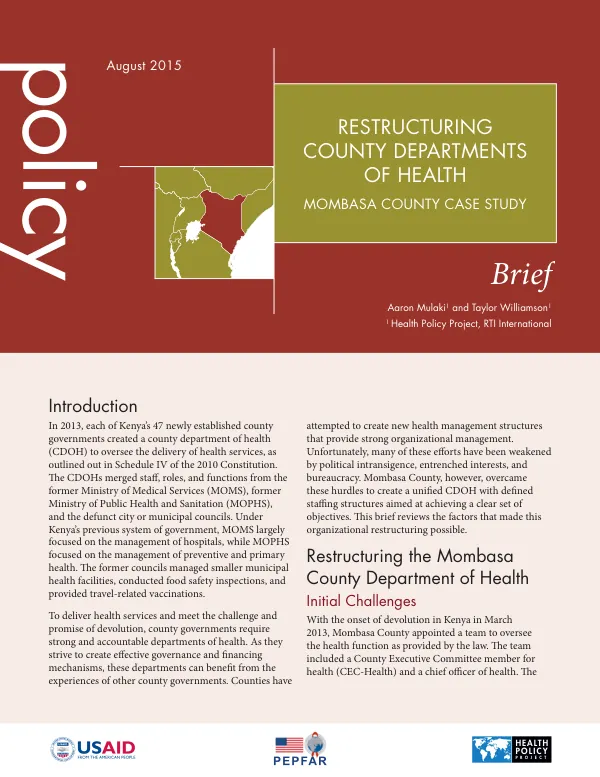
Restructuring County Departments of Health: Mombasa County Case Study
Mombasa County Department of Health Restructuring In 2013, Mombasa County appointed a team to oversee the health function as provided by the law, including a County Executive Committee member for health and a chief officer of health.
2015 · 6 pages
Sign in to readA free account is required to download.
Abstract
The two quickly assembled a county health management team (CHMT) comprising members from the former ministries of health and city council to help them run the department. A county director of health was appointed by the CEC-Health as the technical leader of the CHMT. The Mombasa CDOH faced three primary challenges by July 2013. First, county health leadership had not defined how the former ministries of health and city council were going to merge, resulting in structural and communication challenges. CHMT staff who came from these different institutions did not communicate well and continued to work in silos, leading to a lack of coordination among the CHMT's various units and departments. Second, the newly created CDOH suffered from internal power struggles, with some personnel alleging that leaders favored managers from the former city council. The CHMT members also disagreed about potential health investments, with former MOMS staff supporting investments in clinical services and former MOPHS staff supporting health promotion and disease prevention. Third, the CHMT's accountability to the county health leadership was weak, and the chain of command was unclear. In one instance, CHMT technical staff did not participate in the launch of a mobile maternal outreach service, arguing that they were not invited due to a communication breakdown, and that their roles in the event were unclear. To respond to these challenges and restore public confidence in the management of health services, the Mombasa County government appointed a new CEC-Health and a new chief officer of health. The new CEC-Health requested assistance from the USAID- and PEPFAR-funded Health Policy Project (HPP) to streamline CDOH management structures. The restructuring process involved several steps. First, HPP facilitated discussions with CDOH staff to analyze restructuring needs. The analysis revealed that managing county government health functions requires more planning, communication, and human resource management skills than the former District Health Management Teams possessed. CHMT communicated poorly and duplicated efforts, and county leadership could not hold managers accountable for poor performance. The county health leadership subsequently appointed a Restructuring Technical Committee (RTC) comprising 25 individuals drawn from all health worker types, management functions, ages, genders, and decentralized units. The RTC identified core principles to guide the restructuring exercise, engaged with various Mombasa County health management structures, and implemented a new organizational structure. Next, the RTC analyzed county health functions under the new legal and regulatory framework to ensure that they aligned with the principles of devolution. It also reviewed the Mombasa County Health Strategic Plan to identify key operational areas and propose new functional units and key positions needed to implement the plan. The RTC then developed an organizational structure and submitted it for approval to the County Executive Committee and the County Public Service Board (CPSB). Once the CPSB approved the organizational structure, the RTC specified roles and functions of the key positions in the new structure to develop job descriptions. Each job description clarified the roles and responsibilities, key performance areas, accountability relationships, skills, knowledge, experience, and qualifications required, and the desired attributes for the position. The RTC also created new job descriptions for existing CHMT positions to avoid duplication and clarify accountability relationships and deliverables. To finalize restructuring, the CHMT hired new staff, including a health economist, to lead the planning and budgeting process. The CHMT also developed a communication strategy and a change-management plan to guide explanations of health challenges to the public and to direct staff through the transition. The restructuring process was successful due to several critical factors, including senior-level political will, which was driven by the CEC-Health and the chief officer for health, with support from the county governor. They initiated and led the restructuring process, believing that the CDOH had to be reformed to manage health services efficiently. They also communicated the need for restructuring to CDOH staff and stakeholders and held the RTC accountable for delivering a new organizational structure. The county leadership's commitment to restructuring was a key factor in the success of the process. The CEC-Health and the chief officer for health played a crucial role in driving the restructuring process forward, and their leadership helped to build a sense of ownership and accountability among CDOH staff. The restructuring process also involved the development of a new organizational structure, which was designed to be lean and focused on supporting health service providers. The new structure included a clear chain of command and defined roles and responsibilities for each position. The restructuring process in Mombasa County was a complex and challenging undertaking, but it was ultimately successful due to the commitment and leadership of the county health leadership. The process involved several key steps, including the analysis of restructuring needs, the development of a new organizational structure, and the specification of roles and functions for each position. The county leadership's commitment to restructuring was a key factor in the success of the process,