NATIONAL ENVIRONMENTAL PROTECTION AGENCY
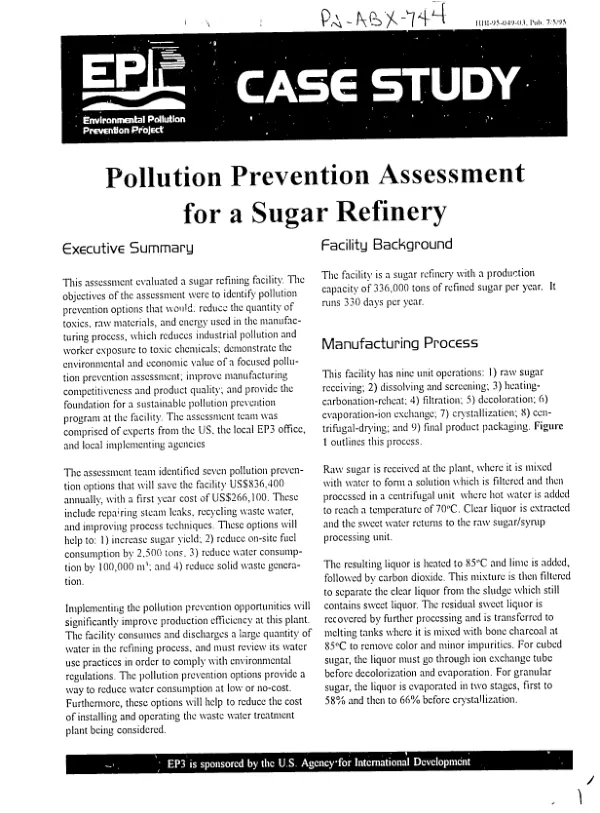
Pollution Prevention Assessment for a Sugar Refinery
The sugar refining facility is a major consumer of water, fuel, and energy, generating significant amounts of waste water, solid waste, and emissions.
2010 · 4 pages
Sign in to readA free account is required to download.
Abstract
The facility's manufacturing process involves nine unit operations, including raw sugar receiving, dissolving and screening, heating-carbonation-reheat, filtration, decoloration, evaporation-ion exchange, crystallization, centrifugal-drying, and final product packaging. The process requires large amounts of water, fuel, and energy, resulting in significant environmental problems. The facility's existing pollution problems include consumption of large amounts of water and fuel, generation of waste water, generation of solid waste, and emissions produced from heavy fuel oil combustion. To address these problems, a pollution prevention assessment was conducted to identify opportunities for reducing industrial pollution and worker exposure to toxic chemicals. The assessment team identified seven pollution prevention options that will save the facility US$836,400 annually, with a first year cost of US$266,100. The seven pollution prevention options include repairing steam leaks and insulating pipes, repairing and replacing fittings on filter machines, sealing doors and lids on the centrifuge and dryer, re-use jute and plastic bags, adjusting process during filtration, installing super-saturation detectors, and recycling wash water from decolorizing charcoal. These options will help to reduce fuel consumption, water consumption, and solid waste generation, while also improving production efficiency and reducing the cost of installing and operating the waste water treatment plant. The facility's manufacturing process involves several unit operations, including raw sugar receiving, dissolving and screening, heating-carbonation-reheat, filtration, decoloration, evaporation-ion exchange, crystallization, centrifugal-drying, and final product packaging. The process requires large amounts of water, fuel, and energy, resulting in significant environmental problems. The facility's existing pollution problems include consumption of large amounts of water and fuel, generation of waste water, generation of solid waste, and emissions produced from heavy fuel oil combustion. The pollution prevention options identified in the assessment will help to reduce the facility's environmental impact and improve its competitiveness and product quality. The options will also provide a foundation for a sustainable pollution prevention program at the facility. The facility's management has already implemented some of the options as part of a major maintenance plan, with a total cost of US$121,200 and a payback period of less than 15 days.