COASTAL RESOURCES CENTER
Population, Health, Environment and Livelihoods
Population, Health, Environment, and Livelihoods approaches address integrated problems that influence people's quality of life.
2011 · 16 pages
Sign in to readA free account is required to download.
Abstract
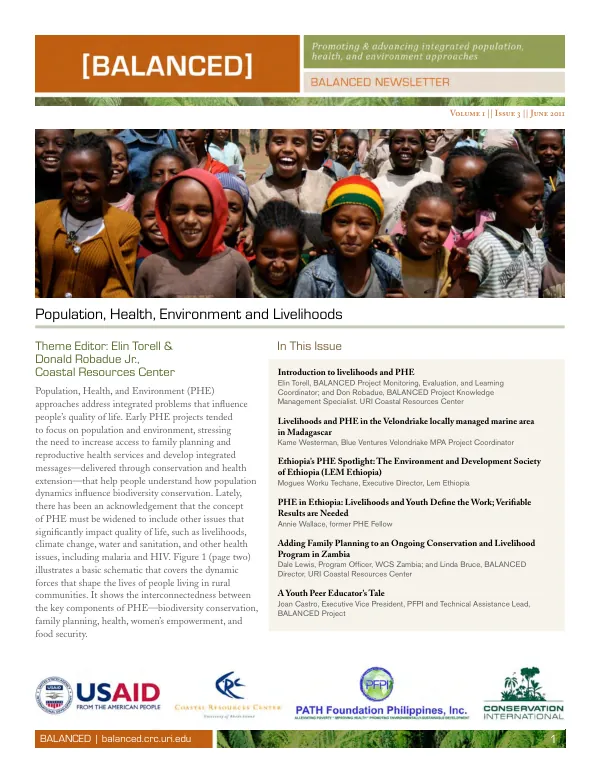
Early PHE projects focused on population and environment, emphasizing the need to increase access to family planning and reproductive health services and develop integrated messages that help people understand how population dynamics influence biodiversity conservation. However, there has been an acknowledgement that the concept of PHE must be widened to include other issues that significantly impact quality of life, such as livelihoods, climate change, water and sanitation, and other health issues. The interconnectedness between the key components of PHE - biodiversity conservation, family planning, health, women's empowerment, and food security - is illustrated in Figure 1. Livelihoods and food security are central parameters for quality of life, and integrating livelihoods into PHE programs makes sense. Although there is little "hard evidence" that livelihoods activities add value to PHE, research has demonstrated the link between tangible benefits that a coastal management program brings and the sustainability of those efforts and its benefits. Four positive dynamics that livelihood initiatives can help reinforce are identified. First, creating conditions that allow individuals to think long term can be achieved through profitable livelihoods, which increase income and enable individuals to prioritize health and conservation. Second, reducing vulnerability to stress and shocks can be achieved through diversified livelihood options, which contribute to better environmental conditions and more sustainable use of natural resources. Third, empowering women through livelihood activities raises their self-confidence and increases their status in the family and community. Fourth, diminishing the use of destructive practices can be achieved through environmentally friendly livelihoods, which provide incentives to protect biodiversity and natural resources. Research has empirically proven the link between income and the environment in many countries and contexts. For example, a study of two fishing communities in Cambodia found that building a portfolio of livelihood options is one of the most important ways that people learn to live with change and uncertainty. Similarly, investments in family planning alongside livelihood interventions have augmented the positive impacts by reducing population growth and ensuring that food security is sustained over time. The articles presented in this issue of the BALANCED newsletter demonstrate the strong links and natural interdependencies between PHE and livelihoods. In the Ethiopia case study presented by Techane, women's income has increased, and so too has their ability to negotiate safe sex and avoid unplanned pregnancies. Wallace also refers to another Ethiopian case where women have become more involved in conservation and men more involved in family planning. The earnings from conservation enterprises motivate people to protect biodiversity in order to maintain and sustain that income stream. The Coastal Resources Center has conducted research in Tanzania and Latin America that found that in many places, women whose incomes increase or who are able to earn an income for the first time often feel more empowered to participate in household and community decision-making and are accorded more respect by their spouses and others in their community. This could mean increasing women's confidence to negotiate the use of contraceptives with their partners as well as increasing women's involvement in biodiversity conservation. In conclusion, integrating livelihoods into PHE programs makes sense, and research has demonstrated the link between tangible benefits that a coastal management program brings and the sustainability of those efforts and its benefits. The positive dynamics that livelihood initiatives can help reinforce include creating conditions that allow individuals to think long term, reducing vulnerability to stress and shocks, empowering women, and diminishing the use of destructive practices.