ENCOMPASS, LLC
Post-Event Report: October-November 2023 In-Person CSAid
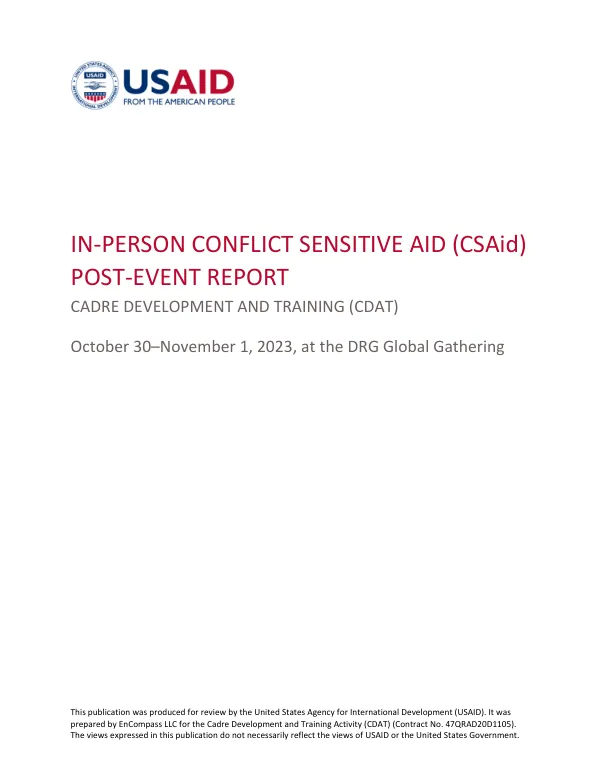
The Conflict Sensitive Aid (CSAid) technical workshop was delivered in-person as part of the Democracy, Human Rights, and Governance (DRG) Global Gathering from October 30 to November 1, 2023.
2023 · 15 pages
Sign in to readA free account is required to download.
Abstract
The workshop was facilitated by the Cadre Development and Training (CDAT) Activity, which is funded by the United States Agency for International Development (USAID). The workshop aimed to equip participants with the skills and knowledge necessary to incorporate conflict sensitivity into their programming. The workshop had three learning objectives: to incorporate analytical tools to examine conflict and violence dynamics and the interactions with USAID assistance, to apply the Do No Harm framework to identify unintended consequences of programming, and to apply conflict sensitivity across the Program Cycle to improve development outcomes in countries affected by violence and conflict. Participants were asked to complete CDAT-administered evaluations during the pre-work and after the technical workshop. The workshop was attended by 25 participants, and the response rate for the technical workshop evaluation was 84 percent. Respondent feedback was positive, with the majority agreeing or strongly agreeing that they were satisfied with the technical workshop sessions, would recommend the course to their colleagues, and were committed to applying what they learned in the course back on the job. Participants also reported high satisfaction with the course facilitators, with 76 percent or more indicating that they were satisfied or very satisfied with each facilitator's knowledge of the subject matter, effectiveness in engaging participants, and effectiveness in facilitating responses to participant comments/questions. The evaluation results showed an increase in participants' ability to perform the key skills identified in the course learning objectives between the pre-work and the technical workshop evaluation. The percentage of respondents who reported being able to perform each of the three key skills fully without guidance or being able to serve as a key resource and advise others increased by 46 percent for incorporating analytical tools, 27 percent for applying the Do No Harm framework, and 40 percent for applying conflict sensitivity across the Program Cycle. Based on the evaluation results and facilitator feedback, CDAT recommends several adjustments for future deliveries of the CSAid course. These recommendations include including a subject matter expert in future deliveries, customizing the delivery based on the audience, and integrating more practical, real-world examples into course content. The team suggests that having a subject matter expert support facilitation would be beneficial, and choosing subject matter experts based on the delivery audience may be advantageous. Additionally, participants expressed a strong desire for more specific and contextual examples, and facilitators discussed the value of having relevant, engaging case studies and including additional voices and experiences. The demographic data for the LNA and technical workshop evaluation respondents showed that the course had a diverse cohort, with participants from various locations, hiring mechanisms, and time worked at USAID. The majority of participants were female, and the most common sector focus at USAID was Democracy, Human Rights, and Governance. The evaluation results and demographic data provide valuable insights into the effectiveness of the workshop and the needs of the participants, which can inform future deliveries of the CSAid course.