JOHN SNOW INTERNATIONAL
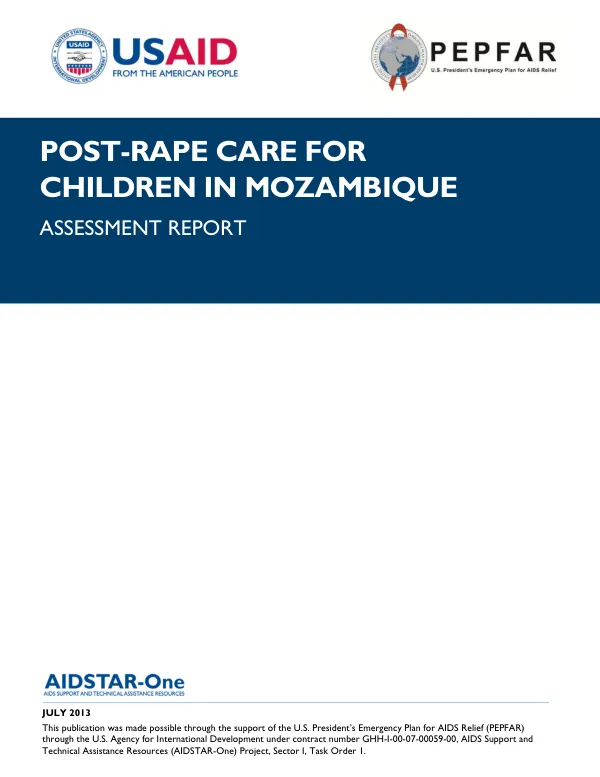
Post-Rape Care for Children in Mozambique: Assessment Report
The assessment of post-rape care for children in Mozambique was conducted in two provinces, Sofala and Zambézia, and in the capital city of Maputo.
2013 · 55 pages
Sign in to readA free account is required to download.
Abstract
The assessment aimed to highlight the availability and practices of post-rape care for children and to identify the factors that support and hinder the provision of services for children who have experienced sexual violence and exploitation. The assessment was conducted primarily to support USAID/Mozambique’s planning in this area of development. The assessment found that sexual violence and exploitation against children is a significant problem in Mozambique, with contextual determinants such as the country's economic development, legacy of civil war, and HIV and sexual and gender-based violence (SGBV) contributing to the issue. The assessment also found that the legal framework relevant to child sexual violence and exploitation is influenced by these factors and is based on the age of the victim and the victim's virginity, rather than the nature of the offense. The assessment highlighted the limited understanding of the law in the community, inconsistencies in its application by law-enforcement agencies and the judicial system, and the lack of reporting of cases of sexual violence and exploitation. The assessment also noted that girls are often seen as commodities that can be exchanged for cash or goods through early marriage arrangements, and that this practice is not recognized as a form of sexual violence and exploitation. The assessment identified several key issues that hinder access to and provision of post-rape care for children, including the lack of awareness and understanding of the law and its application, the limited availability of services, and the stigma and shame associated with sexual violence and exploitation. The assessment also noted that boys are often overlooked in discussions of sexual violence and exploitation. The assessment made several recommendations to address these issues, including improving awareness and understanding of the law and its application, increasing the availability of services, and addressing the stigma and shame associated with sexual violence and exploitation. The assessment also recommended that the government of Mozambique should develop a comprehensive policy on post-rape care for children and that civil society organizations should work to raise awareness and advocate for the rights of children who have experienced sexual violence and exploitation. The assessment found that the current policy framework for post-rape care for children in Mozambique is inadequate and does not address the specific needs of children who have experienced sexual violence and exploitation. The assessment recommended that the government of Mozambique should develop a comprehensive policy on post-rape care for children that addresses the specific needs of children who have experienced sexual violence and exploitation. The assessment also noted that the assessment was conducted primarily to support USAID/Mozambique’s planning in this area of development, and that it does not evaluate any program or service. The assessment aimed to provide a snapshot of key issues that hinder access to and provision of post-rape care for children and to suggest recommendations to support further action to benefit the children of Mozambique and the development of the country.