USAID DEC
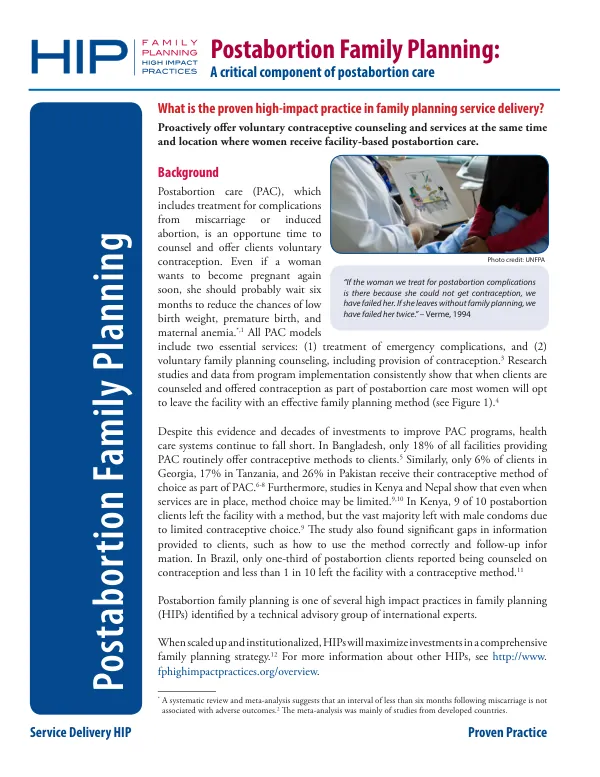
Postabortion Family Planning: A High-Impact Practice in Family Planning Service Delivery
Sign inUNFPA
Postabortion Family Planning: A High-Impact Practice in Family Planning Service Delivery
Postabortion family planning is a critical component of postabortion care, which includes treatment for complications from miscarriage or induced abortion.
2019 · 8 pages
Sign in to readA free account is required to download.
Abstract
The practice involves providing voluntary contraceptive counseling and services to women at the same time and location where they receive facility-based postabortion care. This approach has been proven to be highly effective in increasing contraceptive use and reducing subsequent abortions. Research studies and data from program implementation consistently show that when clients are counseled and offered contraception as part of postabortion care, most women will opt to leave the facility with an effective family planning method. In fact, studies have shown that rates of contraceptive uptake in small-scale intervention studies range between 25% and 98%. Large-scale routine service delivery programs have also achieved high rates of voluntary contraceptive uptake, with some programs reporting that up to 98% of postabortion clients left the facility with a modern contraceptive method. Postabortion family planning can help countries address several challenges, including the high number of induced and spontaneous abortions, which account for an estimated one-quarter of all pregnancies worldwide. In developing countries, the number of induced abortions is on the rise, with nearly half of these being considered unsafe. Providing voluntary contraception to women who wish to delay or limit childbearing can cost just a fraction of the average expenditure on postabortion care, making it a cost-effective strategy. The evidence that postabortion family planning is high impact is based on a wide variety of settings, with data consistently showing that acceptance of contraception is high when women are offered counseling and services as part of postabortion care. Studies have shown that providing voluntary family planning services as part of postabortion care can increase contraceptive use and reduce subsequent abortions. In Zimbabwe, postabortion clients who were offered on-site, ward-based family planning services and methods for free were more than three times as likely to experience an unplanned pregnancy in the 12 months following an abortion as those who were not offered these services. Implementation of postabortion family planning requires a range of free contraceptives, including long-acting methods, to be offered at the point of treatment. This approach has been shown to increase rapidly and unintended pregnancies and repeat abortions can decline as a result. It is essential to provide high-quality postabortion family planning services, including counseling and follow-up information, to ensure that women have the knowledge and support they need to make informed decisions about their reproductive health. In conclusion, postabortion family planning is a critical component of postabortion care that has been proven to be highly effective in increasing contraceptive use and reducing subsequent abortions. By providing voluntary contraceptive counseling and services to women at the same time and location where they receive facility-based postabortion care, countries can address several challenges, including the high number of induced and spontaneous abortions, and reduce the costs associated with treating complications from unsafe abortions.
Related documents