INTERNATIONAL FEDERATION OF THE RED CROSS AND THE RED CRESCENT SOCIETIES
Pounds of Prevention - A Disaster Risk Reduction Summary
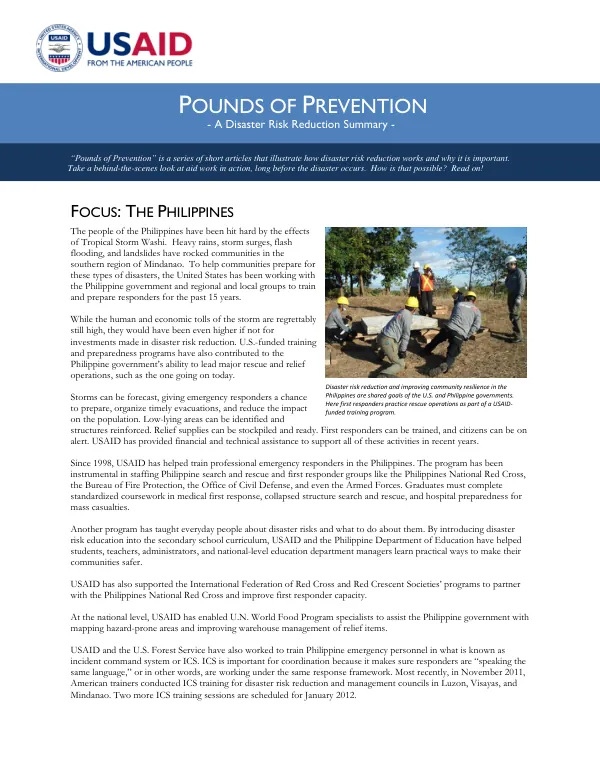
The Philippines has been severely impacted by Tropical Storm Washi, resulting in heavy rains, storm surges, flash flooding, and landslides in the southern region of Mindanao.
2012 · 1 pages
Sign in to readA free account is required to download.
Abstract
The storm has had a significant human and economic toll, but investments in disaster risk reduction have helped mitigate the effects. U.S.-funded training and preparedness programs have contributed to the Philippine government's ability to lead major rescue and relief operations. The U.S. has been working with the Philippine government and regional and local groups to train and prepare responders for the past 15 years. This effort has enabled the Philippine government to lead major rescue and relief operations, such as the one currently underway. Storms can be forecast, giving emergency responders a chance to prepare, organize timely evacuations, and reduce the impact on the population. Low-lying areas can be identified and structures reinforced, relief supplies can be stockpiled and ready, and first responders can be trained, and citizens can be on alert. Since 1998, the United States Agency for International Development (USAID) has helped train professional emergency responders in the Philippines. The program has been instrumental in staffing Philippine search and rescue and first responder groups, including the Philippines National Red Cross, the Bureau of Fire Protection, the Office of Civil Defense, and the Armed Forces. Graduates of the program must complete standardized coursework in medical first response, collapsed structure search and rescue, and hospital preparedness for mass casualties. Another program has taught everyday people about disaster risks and what to do about them. By introducing disaster risk education into the secondary school curriculum, USAID and the Philippine Department of Education have helped students, teachers, administrators, and national-level education department managers learn practical ways to make their communities safer. USAID has also supported the International Federation of Red Cross and Red Crescent Societies' programs to partner with the Philippines National Red Cross and improve first responder capacity. At the national level, USAID has enabled U.N. World Food Program specialists to assist the Philippine government with mapping hazard-prone areas and improving warehouse management of relief items. USAID and the U.S. Forest Service have also worked to train Philippine emergency personnel in the incident command system (ICS), which ensures responders are working under the same response framework. This effort has been ongoing, with recent training sessions conducted in November 2011 and scheduled for January 2012.
Related documents
Documents in this collection
 2012
2012USAID DEC
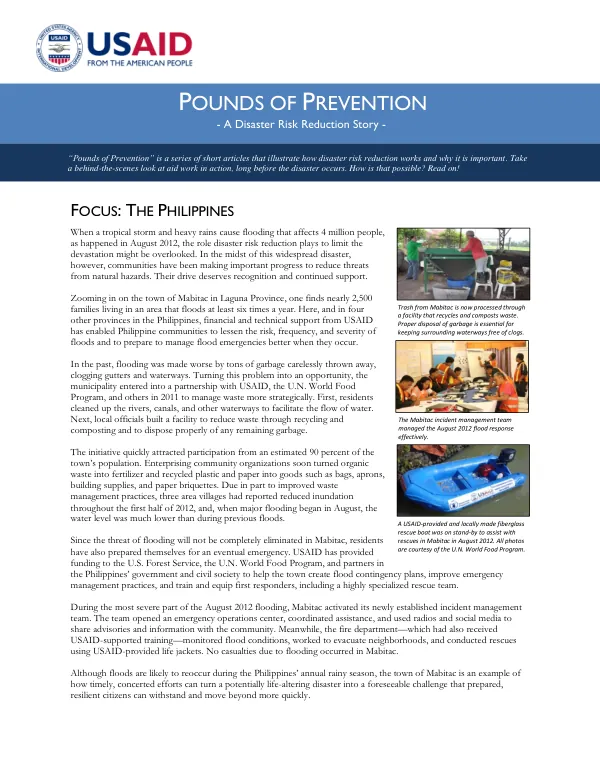
Pounds of Prevention Philippines
Open record 2021
2021USAID DEC
Good Practices and Promising Interventions, Technical Series No. 8: A Cost-Effectiveness Analysis of Mainstreaming Chest X-Ray Screening with Artificial Intelligence-Powered Computer-Aided Detection or Human Readers in Public Facilities
Open record