THE WORLD FOOD PROGRAMME
Pounds of Prevention Philippines
The Philippines has made significant progress in reducing the risk and severity of floods through disaster risk reduction efforts.
2012 · 1 pages
Sign in to readA free account is required to download.
Abstract
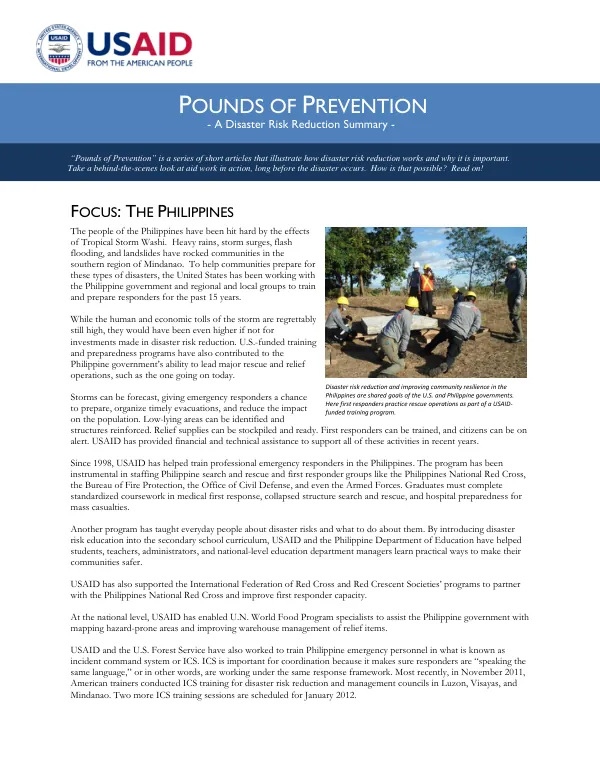
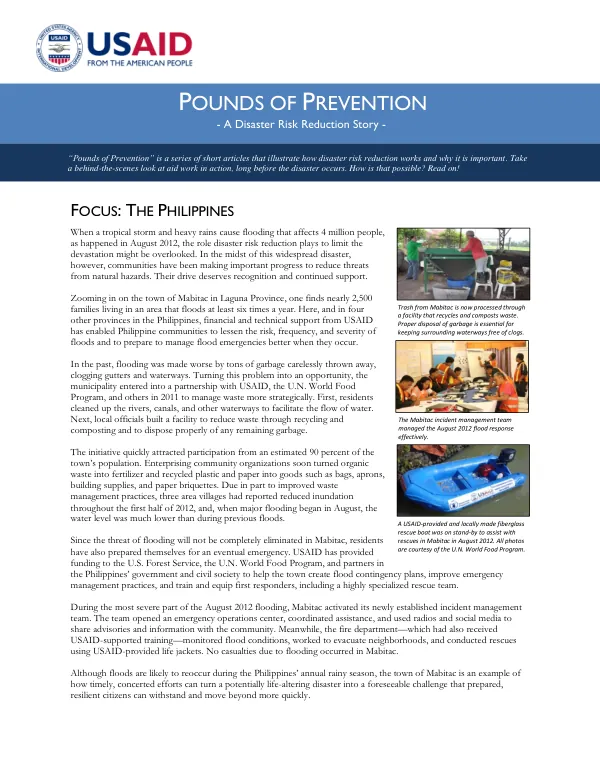
In the town of Mabitac in Laguna Province, nearly 2,500 families living in an area prone to flooding have benefited from financial and technical support from USAID. This support has enabled the community to lessen the risk, frequency, and severity of floods and to prepare for managing flood emergencies better. Prior to the intervention, flooding was exacerbated by tons of garbage carelessly thrown away, clogging gutters and waterways. In 2011, the municipality partnered with USAID, the U.N. World Food Program, and others to manage waste more strategically. Residents cleaned up the rivers, canals, and other waterways to facilitate the flow of water, and local officials built a facility to reduce waste through recycling and composting. This initiative attracted participation from an estimated 90 percent of the town's population, who turned organic waste into fertilizer and recycled plastic and paper into goods such as bags, aprons, building supplies, and paper briquettes. As a result of improved waste management practices, three area villages reported reduced inundation throughout the first half of 2012. When major flooding began in August, the water level was much lower than during previous floods. To further prepare for emergencies, USAID provided funding to the U.S. Forest Service, the U.N. World Food Program, and partners in the Philippines' government and civil society to help the town create flood contingency plans, improve emergency management practices, and train and equip first responders, including a highly specialized rescue team. During the most severe part of the August 2012 flooding, Mabitac activated its newly established incident management team, which opened an emergency operations center, coordinated assistance, and used radios and social media to share advisories and information with the community. The fire department, which had also received USAID-supported training, monitored flood conditions, worked to evacuate neighborhoods, and conducted rescues using USAID-provided life jackets. No casualties due to flooding occurred in Mabitac. The town of Mabitac serves as an example of how timely, concerted efforts can turn a potentially life-altering disaster into a foreseeable challenge that prepared, resilient citizens can withstand and move beyond more quickly. The success of this initiative demonstrates the importance of disaster risk reduction and the potential for communities to mitigate the impacts of natural hazards through proactive planning and preparedness.
Related documents