PRESIDENT'S EMERGENCY PLAN FOR THE U.S. FOR AIDS RELIEF
PQM Annual Report: Oct 1, 2012 - Sep 30, 2013
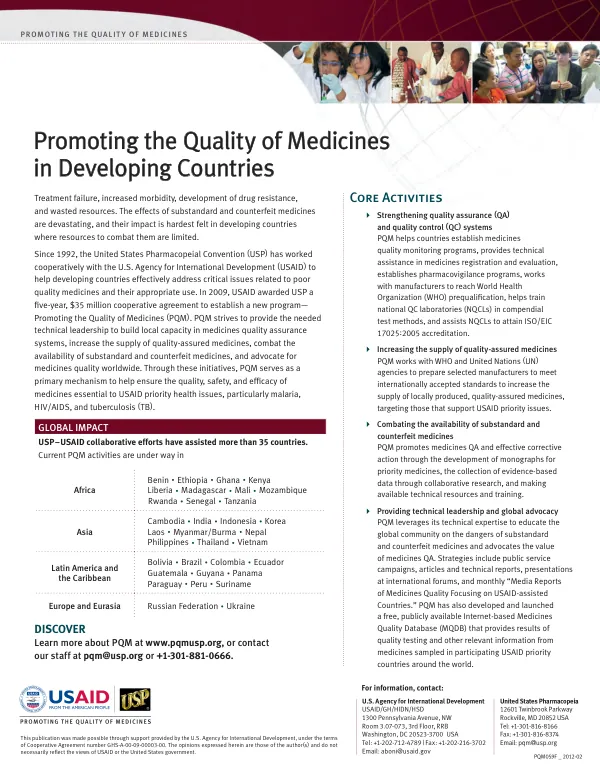
The Promoting the Quality of Medicines (PQM) program is a global initiative aimed at ensuring the quality, safety, and efficacy of medicines essential to USAID priority diseases.
2013 · 38 pages
Sign in to readA free account is required to download.
Abstract
The program serves as a primary mechanism to help address the growing development challenge posed by substandard and counterfeit medicines (SCMs). SCMs can cause treatment failure and adverse reactions, increasing morbidity and mortality, and they may contribute to antimicrobial resistance. In FY13, PQM provided technical assistance to 31 countries in strengthening their national capacity in quality assurance and quality control systems. One approach PQM employed is helping national quality control laboratories (NQCLs) operate with good laboratory practices and become ISO/IEC 17025:2005 accredited or WHO prequalified. In FY 13, PQM assisted seventeen NQCLs in Africa, Asia, and Europe/Eurasia. The NQCL of Thailand achieved WHO prequalification this year, and several labs have ISO/IEC 17025:2005 accreditations or re-accreditations pending. PQM also introduced the "Three-level Approach" for screening medicines, which consists of different QC procedures that increase in complexity and complement the previous levels. As of the end of FY13, four countries (Colombia, Ecuador, Guyana, and Peru) working with PQM through the Amazon Malaria Initiative have institutionalized this approach, while another (Guatemala) is in the process of doing so. In cooperation with the World Health Organization (WHO) and Global Drug Facility (GDF), PQM conducted three workshops in FY13 to inform manufacturers of anti-tuberculosis (TB) medicines how to produce quality-assured medicines by following good manufacturing practices. The workshops explained the WHO Prequalification Program, raised interest in participating, and described how PQM can help in the process. By the end of FY13, PQM was working with 35 manufacturers in 11 countries toward achieving WHO Prequalification status. PQM also provides technical assistance to manufacturers of essential medicines for maternal and child health to improve their GMP compliance. Zincfant 20 mg dispersible tablets, produced by Nutriset/Laboratoire Pharmaceutique Rodael for managing diarrhea in children, achieved WHO Prequalification status this year, with assistance from PQM. Furthermore, as a member of the technical working groups of the UN Commission on Life-saving Commodities, PQM plays a key role in providing quality assurance support for manufacturers of medicines for maternal and child health. PQM works in 31 countries, including Africa, Asia, Europe/Eurasia, and Latin America and the Caribbean. The program's geographic focus includes Burundi, Ethiopia, Ghana, Kenya, Liberia, Mozambique, Nigeria, Senegal, Tanzania, Burma, Cambodia, China, India, Indonesia, Laos, Nepal, Philippines, South Korea, Thailand, Vietnam, Kazakhstan, Russia, Ukraine, Bolivia, Brazil, Colombia, Ecuador, Guatemala, Guyana, Peru, Suriname, and others. The PQM program is funded by USAID, PEPFAR, and PMI under Cooperative Agreement No. GHS-A-00-09-00003-00. The program's total obligated amount for FY13 is $10,281,301, with $4,430,000 in core funding and $5,851,301 in regional funding.