USAID DEC
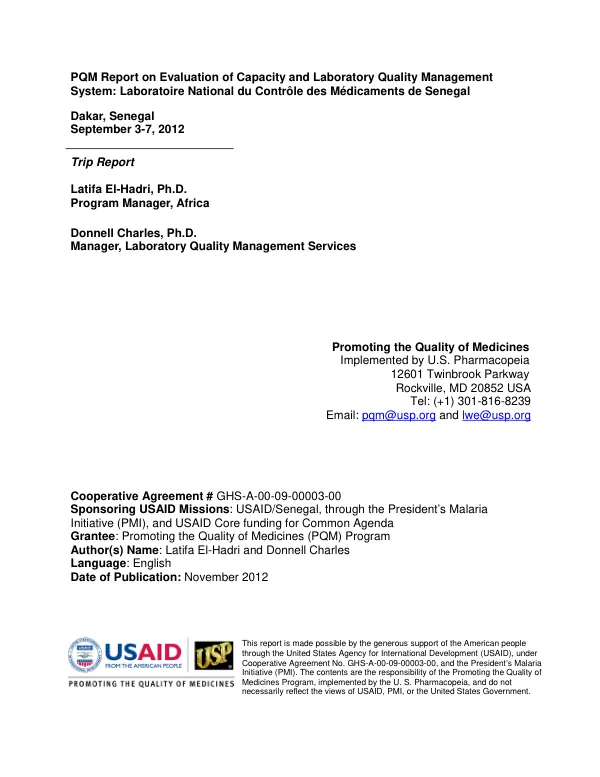
PQM Report on Evaluation of Laboratory Capacity and Quality Management System for Senegal
Sign inUNITED STATES PHARMACOPEIA
PQM Report on Evaluation of Laboratory Capacity and Quality Management System for Senegal
The Laboratoire National du Contrôle des Médicaments de Senegal (LNCM) is working towards obtaining ISO/IEC 17025:2005 accreditation, which is a globally recognized standard for laboratory testing and calibration.
2012 · 32 pages
Sign in to readA free account is required to download.
Abstract
This accreditation is essential for LNCM to demonstrate its commitment to quality and to provide reliable test results to its customers. To achieve this goal, the Promoting the Quality of Medicines (PQM) program conducted an evaluation of LNCM's Quality Management System (QMS) and laboratory capacity. The PQM evaluation was conducted in September 2012, and the results indicate that LNCM has made little progress in implementing a QMS that is compliant with ISO 17025 since the audit performed in September 2010 by the Tunisian National Accreditation Counsel. The evaluation identified several non-conformities, including the lack of implementation of Standard Operating Procedures (SOPs) and poor internal organizational structure. The lab is also missing some major QMS documents and 20 lab SOPs. The evaluation also assessed the technical capacity of the lab by evaluating the critical equipment and information technology server systems. The results indicate that LNCM requires ongoing technical support for their current and future documentation and funding to procure equipment needed for their scope of accreditation in order to implement its ISO 17025 action plan. The PQM evaluation concluded that LNCM is not yet ready for a formal ISO 17025 audit and requires at least 24 months to be ISO 17025 accredited. To address these findings, PQM has provided details of the non-conformities identified and suggested corrective action(s) and timelines to remediate those nonconformities. PQM will work with LNCM on implementing effective corrective and preventive actions (CAPAs) and will continue to provide technical assistance to strengthen its QMS and improve technical capacities. The evaluation also highlighted the importance of leadership by management in implementing the ISO 17025 accreditation action plan. The lab chief and his staff have shown motivation and commitment to implementing the action plan, but more support is needed from management to ensure the successful implementation of the plan. The PQM program is committed to providing technical assistance to LNCM to strengthen its QMS and improve technical capacities. The program will conduct a follow-up visit to assess the progress LNCM is making in implementing CAPAs and rectifying the laboratory's critical findings. The evaluation was conducted by a team of experts from the PQM program, led by Latifa El-Hadri, Ph.D., and Donnell Charles, Ph.D. The team assessed the QMS and laboratory capacity of LNCM and provided recommendations for improvement. The evaluation was funded by the U.S. Agency for International Development (USAID) through the President's Malaria Initiative (PMI) and USAID Core funding for Common Agenda. The PQM program is a successor to the Drug Quality and Information (DQI) program implemented by the United States Pharmacopeia (USP). The program is funded by USAID and is committed to providing technical leadership to developing countries to build local capacity in medicine quality assurance systems, increase the supply of quality medicines to priority USAID health programs, and ensure the quality and safety of medicines globally.
Related documents