USAID DEC
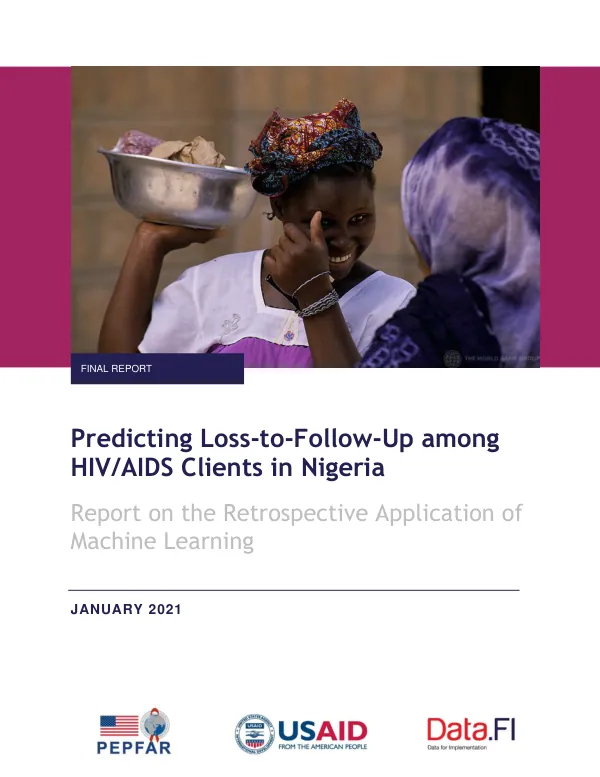
Predicting Loss-to-Follow-Up among HIV/AIDS Clients in Nigeria: Report on the Retrospective Application of Machine Learning
Sign inPALLADIUM INTERNATIONAL, LLC
Predicting Loss-to-Follow-Up among HIV/AIDS Clients in Nigeria: Report on the Retrospective Application of Machine Learning
The Predicting Loss-to-Follow-Up among HIV/AIDS Clients in Nigeria report was prepared by Data.FI, macro-eyes, with support from Jonathan Friedman, Data.FI, Palladium.
2021 · 41 pages
Sign in to readA free account is required to download.
Abstract
The report was produced for review by the U.S. Agency for International Development. The study aimed to predict loss-to-follow-up among HIV/AIDS clients in Nigeria using machine learning. The research team used data from USAID, USAID-funded implementing partners in Nigeria, and other sources to create a dataset. The dataset included features such as client demographics, appointment history, and antiretroviral treatment (ART) duration. The team used a retrospective test setup to evaluate the performance of machine learning models in predicting loss-to-follow-up. The results showed that the models achieved high precision and recall rates, particularly for clients who were late for appointments. The top features identified by the models included client demographics, appointment history, and ART duration. The team also found that the models performed better for female clients than for male clients. The study recommended refining the model by including additional data and integrating machine learning into existing workflows. The report concluded that machine learning can be a valuable tool in predicting loss-to-follow-up among HIV/AIDS clients in Nigeria. The study used a range of metrics to evaluate the performance of the machine learning models, including precision, recall, and area under the precision and recall curve (AUC-PR). The results showed that the models achieved high precision and recall rates, particularly for clients who were late for appointments. The team also found that the models performed better for female clients than for male clients. The study identified several key predictors of loss-to-follow-up, including client demographics, appointment history, and ART duration. The team also found that the models performed better for clients who were at risk of loss-to-follow-up, as identified by the phenotyping method. The study recommended refining the model by including additional data and integrating machine learning into existing workflows.
Related documents
Documents in this collection
 2023
2023USAID DEC
Improving Linkage of Pregnant People Living with HIV to ART through Data Cleaning
Open record 2023
2023USAID DEC