USAID DEC
Preference for Sayana Press versus intramuscular Depo-Provera among HIV-positive women in Rakai, Uganda: a randomized crossover trial
Sign inJOHNS HOPKINS UNIVERSITY BLOOMBERG SCHOOL OF PUBLIC HEALTH/INFO PROJECT
Preference for Sayana Press versus intramuscular Depo-Provera among HIV-positive women in Rakai, Uganda: a randomized crossover trial
HIV-positive women in Rakai, Uganda, have limited access to effective contraceptive methods, which can lead to unintended pregnancy and vertical HIV transmission.
2013 · 11 pages
Sign in to readA free account is required to download.
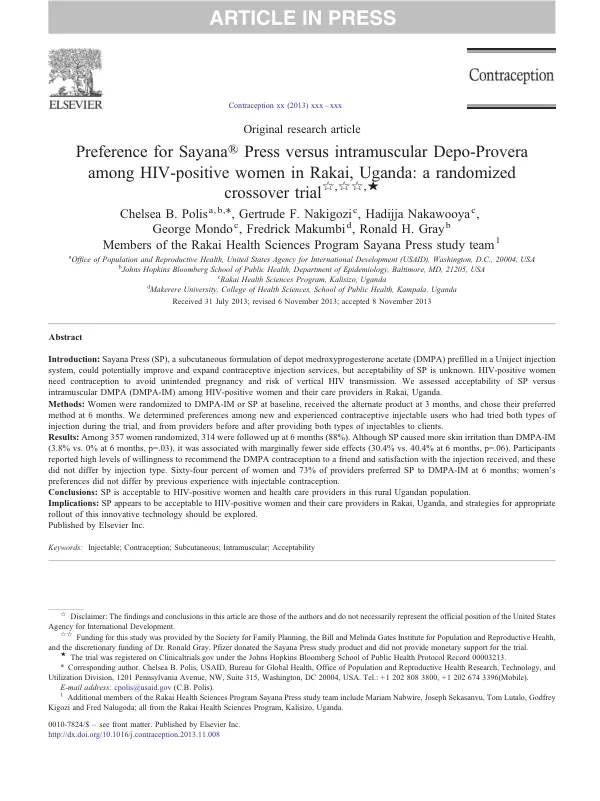
Abstract
Injectable contraceptives are the most widely used hormonal contraceptive method in sub-Saharan Africa, but 25% of married reproductive-aged women in the region have an unmet need for contraception. Innovations to simplify contraceptive provision, such as Sayana Press (SP), could improve access, particularly for rural and underserved populations. SP is a subcutaneous formulation of depot medroxyprogesterone acetate (DMPA) prefilled in a Uniject injection system. It has equivalent contraceptive efficacy to intramuscular Depo-Provera (DMPA-IM) but offers several advantages, including ensuring correct dosing, minimizing wastage, simplifying procurement and logistics, and avoiding transmission of blood-borne pathogens. SP could be administered by lower-echelon health workers, facilitating task-shifting to address shortages of medical personnel in rural Africa. A randomized crossover trial was conducted to assess the acceptability of SP versus DMPA-IM among HIV-positive women requesting injectable contraception in Rakai, Uganda. The trial enrolled 357 women aged 18-45 who were interested in using injectable contraception and met eligibility criteria. Participants were randomized to receive either DMPA-IM or SP at baseline and received the alternate product at 3 months. At 6 months, participants chose their preferred method. The trial found that SP caused more skin irritation than DMPA-IM (3.8% vs. 0% at 6 months, p=.03), but it was associated with marginally fewer side effects (30.4% vs. 40.4% at 6 months, p=.06). Participants reported high levels of willingness to recommend the DMPA contraception to a friend and satisfaction with the injection received, and these did not differ by injection type. At 6 months, 64% of women and 73% of providers preferred SP to DMPA-IM. The trial suggests that SP is acceptable to HIV-positive women and health care providers in this rural Ugandan population. The findings have implications for the rollout of this innovative technology, which could improve access to effective contraceptive methods for HIV-positive women in Rakai, Uganda.