USAID DEC
Preparing Jamaican Children in State Care for Independent Living: A Situation Analysis
Sign inUSAID DEC
Preparing Jamaican Children in State Care for Independent Living: A Situation Analysis
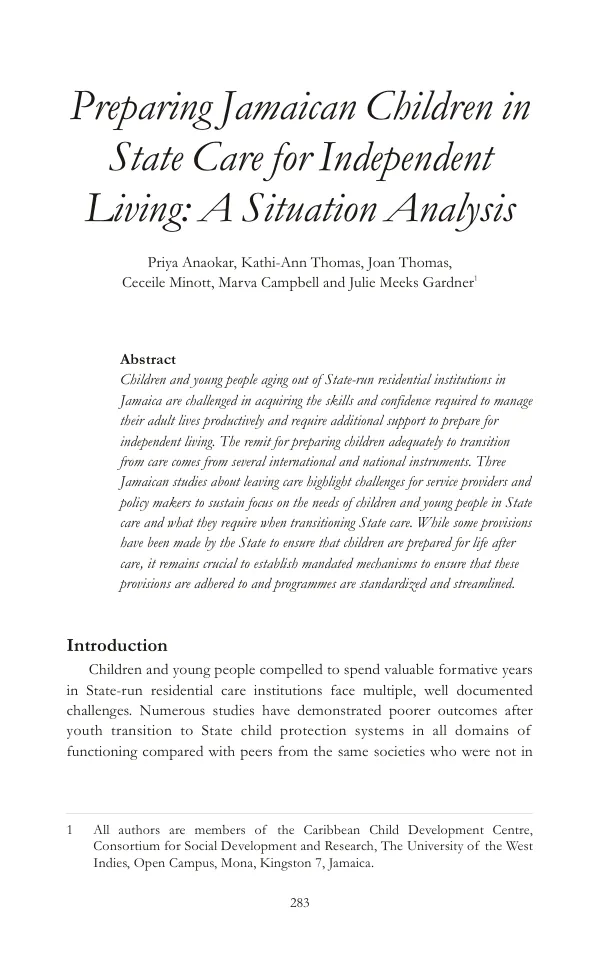
Children and young people aging out of State-run residential institutions in Jamaica face significant challenges in acquiring the skills and confidence required to manage their adult lives productively.
2021 · 16 pages
Sign in to readA free account is required to download.
Abstract
This issue is highlighted by several international and national instruments, including the United Nations Convention on the Rights of the Child, 1989, and the Jamaican Child Care and Protection Act, 2004. The remit for preparing children adequately to transition from care comes from these instruments, which emphasize the importance of protecting the best interests of children in care. Jamaica's child protection system is governed by the Child Care and Protection Act, 2004, which was reviewed and revised in 2016. The Child Development Agency is responsible for providing care for children who are found to be in need of care and protection. The agency provides residential child care services, including direct responsibility for the operation and management of five government children's homes and four places of safety. The agency also provides general monitoring and inspection of facilities within the residential sector to ensure that services are being delivered according to prescribed standards of care. Preparing children for independent living is a critical aspect of the child protection system. The United Nations Guidelines for Children in Alternative Care outline the support to be provided for "after care" and dictate that the plan for transition be in place well before the child is ready to exit care. The Jamaican Child Care and Protection Act, part III, section 62, mandates that children's involvement in their transition plan be consulted and that they be able to express their views about significant decisions affecting them. Three recent studies carried out in Jamaica highlight the challenges faced by youth on leaving care. The Keating report (2003) focused on the insecurity and fear faced by wards of the State concerning their own futures and their unpreparedness to exit care. The Child Development Agency Review and the Independent Living Programme Proposal for Wards of the State underscored the concept of Independent Living, identified service gaps, and made recommendations to improve existing programmes. These studies emphasize the need to better prepare Jamaican children for life after exiting care. Jamaica's economic circumstances pose significant challenges for youth in State care. The country's economy is heavily reliant on tourism, agriculture, and bauxite mining, and many young people face unemployment and low-wage jobs. The Planning Institute of Jamaica's "Vision 2030 Jamaica" strategic plan aims to lead to the attainment of development status by 2030 and to produce a nation where Jamaicans are empowered to achieve their fullest potential. However, the plan must include strong capacity building to prepare children, including those in residential care, for independent living. The Child Development Agency is responsible for implementing policies and programmes to support children in care. However, the agency faces challenges in providing adequate support to children transitioning out of care. The agency's licensing and regulatory oversight of privately operated children's homes is also critical in ensuring that services are being delivered according to prescribed standards of care.