FLORIDA INTERNATIONAL UNIVERSITY
Presenting Workshops to Adults
Presenting Workshops to Adults is a technical note designed to be shared, prepared by Brian E.
2011 · 2 pages
Sign in to readA free account is required to download.
Abstract
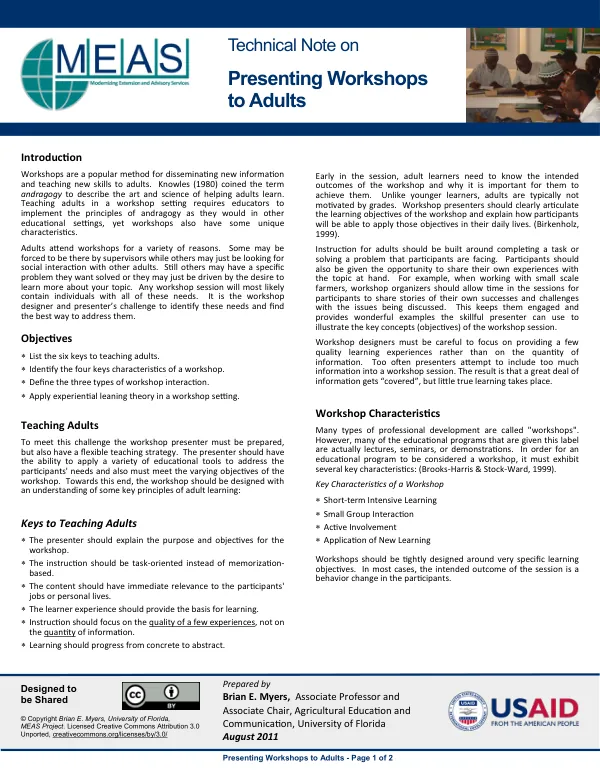
Myers, Associate Professor and Associate Chair of Agricultural Education and Communication at the University of Florida. The document is part of the MEAS Project and is licensed under Creative Commons Attribution 3.0 Unported. The note begins by explaining that workshops are a popular method for disseminating new information and teaching new skills to adults. The term andragogy, coined by Knowles in 1980, describes the art and science of helping adults learn. Teaching adults in a workshop setting requires educators to implement the principles of andragogy, yet workshops also have unique characteristics. Adults attend workshops for various reasons, including being forced to attend, seeking social interaction, or wanting to solve a specific problem. Workshop designers and presenters must identify these needs and find the best way to address them. To meet this challenge, the presenter should be prepared and have a flexible teaching strategy, applying a variety of educational tools to address the participants' needs. The note highlights six key principles of teaching adults, including explaining the purpose and objectives of the workshop, providing task-oriented instruction, and focusing on the quality of a few experiences rather than the quantity of information. Instruction for adults should be built around completing a task or solving a problem that participants are facing, and participants should be given the opportunity to share their own experiences with the topic at hand. Workshops should exhibit several key characteristics, including short-term intensive learning, small group interaction, active involvement, and application of new learning. Workshops should be tightly designed around very specific learning objectives, with the intended outcome being a behavior change in the participants. Participant interaction is an essential component of a workshop experience, and participants should be actively involved in the learning experience. The note identifies three important types of workshop interaction: presenter-participant, content-participant, and participant-participant. To increase the impact of workshop sessions, time must be provided for participants to practice the new competency gained from the workshop. Experiential learning is an important fundamental of adult learning, and one teaching method that can be employed by workshop presenters is experiential learning. Instruction using this model begins with the participants having direct contact with the experience, followed by reflection and abstract conceptualization. The note concludes by emphasizing that if designed and used correctly, workshops can be powerful educational experiences that can have tremendous impact on learners. It is the responsibility of the designer and presenter to ensure that all the key characteristics of a workshop are included in the learning experience and that the fundamentals of adult learning are maximized to make it a positive experience for both participant and presenter. The document references several sources, including Birkenholz, Brooks-Harris and Stock-Ward, Knowles, and Kolb, and is part of a series on Effective Teaching and Learning. The publication was made possible by the generous support of the American people through the United States Agency for International Development, USAID.
Related documents