FLORIDA INTERNATIONAL UNIVERSITY
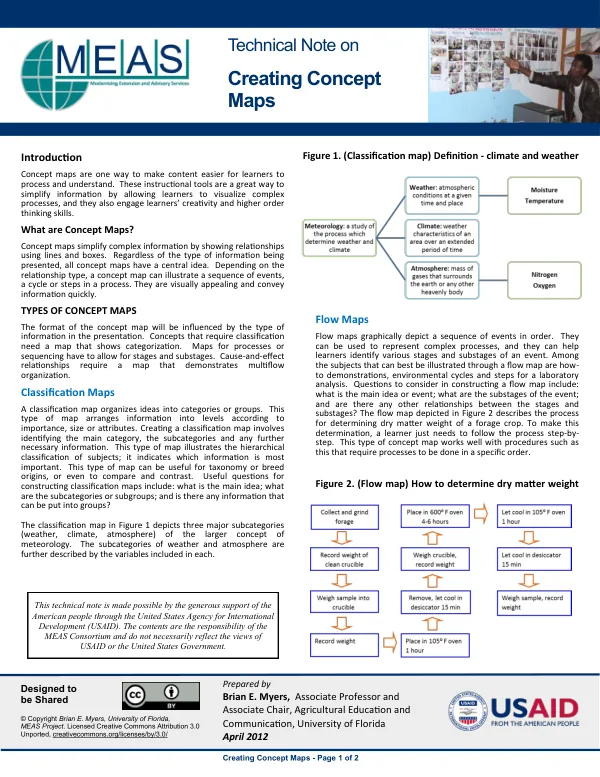
Technical Note on Creating Concept Maps
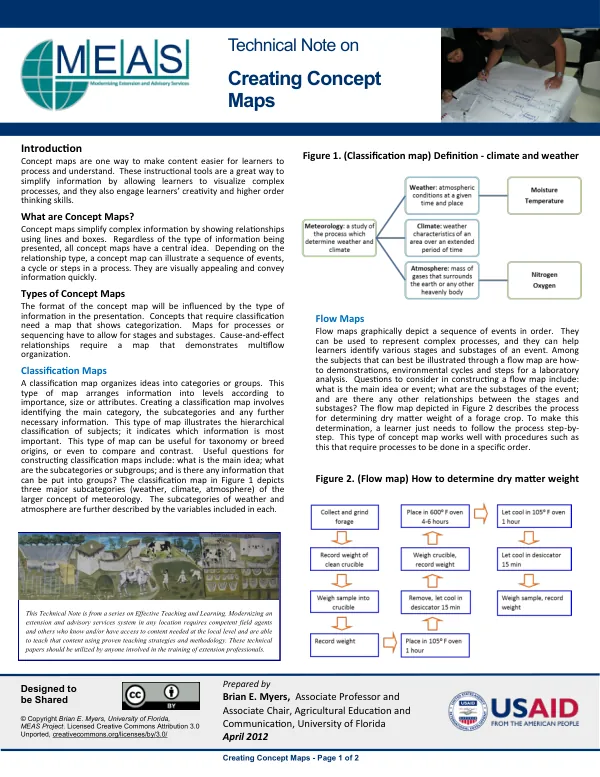
Concept maps are a visual representation of complex information, designed to facilitate learning and understanding.
2012 · 2 pages
Sign in to readA free account is required to download.
Abstract
They simplify information by showing relationships between concepts using lines and boxes, with a central idea that ties the entire map together. Concept maps can illustrate a sequence of events, a cycle, or steps in a process, and are visually appealing, conveying information quickly. There are several types of concept maps, each suited to a specific type of information. Classification maps organize ideas into categories or groups, arranging information into levels according to importance, size, or attributes. This type of map illustrates the hierarchical classification of subjects, indicating which information is most important. Classification maps can be useful for taxonomy, breed origins, or comparing and contrasting. Flow maps graphically depict a sequence of events in order, representing complex processes and helping learners identify various stages and substages of an event. Flow maps can be used to represent how-to demonstrations, environmental cycles, and steps for a laboratory analysis. Questions to consider when constructing a flow map include the main idea or event, the substages of the event, and any other relationships between the stages and substages. Multiflow maps help simplify a complex cause-and-effect relationship by representing one central event with causes and effects depicted on each side. Multiflow maps can be used for subjects such as animal nervousness, weight gain, or the weather. Questions to consider when constructing a multiflow map include the causes and effects of the event, which causes relate to which effects, and which causes and effects are most important. Compare and contrast maps provide a clear and simple means to organize the characteristics of two or more items and determine how they are similar and different. A compare and contrast map can be used to summarize information about differences and similarities, and to analyze the positive and negative aspects of two issues or topics. Questions to consider when constructing a compare and contrast map include the things being compared, the attributes of each, and how the similarities and differences can be evaluated. Concept maps have several benefits, including addressing multiple learning styles, facilitating knowledge and thinking, and improving retention of new knowledge. They are easy for instructors to prepare and easy for learners to comprehend, making them an effective approach to engaging learners. Concept maps can be used for various learning or instructing styles and are a great way to improve the presentation of any subject matter.