SAVE THE CHILDREN FUND
Show what you know! Quiz on HIV Risk
The Save the Children Show What You Know!
2 pages
Sign in to readA free account is required to download.
Abstract
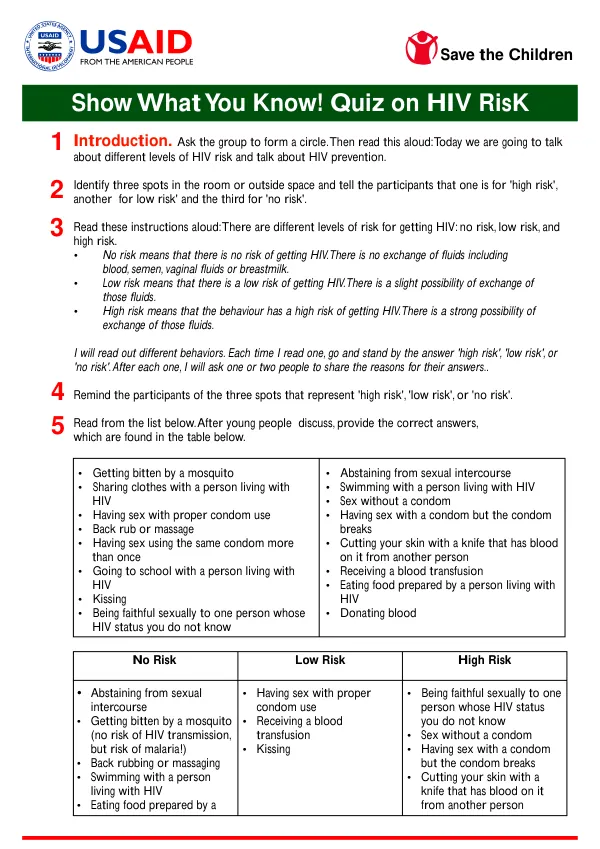
Quiz on HIV Risk is a comprehensive educational program designed to inform young people about different levels of HIV risk and prevention methods. The program begins with an introduction, where participants are asked to form a circle and discuss the importance of learning about HIV prevention. The program then proceeds to identify three spots in the room or outside space, representing 'high risk', 'low risk', and 'no risk' for HIV transmission. Participants are instructed to stand by the spot that corresponds to the level of risk associated with various behaviors. The behaviors listed include getting bitten by a mosquito, abstaining from sexual intercourse, sharing clothes with a person living with HIV, and others. The program provides a table with the correct answers to the behaviors, categorizing them as 'no risk', 'low risk', or 'high risk' for HIV transmission. The table indicates that behaviors such as abstaining from sexual intercourse, getting bitten by a mosquito, and receiving a blood transfusion from a trusted source are considered 'no risk' or 'low risk'. On the other hand, behaviors such as sex without a condom, having sex with a condom that breaks, and sharing clothes with a person living with HIV are considered 'high risk'. The program also includes a discussion section, where participants are asked to think about and discuss their answers to various questions. These questions include the importance of learning about HIV prevention for both young men and women, the community's perception of condoms, and where young people can access condoms and information about HIV prevention. The program concludes with a closing section, where participants are reminded that HIV is contained in certain body fluids and can be transmitted through sex without a condom, childbirth, breastfeeding, and sharp instruments that contain blood. The program emphasizes the importance of prevention methods such as abstinence, sticking to one partner, proper condom use, and seeking HIV medicine before and during pregnancy. The program also highlights other important facts, including that HIV is not spread by sharing food or mosquitoes, and that the only way to know if a person has HIV is through a blood test. Finally, the program includes a commitment section, where participants are asked to name one place where they can seek HIV counseling and testing.
Related documents