USAID DEC
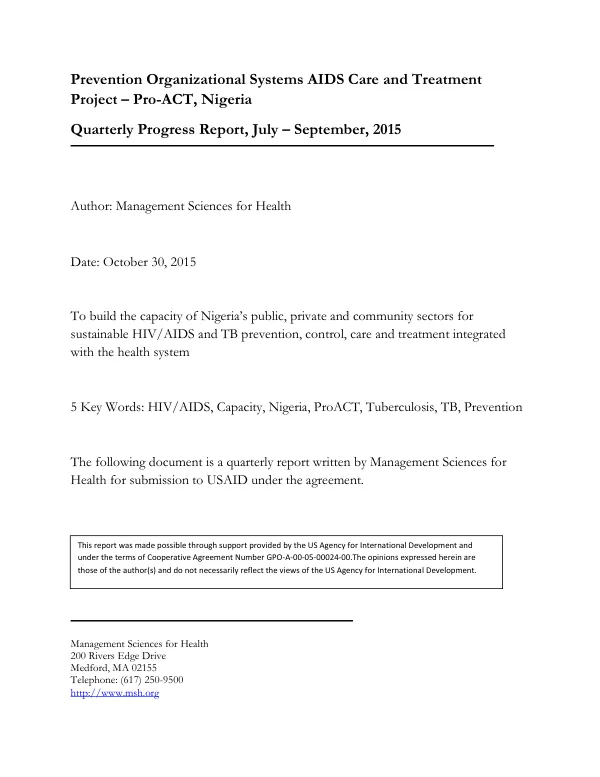
Prevention Organizational Systems AIDS Care and Treatment Project – Pro-ACT, Nigeria Quarterly Progress Report, July – September, 2015
Sign inMANAGEMENT SCIENCES FOR HEALTH
Prevention Organizational Systems AIDS Care and Treatment Project – Pro-ACT, Nigeria Quarterly Progress Report, July – September, 2015
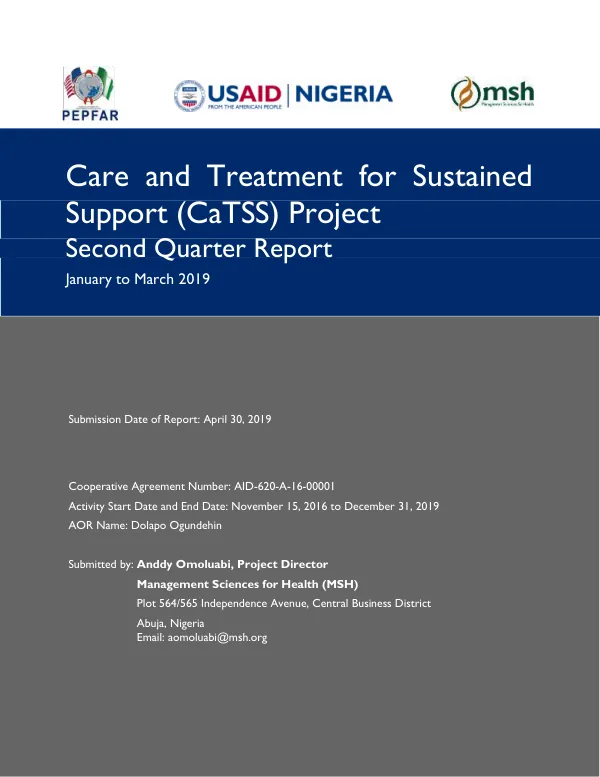
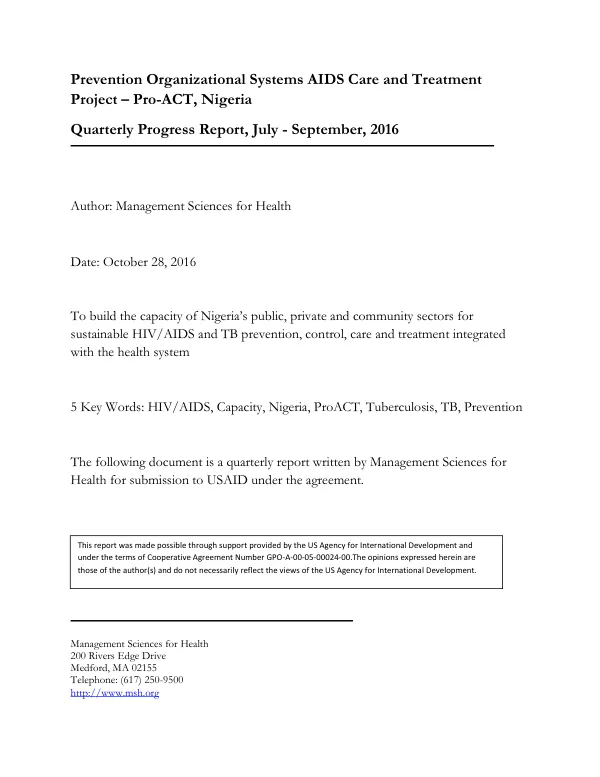
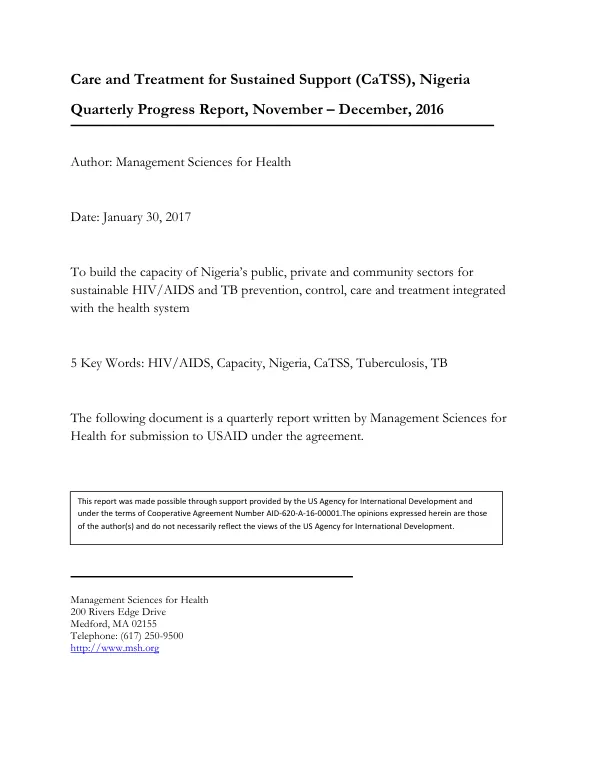
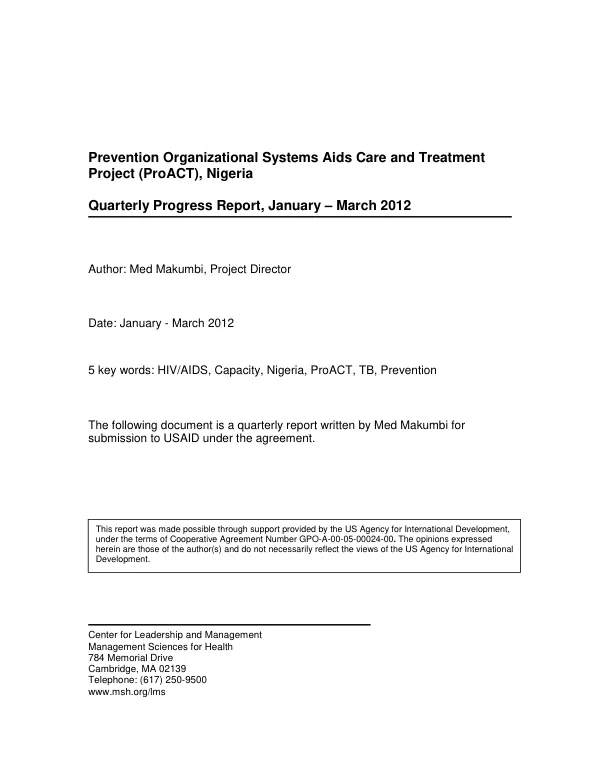
The Prevention Organizational Systems AIDS Care and Treatment Project (Pro-ACT) in Nigeria is a USAID-funded initiative aimed at building the capacity of Nigeria's public, private, and community sectors for sustainable HIV/AIDS and TB prevention, control, care, and treatment integrated with the health system.
2015 · 134 pages
Sign in to readA free account is required to download.
Abstract
The project is implemented by Management Sciences for Health (MSH) and has a total estimated contract/agreement amount of $85,022,571.00. The project's intermediate results include strengthening civil society organization (CSO) and community structures for sustained HIV/AIDS and TB services, sustaining access to quality integrated HIV/AIDS and TB services and products, and strengthening the public and private sector to increase demand for HIV/AIDS and TB services and interventions, especially among target groups. The project's life span is from July 16, 2009, to November 14, 2016. As of the 4th quarter of 2015, the project has made significant progress in achieving its objectives. The financial report for the quarter indicates that the project has obligated $75,052,909.99, representing 88% of the total estimated contract/agreement amount. The current pipeline amount is not specified in the report. The project's implementation progress is reported in various sectors, including community services, clinical services, laboratory services, supply chain management, health system strengthening, monitoring and evaluation, and implementation status by state. The report highlights major achievements, challenges, and planned activities for the next quarter. In the community services sector, the project has established 15 community-based organizations (CBOs) that provide HIV/AIDS and TB services to over 10,000 clients. The CBOs have also established support groups for people living with HIV/AIDS (PLHIV) and orphans and vulnerable children (OVC). In the clinical services sector, the project has supported the establishment of 10 comprehensive care and treatment sites (CCTS) that provide HIV/AIDS and TB services to over 5,000 clients. The CCTS have also established electronic medical records (EMR) systems to improve data management and quality of care. The laboratory services sector has seen significant progress, with the establishment of 5 laboratory revolving funds (LRF) that provide laboratory services to over 2,000 clients. The LRFs have also established quality assurance (QA) systems to ensure the accuracy and reliability of laboratory results. The supply chain management sector has made significant progress, with the establishment of a logistics management information system (LMIS) that tracks the movement of HIV/AIDS and TB commodities. The LMIS has improved the efficiency and effectiveness of supply chain management, reducing stockouts and overstocking. The health system strengthening sector has seen significant progress, with the establishment of a health management information system (HMIS) that tracks health data at the state and national levels. The HMIS has improved the quality and accuracy of health data, enabling policymakers to make informed decisions. The monitoring and evaluation sector has established a data quality assurance (DQA) system that ensures the accuracy and reliability of data. The DQA system has improved the quality of data, enabling the project to track progress and make adjustments as needed. The implementation status by state report highlights the progress made in each state, including Kebbi, Kwara, Niger, Sokoto, and Zamfara. The report highlights the challenges faced in each state and the planned activities for the next quarter. Overall, the Pro-ACT project has made significant progress in achieving its objectives, with a strong focus on community services, clinical services, laboratory services, supply chain management, health system strengthening, and monitoring and evaluation. The project's progress has improved the quality and accessibility of HIV/AIDS and TB services in Nigeria, contributing to the country's efforts to achieve the Millennium Development Goals (MDGs) and the Sustainable Development Goals (SDGs).
Related documents
Documents in this collection
 2015
2015USAID DEC
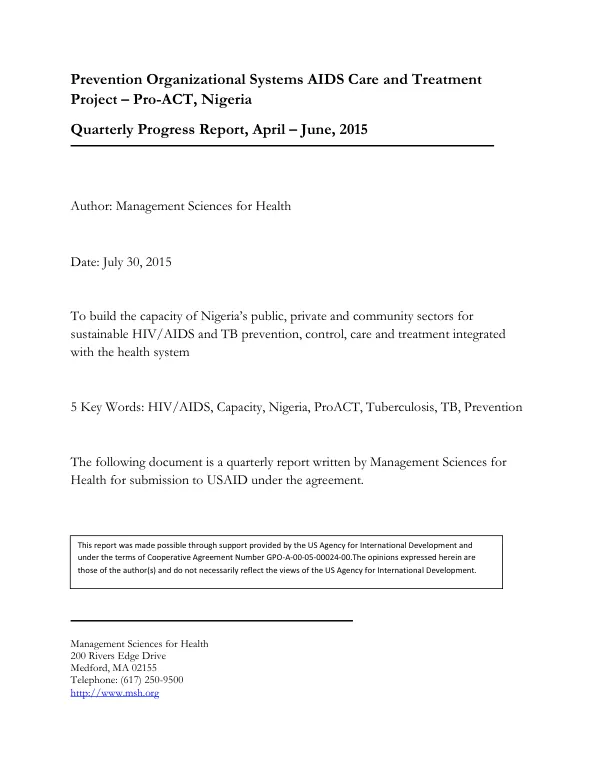
Prevention Organizational Systems AIDS Care and Treatment Project – Pro-ACT, Nigeria Quarterly Progress Report, April – June, 2015
Open record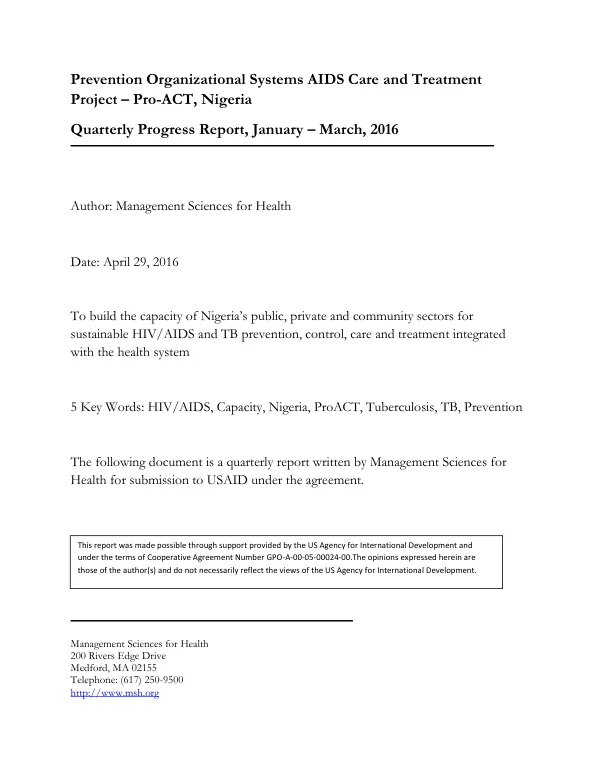 2016
2016USAID DEC
Prevention Organizational Systems AIDS Care and Treatment Project – Pro-ACT, Nigeria Quarterly Progress Report, January – March, 2016
Open record