JSI RESEARCH & TRAINING INSTITUTE, INC
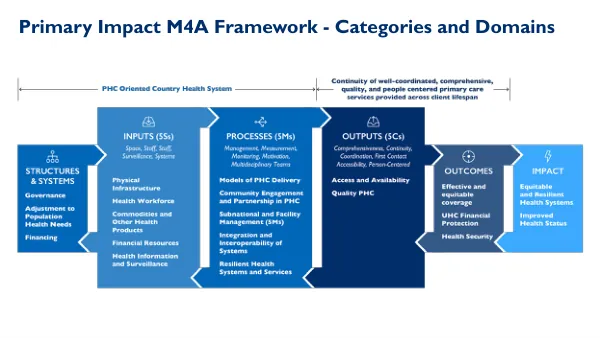
Primary Impact M4A Framework - Categories and Domains
The Primary Impact Measurement for Action Framework is a comprehensive framework designed to assess the effectiveness of primary health care (PHC) delivery systems.
2023 · 7 pages
Sign in to readA free account is required to download.
Abstract
The framework categorizes PHC into five domains: Effective Models of PHC Delivery, Community Engagement and Partnership, Sub-National and Facility Management, System Integration and Interoperability, and Resilient Health Systems and Services. Effective Models of PHC Delivery focuses on the structure and implementation of PHC services, including community-based care and empanelment. This domain emphasizes the importance of integrated and well-coordinated patient-centered services within communities. Key indicators for this domain include the existence of formal Community Health Worker programs, active community outreach, and proactive population outreach. Community Engagement and Partnership in PHC involves the empowerment of communities to engage in planning and provide feedback related to PHC service delivery. This domain includes indicators such as social accountability, which measures the extent to which subnational units and facilities ensure social accountability of PHC to the community served. Sub-National and Facility Management (5Ms) is a critical domain that focuses on the management capacities and performance of subnational units and facilities. This domain includes indicators such as budget allocation and execution, HRH management capacity and performance, and facility and district management capability and leadership. System Integration and Interoperability emphasizes the importance of integrating supply chain, laboratory, and information systems to increase efficiencies and enable patient-centered care. This domain includes indicators such as the availability of essential medicines, priority medical equipment, and other medical devices. Resilient Health Systems and Services focuses on the ability of subnational units and facility systems to respond and adapt to public health and other emergencies, while maintaining continuity of essential PHC service provision. This domain includes indicators such as the existence of formal Community Health Worker programs and proactive population outreach. The framework also emphasizes a light-lift approach to additional data collection at the facility and subnational level, leveraging existing data collection efforts and supplementing them with a checklist-based approach. The recommended core indicators for the framework include physical infrastructure, health workforce, commodities and other health products, models of PHC delivery, community engagement and partnership, subnational and facility management, system integration and interoperability, and resilient health systems and services. The framework includes 28 unique indicators, with 3 collected at more than one level. The recommended core indicators are aligned with the GH Common Indicators and will be collected by that team. The framework was developed in partnership with MOMENTUM Knowledge Accelerator, which is implemented by Population Reference Bureau (PRB) with partners JSI Research and Training Institute, Inc. (JSI) and Ariadne Labs under USAID cooperative agreement #7200AA20CA00003.