USAID DEC
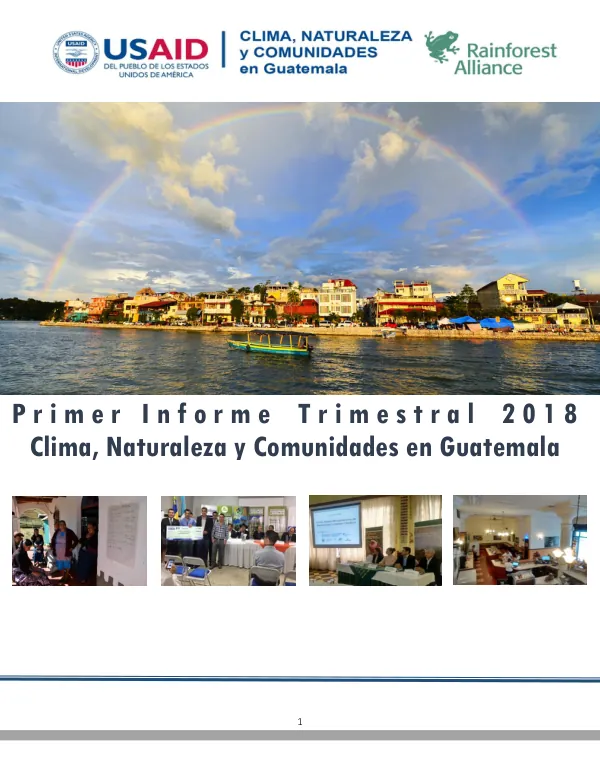
Primer Informe Trimestral del año fiscal 2018: Clima, Naturaleza y Comunidades en Guatemala
Sign inAGENCIA DE LOS ESTADOS UNIDOS PARA EL DESARROLLO INTERNACIONAL
Primer Informe Trimestral del año fiscal 2018: Clima, Naturaleza y Comunidades en Guatemala
The Programa Clima, Naturaleza y Comunidades de Guatemala (CNCG) implemented its first actions related to the Plan of Closure during this trimester, having satisfactorily achieved the original objectives and indicators committed to the project's mission.
2018 · 28 pages
Sign in to readA free account is required to download.
Abstract
The efforts during the project's life have focused on integrating activities under the central goals of the project, disseminating the market-based conservation model, while emphasizing the lessons learned from the concessionary model and the forest management experiences of the Verapaces and Altiplano in Guatemala. In a small scale, some of the lessons learned by CNCG have been replicated in the buffer zone (ZAM of the RBM), concessions in crisis (such as the Asociación Forestal Integral Cruce a la Colorada (AFICC) and the cooperatives of the Parque Nacional Sierra del Lacandón (PNSL), like the Cooperativa La Lucha), related to sustainable forest management and value addition. Additionally, the lessons learned from the management of timber and non-timber products in concessions were shared with representatives of the Ejidos of Quintana Roo, CONAP personnel from the Central, Verapaces, and Izabal offices, and CNCG personnel have been integrated into the Technical Committee for Forest Management, which is responsible for the process of bidding for new areas of concession. Apart from these achievements, the program strengthened the business capacities of local producers for non-timber chains (including honey, ramón, and xate), making a particular effort to facilitate negotiation with the Ministerio de Ambiente y Recursos Naturales (MARN) and CONAP regarding the taxative list applied in Petén to honey production. In the case of timber products, CNCG supported the Empresa Comunitaria de Servicios del Bosque (FORESCOM) and concessions in searching for new markets, such as the relationship between AFICC and the Hardwoods of North America company. In an effort to contribute to reducing forest cover loss, CNCG advised and facilitated access to new financial mechanisms operated by cooperatives for the Chachaklun company during this trimester, focused on supporting forest exploitation, which contributes to the economic dynamization of the subsector of smaller diameters. Additionally, CNCG advances in the development of publications and materials that document the project's learnings and facilitates the dissemination of results among diverse audiences. During the trimester, two videos (Flores Huella Cero and Cinco años de CNCG) were concluded, and work is being done on the review of 36 technical documents related to adaptation, low-emission economy, businesses, and technical and policy instruments. The actions of CNCG during the trimester were oriented towards the implementation of the closure plan and sought to contribute to the sustainability of the processes driven by the project. The most relevant aspects of the trimester are described below: Through the rapid response funds, assistance was provided to AFICC in the processing of wood, achieving the first export of mahogany to the Hardwoods company, an action that had a positive impact on recovering community credibility in forest management and taking firm steps in the governance of that concession. In Carmelita, Uaxactún, and the Parque Nacional (PN) Yaxhá, through the RRF, capacities were strengthened for operating community tourism, for which among other actions, promotional videos were elaborated, and Asociación de Organizaciones de la Región de Yaxhá (ASODESTY) was accompanied in the process of negotiating the PN Yaxhá tourism concession. In the Flores Huella initiative, financed with RRF, the greenhouse gas inventory (GEI) of the municipality of Flores was concluded, and the Municipal Plan for Mitigation of Climate Change was elaborated. The results were socialized in the Consejos Municipales de Desarrollo (COMUDE) and the municipality, promoting actions for the implementation of the plan, such as reforestation, waste management, and lighting change. As a contribution of CNCG to the maintenance of forest cover, in Petén, access to forest credit facilitated by cooperatives was promoted, with a total amount of USD 204,000. The funds served for the management of forest plantations in San Francisco Petén, contributing to the restoration of the ZAM. With counterpart funds, the program supported research on the management of ramón with the objective of providing information to CONAP.