USAID DEC
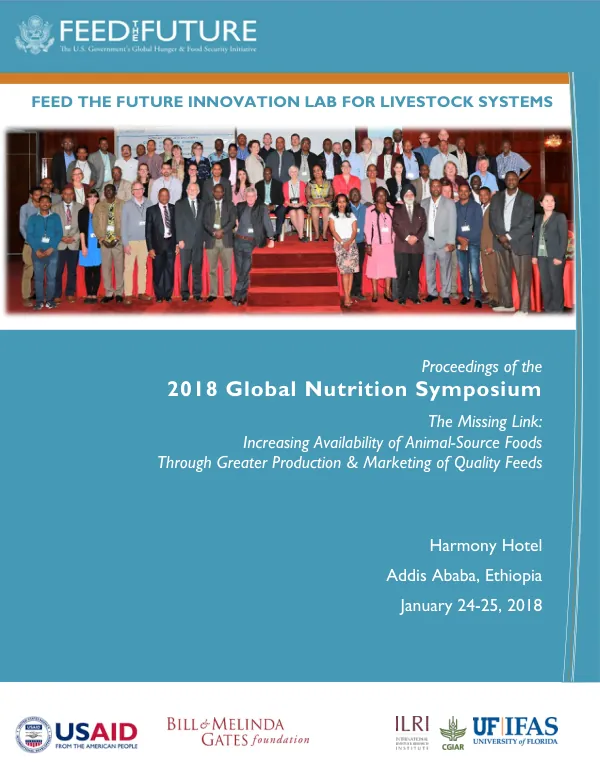
Proceedings of the 2018 Global Nutrition Symposium: The Missing Link: Increasing Availability of Animal-Source Foods Through Greater Production and Marketing of Quality Feeds
Sign inFLORIDA INTERNATIONAL UNIVERSITY
Proceedings of the 2018 Global Nutrition Symposium: The Missing Link: Increasing Availability of Animal-Source Foods Through Greater Production and Marketing of Quality Feeds
The 2018 Global Nutrition Symposium explored the challenges and opportunities of quality feeds as a fundamental issue for livestock production.
2018 · 48 pages
Sign in to readA free account is required to download.
Abstract
Participants from Ethiopia and across the world reviewed and debated best ways forward on improving the availability of essential, high-quality feeds for smallholder farmers. Quality feed is a key factor driving the availability of animal-source foods, which has direct impacts on human nutrition. Worldwide, poor animal nutrition caused by inferior or insufficient feed reduces weight gain and the production of milk, meat, or eggs, decreasing revenue from livestock production and compromising animal health. Lack of sufficient quantities of high-quality feed hinders smallholder livestock systems from reaching their potential to meet the increasing demand for animal source foods. Natural pastures shrink in both absolute terms and per livestock unit due to land use for urban and other development, climate change, and overuse. In many environments, changing climates and overuse have reduced resource quality with poor quality grasses and shrubs dominating over native vegetation. Yet the majority of livestock in developing countries rely on natural pastures and resources as their main source of feed. For instance, natural pastures provide 78% of all livestock feed in Ethiopia and 80-84% of sheep and goat feed in Burkina Faso. Cereal straws, which form the bulk of supplemented livestock feeds in smallholder systems, are well known to be poor in nutritional quality and therefore constrain productivity. High-quality forages, supplemental concentrates, and byproducts that can substantially increase livestock productivity are often under-exploited in such systems, for reasons ranging from unaffordability and lack of land to lack of awareness and knowledge about their importance and use. Negative impacts from the lack of quality feed are direct, dramatic, and varied at different levels, impairing animal health, reducing growth rates, and decreasing milk and egg production. Opportunities to improve the supply of quality livestock feeds abound for the public and private sector as well as their research and development partners. The 2018 Global Nutrition Symposium focused on analyzing and further developing these opportunities based on lessons learned from key stakeholders in the livestock feed and animal-source food value chains. The Symposium examined the supply of quality feeds from all sources, including natural grasslands, cultivated forages, crop residues, concentrate supplements, and agricultural by-products. It also considered how to increase the supply of quality feed through market-driven solutions and institutional arrangements, and evaluated past experiences and the future potential of diverse mechanisms in different social and agroecological livestock systems settings. The Symposium was organized with the support of two key national research organizations in Ethiopia: the Ethiopian Institute for Agricultural Research (EIAR) and the Agricultural Transformation Agency of Ethiopia (ATA). The main organizers were the Feed the Future Innovation Lab for Livestock Systems at the University of Florida and its main partner, the International Livestock Research Institute (ILRI). The Symposium received combined support from USAID and the Bill & Melinda Gates Foundation, which enabled the event to take place. Feedback from participants indicated that their expectations for the symposium were met, with 89% of participants reporting that their expectations were met.