USAID DEC
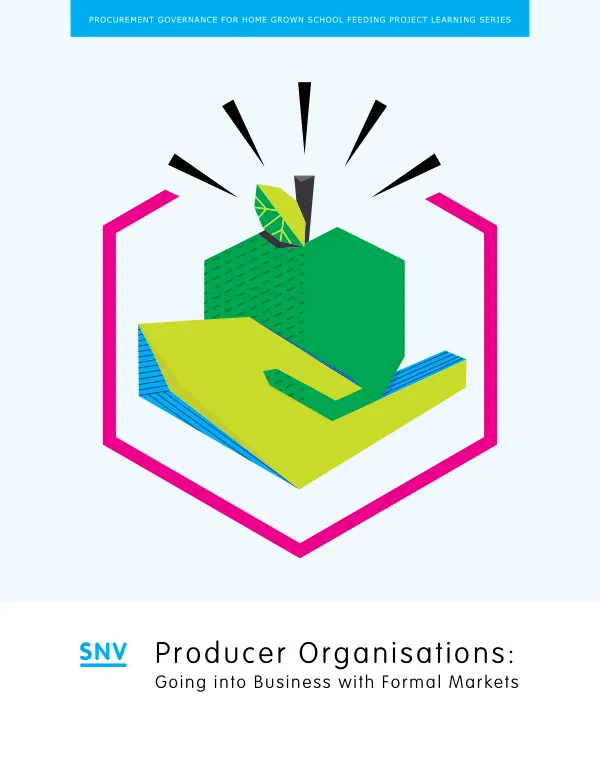
Procurement Governance for Home Grown School Feeding Project Learning Series: Going into Business with Formal Markets
Sign inTHE BILL AND MELINDA GATES FOUNDATION
Procurement Governance for Home Grown School Feeding Project Learning Series: Going into Business with Formal Markets
The Procurement Governance for Home Grown School Feeding project, implemented by SNV in Ghana, Kenya, and Mali, aims to link smallholder farmers with government-led school feeding programmes.
2016 · 33 pages
Sign in to readA free account is required to download.
Abstract
The project is based on the premise that a structured demand market, coming from reliable and predictable needs for food products, is a compelling opportunity for smallholder farmers. However, to supply to the structured demand market, smallholder farmers face critical constraints, such as low volume, variety of products and quality, and lack of information and experience on meeting the requirements to establish formal relationships. Producer organisations (POs) can play a key role in facilitating opportunities for smallholder farmers to leverage structured demand market possibilities. POs can act as intermediaries between farmers and buyers, providing support and services to farmers and facilitating their access to formal markets. However, many POs in the project areas lack the necessary organisational, infrastructural, financial, and management capacity for effective commercial operations. The project identified existing POs and supported them in addressing weaknesses that prevented their successful involvement in procurement processes of the school feeding programmes. The diversity of situations led to a variety of support activities, but also to the conclusion that a strategic vision on PO strengthening is needed to transform them into competitive partners in formal markets. A competitiveness analytical framework for producer organisations was developed, based on the value chain model for manufacturing organisations of Michael Porter. The framework distinguishes six key performance indicators, taking into account a setting of smallholder farmers in developing countries that aim to access school feeding and other formal and structured demand markets. The indicators are: 1. Production potential of the members of the producer organisation, which reflects the potential of the members in supplying the required volume, variety, and quality to meet the needs of the markets the PO claims to access. 2. Coverage of the core activities, which refers to the type and nature of support for buyers and members and the completeness of the different operational PO activities and services. 3. Level of market integration of the producer organisation, which reflects how well the POs are able to link up with the buyers, and is measured by the type and nature of the relationship with buyers, such as transactional vs. contractual. 4. Financial capacity of the producer organisation, which is measured through the PO's ability to generate sufficient cash flow and investment finance for their core and non-core activities. 5. Efficiency and planning, which refers to the ability of the PO to effectively plan, execute, monitor, and control different activities. 6. Human resource support, which focuses on the human resource capacity and the development elements of members, board, management, and staff. The indicators were used to define a number of critical performance factors to analyse a total of fourteen cases, ten related with project activities and four not from the project. The study shows a significant diversity in the performance of the POs on the different indicators, making it difficult to relate directly the performance with business results of the organisations. However, the information from the POs provides a valuable insight into the challenges and opportunities faced by POs in accessing formal markets. The document provides development partners with an approach for ascertaining the competitiveness of POs as well as responsive interventions that, when used together, form a strategic vision for PO strengthening. The approach is based on the understanding that POs need to be transformed into competitive partners in formal markets, and that a strategic vision on PO strengthening is needed to achieve this goal. The document aims to provide guidance to policymakers and development practitioners to further enrich their understanding and guide them in identifying and introducing appropriate interventions that can balance objectives and be successful in developing more effective, inclusive, and sustainable supply chains that have competent producer organisations at the core.
Related documents