TETRA TECH
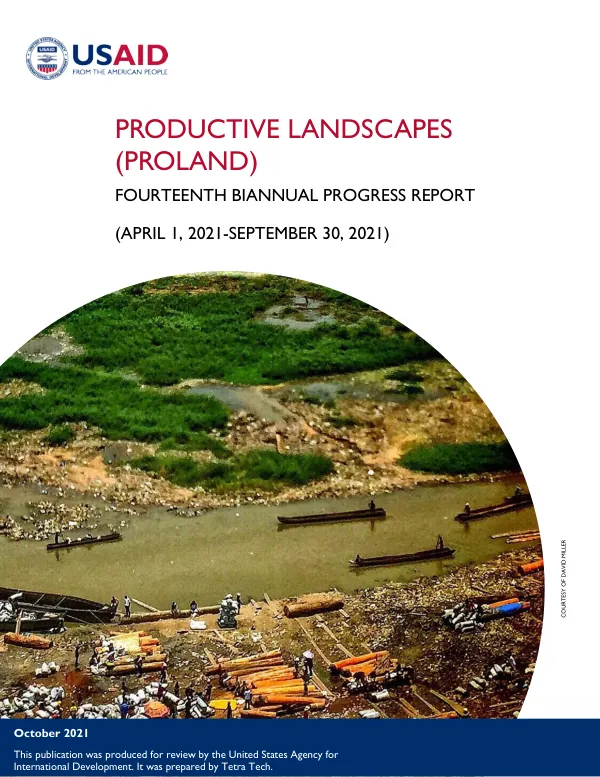
Productive Landscapes Fourteenth Biannual Progress Report
The Productive Landscapes (ProLand) Project is a 72-month task order under the Restoring the Environment through Prosperity, Livelihoods, and Conserving Ecosystems (REPLACE) Indefinite Delivery Indefinite Quantity Contract (IDIQ).
2021 · 17 pages
Sign in to readA free account is required to download.
Abstract
The project aims to provide assistance to the United States Agency for International Development (USAID) to catalyze change in land management systems, enabling people and institutions in developing countries to make informed, actionable, and effective development decisions. The project's goal is to develop tools and evidence to demonstrate that sustainable intensification of land uses with best management practices can achieve multiple gains simultaneously, including increased food production, reduced biodiversity loss, reduced greenhouse gas emissions, enhanced adaptation to climate change, and increased inclusive broad-based economic growth. The specific objectives are to demonstrate that sustainable intensification can increase agricultural production and carbon sequestration, increase biodiversity, and increase resilience of rural household livelihoods to respond to and prepare for climate change. The project's tasks include improving the evidence from existing successes by documenting and disseminating existing data and success stories relevant to integrated climate change, biodiversity, food security, and natural resources management programs for increased landscape productivity and resilience. Additionally, the project aims to develop a Nature, Wealth & Power toolbox of methodologies and best practices for increasing landscape productivity and resilience, prepare the future evidence base for new success stories in productive landscapes management, and implement a program of work to support the uptake of Community-Based Natural Resource Management best practices. The ProLand project has made significant progress in its life, including the development of guidance on how to design investment in agricultural landscapes to mitigate forest impacts. This guidance was developed through a global review of theory and case studies, which assessed the practices farmers adopt to intensify agricultural production and government actions that influence agricultural expansion into forests. The review identified three pathways intended to inform the design and implementation of deliberate investments to reduce agriculture's footprint. The project has also developed reports on sustainable agricultural intensification, sustainable woodfuel production systems, and community-based forestry enterprises. These reports provide guidance on how to design investment in agricultural landscapes to mitigate forest impacts, and how to implement sustainable woodfuel production systems and community-based forestry enterprises to increase landscape productivity and resilience. In the reporting period from April 1, 2021 to September 30, 2021, the project made significant progress in its financial summary, with a total expenditure of $X million. The project also made progress in its global assessments of landscape productivity enhancement approaches, including the development of guidance on sustainable agricultural intensification and the implementation of sustainable woodfuel production systems and community-based forestry enterprises. The project's progress in the reporting period demonstrates its commitment to achieving its objectives and making a positive impact on the environment and local communities. The project's continued focus on sustainable intensification, biodiversity conservation, and climate change adaptation will help to ensure that the project's goals are met and that the project's impact is sustained over time. The project's work on sustainable woodfuel production systems has focused on developing guidance on how to implement sustainable woodfuel production systems to increase landscape productivity and resilience. This guidance was developed through a review of existing literature and case studies, which identified best practices for sustainable woodfuel production systems and provided guidance on how to implement these systems in different contexts. The project's work on community-based forestry enterprises has focused on developing guidance on how to implement community-based forestry enterprises to increase landscape productivity and resilience. This guidance was developed through a review of existing literature and case studies, which identified best practices for community-based forestry enterprises and provided guidance on how to implement these enterprises in different contexts. Overall, the ProLand project has made significant progress in its life, including the development of guidance on sustainable agricultural intensification, sustainable woodfuel production systems, and community-based forestry enterprises. The project's continued focus on sustainable intensification, biodiversity conservation, and climate change adaptation will help to ensure that the project's goals are met and that the project's impact is sustained over time.