USAID DEC
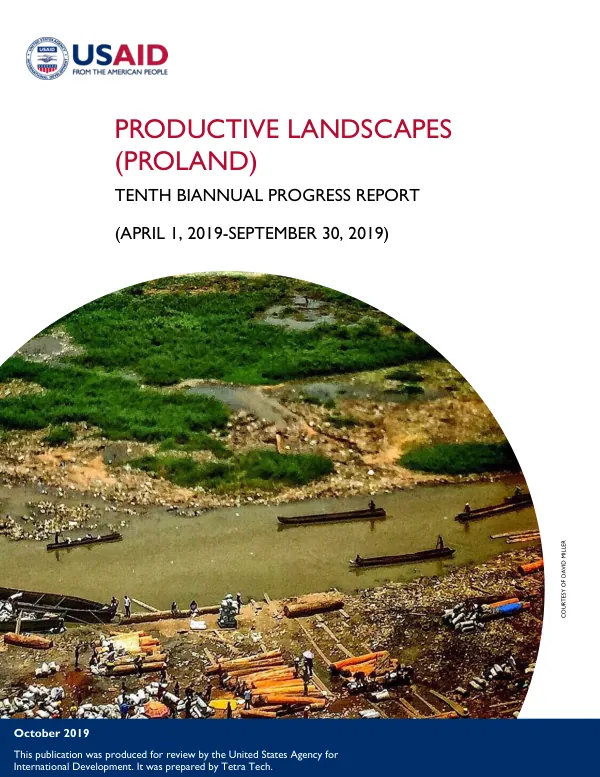
Productive Landscapes (ProLand) Tenth Biannual Progress Report (April 1, 2019-September 30, 2019)
Sign inACDI/VOCA
Productive Landscapes (ProLand) Tenth Biannual Progress Report (April 1, 2019-September 30, 2019)
The Productive Landscapes (ProLand) Project is a 72-month task order under the Restoring the Environment through Prosperity, Livelihoods, and Conserving Ecosystems (REPLACE) Indefinite Delivery Indefinite Quantity Contract (IDIQ).
2019 · 11 pages
Sign in to readA free account is required to download.
Abstract
The project is implemented by Tetra Tech in association with subcontractor ACDI/VOCA, and is currently managed by the Office of Global Climate Change (GCC) in the Bureau of Economic Growth, Education, and the Environment (E3). The purpose of the ProLand project is to provide assistance to USAID to catalyze change in land management systems so that people and institutions in developing countries can make informed, actionable, and effective development decisions. The goal of this task order is to develop tools and evidence to demonstrate that by sustainably intensifying land uses with best management practices, it is possible to achieve multiple gains simultaneously, including increased food production, reduced biodiversity loss, reduced greenhouse gas emissions, enhanced adaptation to climate changes, and increased inclusive broad-based economic growth. The specific objectives of the project are to demonstrate by the end of the contract that multiple benefits from sustainable intensification have been achieved using best management approaches that: increase agricultural production while also increasing carbon sequestration above and/or below ground on farming and grazing lands; increase biodiversity, for instance by reducing deforestation rates, increasing natural forests and rangelands, providing ecologically sustainable benefits to local communities, and enhancing ecosystem services; and increase resilience of rural household livelihoods to climate change via increased rainwater capture/groundwater infiltration, diversification and integration of farm production systems, enhanced ecosystem service provision, and greater adoption of community-based natural resource management governance structures. During the reporting period, the ProLand team made significant progress on assessments of three promising landscape productivity enhancement approaches: sustainable agricultural intensification, sustainable woodfuel production systems, and community-based forestry enterprises. The team advanced a sustainable agricultural intensification working paper that highlights common intensification strategies employing improved technology and practices, as well as governance approaches to reduce the conversion of natural lands via incentive mechanisms and multi-institutional planning and policy. The team also completed a third iteration of the sustainable agricultural intensification working paper that incorporates comments from USAID. Additionally, the team is advancing case studies from the literature that highlight some of the strengths and weaknesses of sustainable agricultural intensification strategies and approaches. USAID provided comments on the first case study on cocoa and certification and the role developing country governments might play in terms of long-term adoption, and ProLand returned a revised version to USAID for further review. In June 2019, USAID provided a task order modification to increment funding by $549,999, bringing the total amount obligated to $4,564,035, and to extend the period of performance to September 29, 2020. The ProLand team also met to discuss ideas for consolidating activities in the final year of the project by building on activity advances, strengthening synergies, and/or filling technical gaps. The team will hold a final year activity planning session with USAID in October 2019 to develop concrete actions for defining, reviewing, approving, and disseminating activity products. The ProLand project has made significant progress in developing global assessments around three promising approaches to enhancing landscape productivity, including sustainable agricultural intensification, sustainable woodfuel production systems, and community-based forestry enterprises. The project has also made progress in supporting GCC SL programming and a newly initiated activity with the USAID Guatemala Mission, and has achieved significant accomplishments related to outreach and uptake.