USAID DEC
Productivity gaps among groundnut farmers in Kenya and Uganda: A stochastic production frontier analysis
Sign inINTERNATIONAL INSTITUTE OF TROPICAL AGRICULTURE
Productivity gaps among groundnut farmers in Kenya and Uganda: A stochastic production frontier analysis
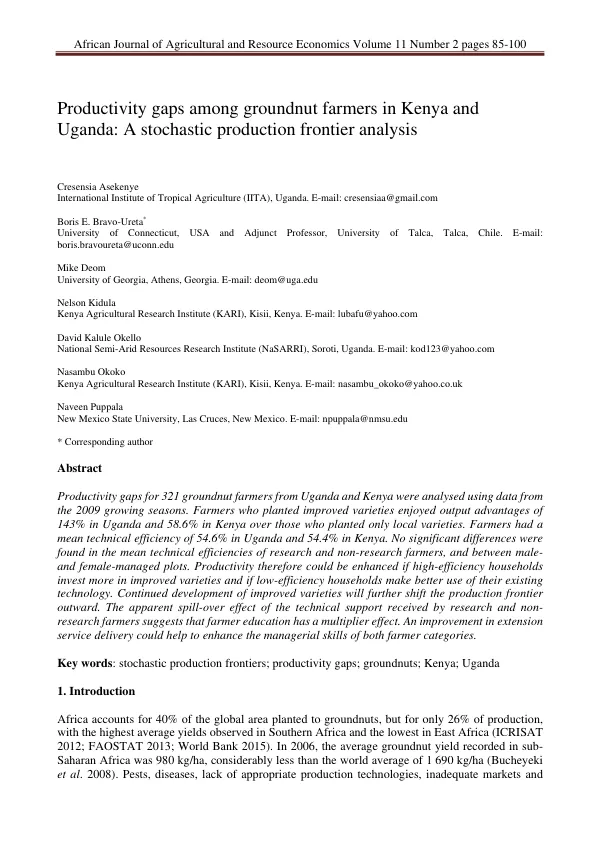
Groundnut farmers in Kenya and Uganda exhibit significant productivity gaps, with farmers who planted improved varieties achieving output advantages of 143% in Uganda and 58.6% in Kenya over those who planted only local varieties.
2016 · 16 pages
Sign in to readA free account is required to download.
Abstract
The study, which analyzed data from the 2009 growing seasons, found that farmers who adopted improved seeds experienced higher yields, indicating the potential for increased productivity through the adoption of improved technologies. The analysis used a stochastic production frontier approach to decompose productivity growth into technological progress (TP) and technical efficiency (TE). TP refers to productivity gains stemming from the adoption of improved seeds, while TE is the ability to achieve maximum output using existing resources and technology. The study found that farmers had a mean technical efficiency of 54.6% in Uganda and 54.4% in Kenya, indicating that there is room for improvement in the management of existing resources and technology. The study also examined productivity gaps associated with the managerial performance of research farmers versus non-research farmers, and of male- versus female-managed farms. No significant differences were found in the mean technical efficiencies of research and non-research farmers, and between male- and female-managed plots. However, the study suggests that continued development of improved varieties will further shift the production frontier outward, and that farmer education has a multiplier effect, as evidenced by the apparent spill-over effect of technical support received by research and non-research farmers. The study's findings have implications for policy and practice in the agricultural sector. To maximize benefits, the adoption of improved seeds should be coupled with the use of improved crop husbandry techniques, along with enhanced opportunities to sell any marketable surpluses. The study also highlights the importance of improving extension service delivery to enhance the managerial skills of both farmer categories. By addressing these productivity gaps, farmers in Kenya and Uganda can increase their yields and improve their livelihoods. The study's results are consistent with previous research on productivity in African agriculture, which has shown that there is considerable room to raise agricultural output from African farms, given the prevailing technology and without additional conventional inputs. The study's findings on technical efficiency estimates for African studies published between 2005-2015 are also consistent with previous research, which has shown that the overall average technical efficiency for African agriculture is around 69.5%.