FUTURES GROUP INTERNATIONAL, LLC
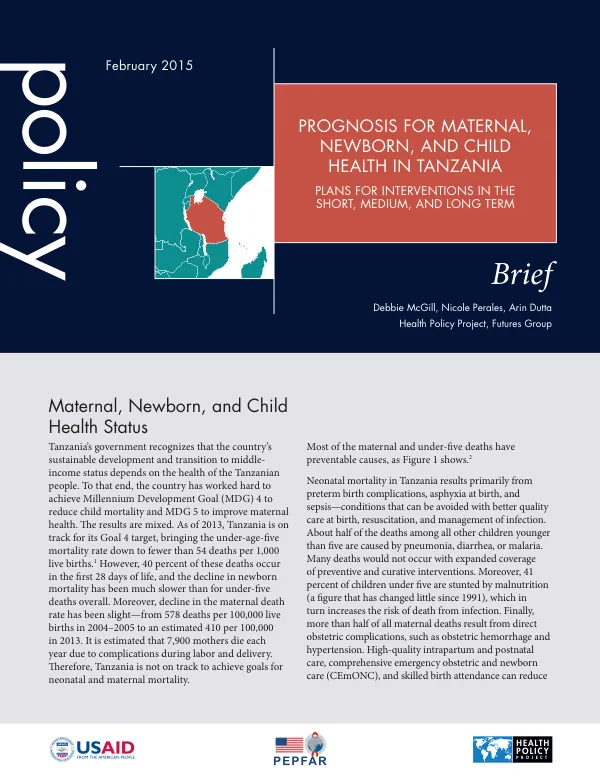
Prognosis for Maternal, Newborn, and Child Health in Tanzania
Maternal, Newborn, and Child Health in Tanzania is a critical area of focus for the country's government, as it recognizes that sustainable development and transition to middle-income status depend on the health of the Tanzanian people.
2015 · 6 pages
Sign in to readA free account is required to download.
Abstract
The country has made progress in achieving Millennium Development Goal (MDG) 4 to reduce child mortality, with the under-age-five mortality rate decreasing to fewer than 54 deaths per 1,000 live births as of 2013. However, the decline in newborn mortality has been slower, and the maternal death rate has shown little improvement, with an estimated 7,900 mothers dying each year due to complications during labor and delivery. Most maternal and under-five deaths in Tanzania have preventable causes, with neonatal mortality resulting primarily from preterm birth complications, asphyxia at birth, and sepsis. Many deaths among children under five are caused by pneumonia, diarrhea, or malaria, and would not occur with expanded coverage of preventive and curative interventions. Malnutrition is also a significant issue, with 41 percent of children under five being stunted, which increases the risk of death from infection. High-quality intrapartum and postnatal care, comprehensive emergency obstetric and newborn care (CEmONC), and skilled birth attendance can reduce maternal and newborn mortality, but only if three major types of delay are also addressed: delay in recognizing and seeking care, delay in transport to facilities to receive basic emergency obstetric and newborn care (BEmONC) and CEmONC, and delay in receiving care at facilities. The Current Policy Framework in Tanzania includes the Sharpened One Plan, which was launched in April 2014 and focuses on interventions in two of the country's poorest, most rural zones - Lake and Western. The plan aims to scale up interventions with the highest potential impact, such as family planning, care at birth, postpartum care, and postnatal care; mechanisms to avert stockouts of commodities essential to reproductive, maternal, neonatal, child, and adolescent health (RMNCAH); and increased accountability and transparency at every level of the health system responsible for RMNCAH. If the Sharpened One Plan were fully funded at US$206 million, an analysis using the Lives Saved Tool (LiST) shows it could have the following impacts by December 2015: a 30 percent reduction in maternal deaths, a 31 percent reduction in neonatal deaths, and a 25 percent reduction in under-five deaths. Big Results Now (BRN) is an initiative across multiple development sectors that aims to reduce maternal and neonatal mortality in five regions within the Lake and Western zones by 20 percent by June 2018. BRN will scale up high-impact interventions to complement those under the Sharpened One Plan, including raising community awareness and demand for BEmONC and CEmONC, upgrading facilities to offer these services, using mobile phone messaging to support use of the services at the upgraded facilities, and increasing voluntary blood donations to keep pace with the demand associated with expansion of emergency care. The total financial need for BRN together with the Sharpened One Plan is high, and securing full funding for both will be a hard task. The Next Medium-Term Plan in Tanzania will inform the country's next five-year plan to reduce maternal, newborn, and child deaths. The One Plan II 2016-2020 will provide guiding principles on investment priorities for RMNCAH, given budgetary pressures. The new plan will retain the Sharpened One Plan's geographic focus on the underserved Lake and Western zones, while also calling for scale-up among rural populations across all regions. The new plan will also maintain the Sharpened One Plan's focus on high-impact maternal and neonatal interventions during labor and immediately postpartum. Ensuring the availability of emergency obstetric and newborn care in health facilities will also play a central role in One Plan II.
Related documents