USAID
Program Cycle Implementation: Status of Program Cycle Implementation
The Bureau for Policy, Planning and Learning (PPL) at USAID has been implementing the Program Cycle, a framework for achieving development results in collaboration with partners.
2014 · 2 pages
Sign in to readA free account is required to download.
Abstract
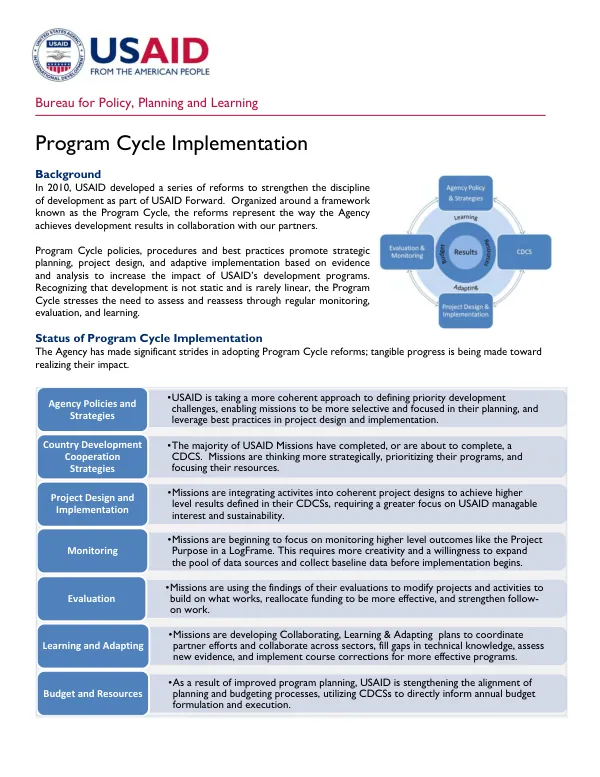
The Program Cycle was developed in 2010 as part of USAID Forward, a series of reforms aimed at strengthening the discipline of development. The Program Cycle promotes strategic planning, project design, and adaptive implementation based on evidence and analysis to increase the impact of USAID's development programs. It recognizes that development is not static and is rarely linear, and therefore stresses the need to assess and reassess through regular monitoring, evaluation, and learning. Significant strides have been made in adopting Program Cycle reforms, with tangible progress toward realizing their impact. USAID is taking a more coherent approach to defining priority development challenges, enabling missions to be more selective and focused in their planning, and leveraging best practices in project design and implementation. Agency policies and strategies have been updated to support the Program Cycle, with the majority of USAID Missions having completed or about to complete a Country Development Cooperation Strategy (CDCS). Missions are thinking more strategically, prioritizing their programs, and focusing their resources. Country Development Cooperation Strategies are being integrated into coherent project designs to achieve higher-level results, requiring a greater focus on USAID manageable interest and sustainability. Project design and implementation are also being improved, with missions beginning to focus on monitoring higher-level outcomes like the Project Purpose in a LogFrame. This requires more creativity and a willingness to expand the pool of data sources and collect baseline data before implementation begins. Monitoring is being used to modify projects and activities to build on what works, reallocate funding to be more effective, and strengthen follow-on work. Evaluation is being used to develop Collaborating, Learning & Adapting plans to coordinate partner efforts and collaborate across sectors, fill gaps in technical knowledge, assess new evidence, and implement course corrections for more effective programs. As a result of improved program planning, USAID is strengthening the alignment of planning and budgeting processes, utilizing CDCSs to directly inform annual budget formulation and execution. The adoption of the Program Cycle has provided missions with unique opportunities for sharing lessons learned and best practices, as well as identifying challenges in implementing the reforms. A range of resources are available to support Program Cycle implementation, including the Standardization Project, Program Cycle How-To Notes and Tools, trainings, workshops, TDY/eTDYs, ProgramNet, and Learning Lab. ProgramNet is USAID's internal, interactive online community devoted to sharing knowledge and promoting learning on implementing the Program Cycle. It hosts practical tools, events, and examples of mission products from each phase of the Program Cycle, including Frequently Asked Questions, blog posts from subject matter experts, a library of templates and models, discussion forums, webinars, and virtual Office Hours. The Learning Lab is an online learning community where USAID and partners connect and collaborate to build best practices for joint implementation of the Program Cycle. It provides a space to gather ideas, input, and resources, and includes introductory Program Cycle videos, examples of learning and adapting, working groups for collaboration and learning, and a growing Learning Library. Points of contact are available for each component of the Program Cycle to provide support and assistance. These points of contact include David Strine for Agency Policy and Strategies, Tony Pryor for Country Development Cooperation Strategies, Carissa Page for Project Design and Implementation, Christine MacAulay for Monitoring, Virginia Lamprecht for Evaluation, and Stacey Young for Learning and Adapting.