USAID DEC
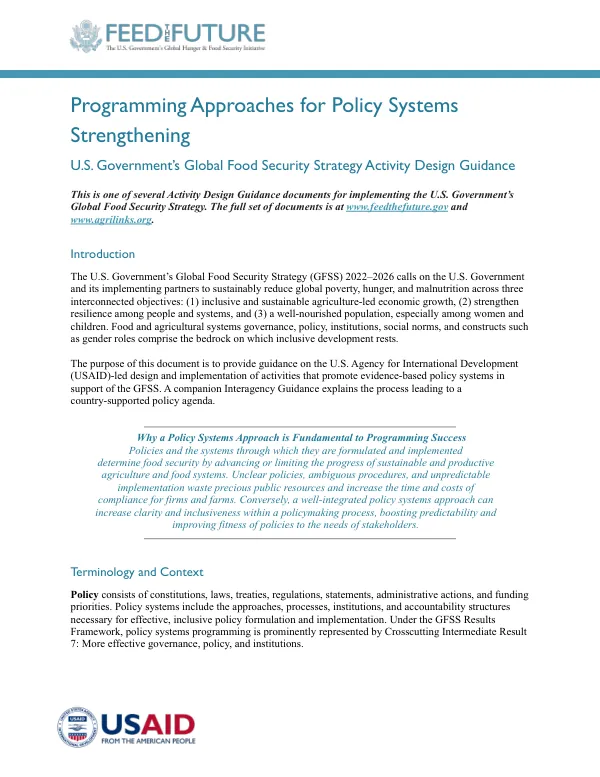
Programming Approaches for Policy Systems Strengthening_GFSS Activity Design Guidance
Sign inUSAID
Programming Approaches for Policy Systems Strengthening_GFSS Activity Design Guidance
The U.S.
2023 · 10 pages
Sign in to readA free account is required to download.
Abstract
Government's Global Food Security Strategy (GFSS) 2022-2026 aims to sustainably reduce global poverty, hunger, and malnutrition across three interconnected objectives. These objectives include inclusive and sustainable agriculture-led economic growth, strengthening resilience among people and systems, and a well-nourished population, especially among women and children. Food and agricultural systems governance, policy, institutions, social norms, and constructs such as gender roles comprise the bedrock on which inclusive development rests. Policies and the systems through which they are formulated and implemented determine food security by advancing or limiting the progress of sustainable and productive agriculture and food systems. A well-integrated policy systems approach can increase clarity and inclusiveness within a policymaking process, boosting predictability and improving fitness of policies to the needs of stakeholders. Policy consists of constitutions, laws, treaties, regulations, statements, administrative actions, and funding priorities. Policy systems include the approaches, processes, institutions, and accountability structures necessary for effective, inclusive policy formulation and implementation. The GFSS Results Framework prominently represents policy systems programming by Crosscutting Intermediate Result 7: More effective governance, policy, and institutions. Policy programs should address three fundamental elements that underpin an effective and participatory policy system: a prioritized policy agenda, institutional architecture, and mutual accountability. A prioritized policy agenda defines target policy actions to be implemented by local stakeholders, including government, private sector, civil society, and other actors. Institutional architecture refers to the country's capacity to undertake transparent, inclusive, predictable, and evidence-based policy change. Mutual accountability is the process to improve alignment, contribution, and accountability of all stakeholders to accelerate inclusive growth. The policy matrix is a set of priority policies integral to achieving the GFSS Country Plan's objectives. A policy matrix articulates a select number of high-level policy results, which are high-level, priority policy changes necessary to achieve Feed the Future GFSS objectives in the country. These strategic outcomes should be aspirational, yet achievable. Policy actions comprise actions the U.S. Government will support to work with policy stakeholders toward achieving the prioritized policy objective. The policy results and those policy actions to achieve the results should be politically feasible and achievable within a reasonable period of time, based on expected availability of Feed the Future, local, and other development partner resources. The policy areas under the GFSS Policy Matrix include resilience and agricultural risk management, agricultural and livestock inputs and services, enabling environment for private sector development, agricultural trade, diet quality, food loss and waste, food safety, climate adaptation and mitigation, land and natural resource tenure, rights, and policy, inclusion, digital technology, institutional architecture and mutual accountability. Designing activities that work in the policy system through the stages of concept and design involves conducting relevant analyses, identifying the most important policy and regulatory changes needed to ensure the achievement of the GFSS Country Plan objectives, and developing a prioritized policy agenda.
Related documents
Documents in this collection
 2021
2021USAID DEC
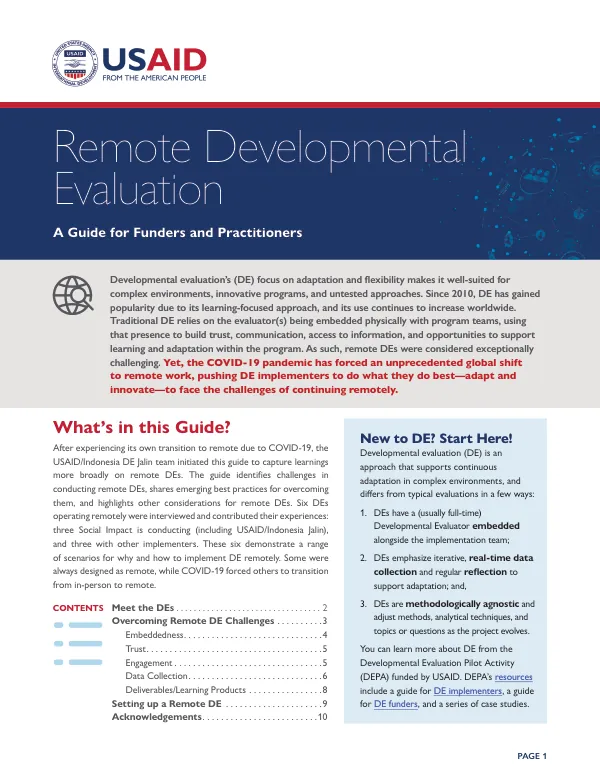
Remote Developmental Evaluation: A Guide for Funders and Practitioners
Open record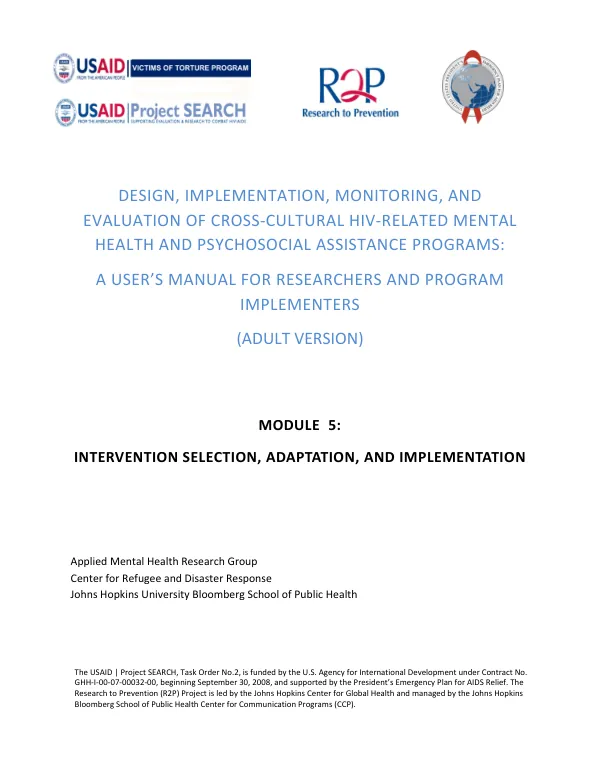
USAID DEC
Design, Implementation, Monitoring, and Evaluation of Cross-Cultural HIV-Related Mental Health and Psychosocial Assistance Programs: A User’s Manual for Researchers and Program Implementers (Adult Version)
Open record