INTERNATIONAL ALERT
Programming Effectively Against Conflict and Extremism (PEACE) IQC
The Solutions for Peace and Recovery (SPR) project aims to enhance social cohesion through the inclusion of women and marginalized groups in seven priority territories in the eastern Democratic Republic of Congo (DRC).
2016 · 4 pages
Sign in to readA free account is required to download.
Abstract
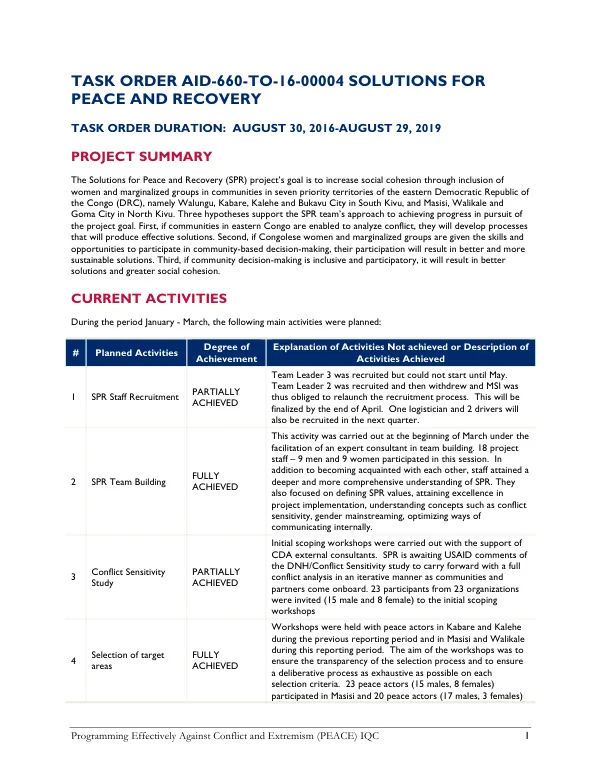
The project's goal is to develop effective solutions to conflict through community-based decision-making processes. Three key hypotheses underpin the SPR team's approach: enabling communities to analyze conflict will lead to effective solutions, empowering women and marginalized groups will result in better and more sustainable solutions, and inclusive decision-making will produce better solutions and greater social cohesion. The project's activities during the period January to March included the recruitment of team members, conflict sensitivity workshops, and the selection of target areas. The recruitment process was partially achieved, with the hiring of a team leader and logistician, but was delayed due to the unavailability of staff. The conflict sensitivity workshops were also partially achieved, with initial scoping workshops conducted with the support of consultants, but the full conflict analysis was delayed due to the need for USAID comments. The selection of target areas was fully achieved, with workshops held in Kabare, Kalehe, Masisi, and Walikale to ensure transparency and a deliberative process on each selection criterion. The women's network mapping was not achieved due to the focus on the project launch. The official launch was fully achieved, with attendance by the donor, the Government of the two provinces, and civil society actors. The project faced several challenges, including visa delays, launch focus, recruitment delays, spending delays, and the lack of organization and accessibility of the Congolese government. The project team has proposed various strategies to address these challenges, including the establishment of a contact group of government officials and the organization of collaborative activities with key government ministries. The project has also identified opportunities, including the formation of a group of SPR focal points in each province and the USAID Partner meeting, which provided a chance to interact with and lay the groundwork for future collaboration. The project anticipates the first round of applicants for grants within the first 30 days of the new reporting period. The project's progress has been hindered by the delays in the development and approval of the Action Plan for SPR (APS), which has led to delays in the partner selection and awarding of grants. The project team has proposed strategies to address these challenges and is working to overcome the lack of organization and accessibility of the Congolese government. The project's Steering Committee meeting was fully achieved, with all designated representatives present physically or through Skype. The development of a Memorandum of Understanding (MoU) between member organizations of the MSI, Alert, and Alert Consortium was initiated to clarify roles and responsibilities without accountability mechanisms and follow-up. The project has produced a video entitled "Visions of Peace," which was shown and distributed at the launch for launch attendees to use as they see fit. The video is available online. The project has also conducted video production, which was fully achieved. The project's baseline study has not been implemented, but the recruitment of a consultant for media analysis and the Request for Proposal (RFP) for the Social Cohesion Perception survey have been finalized during this reporting period. The RFP will be issued in the following quarter. The project's APS information and sensitization sessions were fully achieved, with a high level of participation from civil society organizations. The project presented the grant process and provided an opportunity for participants to pose questions and make comments. More than 150 organizations and local entities participated in these sessions in Goma and Bukavu. The project's SPR-VIP meetings were mostly achieved, with 8 meetings held with key provincial ministers in both provinces. However, the project was unable to hold meetings with the governors of the two provinces, who are known for their limited accessibility. The project is devising various strategies to ensure that both governors are fully aware of the project's activities. The project's video production was fully achieved, with the creation of a video entitled "Visions of Peace." The video was shown and distributed at the launch for launch attendees to use as they see fit. The video is available online.