INTERNATIONAL ALERT
Programming Effectively Against Conflict and Extremism (PEACE) IQC
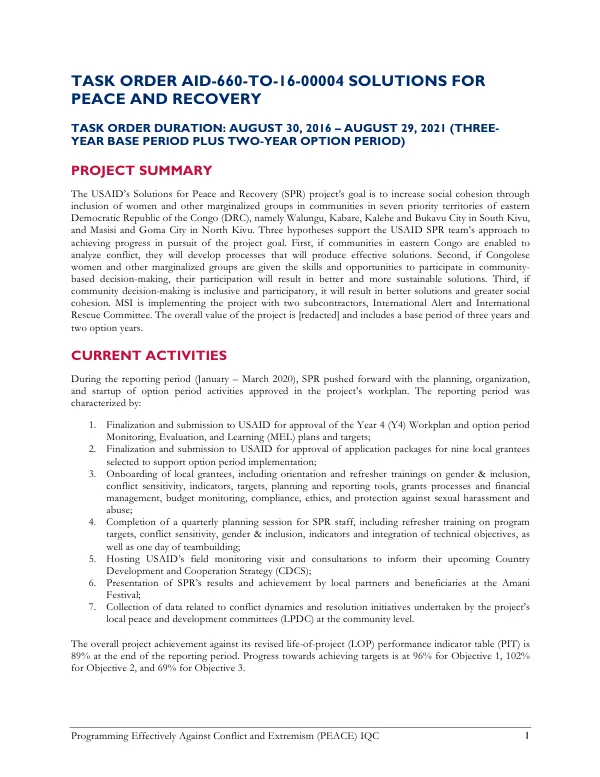
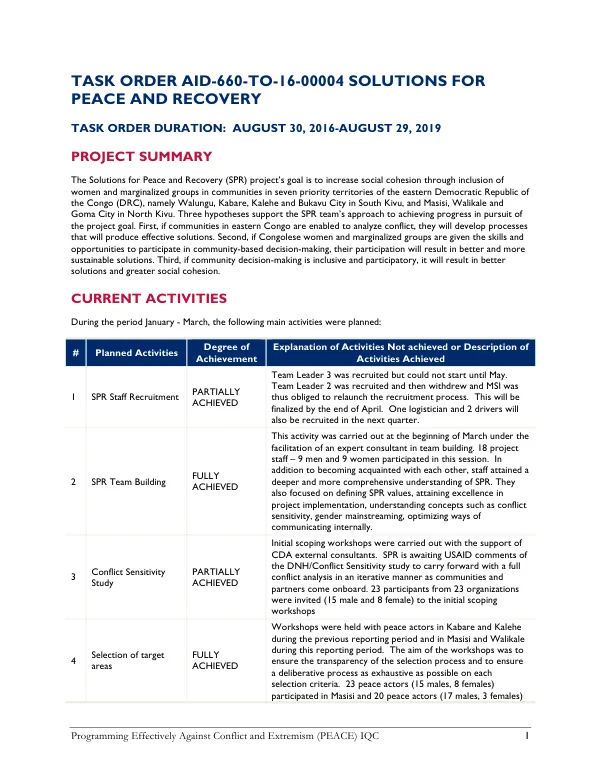
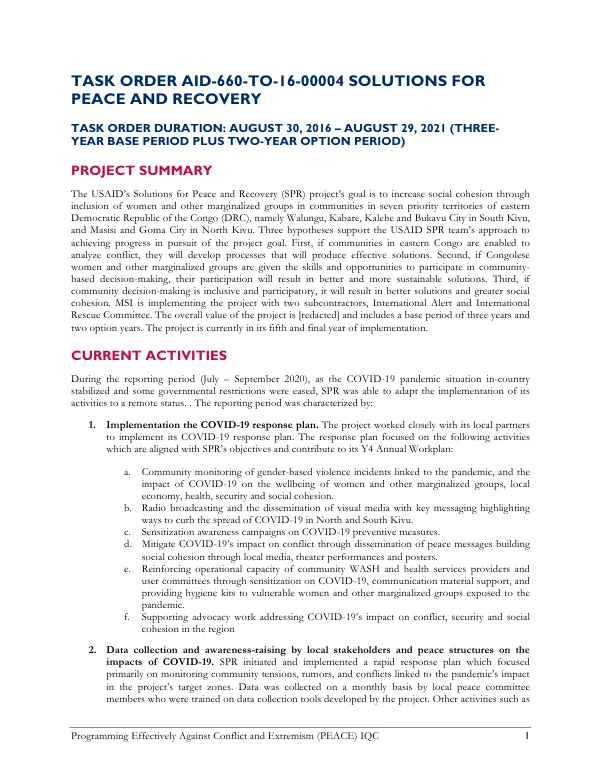
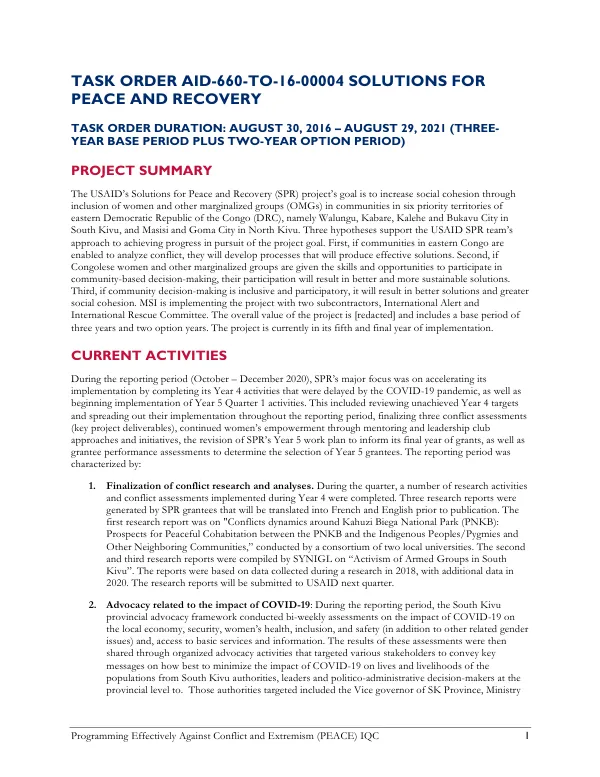
The Solutions for Peace and Recovery (SPR) project in the Democratic Republic of the Congo (DRC) aims to increase social cohesion through the inclusion of women and other marginalized groups in communities in seven priority territories of eastern DRC.
2019 · 4 pages
Sign in to readA free account is required to download.
Abstract
The project is implemented by Management Systems International (MSI) with two subcontractors, International Alert and International Rescue Committee. The overall value of the project is [redacted] and includes a base period of three years and two option years. The project's goal is supported by three hypotheses: communities in eastern Congo can develop effective solutions to conflict through analysis and process development; Congolese women and other marginalized groups can contribute to better and more sustainable solutions through participation in community-based decision-making; and inclusive and participatory community decision-making can lead to better solutions and greater social cohesion. In the quarter ending December 2018, the project continued to make progress in its implementation and expansion of its advocacy component and conflict sensitivity themes. The project team, along with 39 grantees, improved its achievement against its Performance Indicator Table (PIT) from [redacted] % at the end of Year 2 (August 2018) to an average of [redacted] % of its overall performance. Main activities during this quarter included the South Kivu Peace Forum, which brought together over 200 people to share views on solutions to specific conflict drivers and prevent election-related violence. The project also continued to implement its grants program, with all grantees actively implementing activities under the project. The SPR team began validation and closeout procedures for 16 grantees and plans to close their projects and contracts in Q2 of 2019. The project fully executed grant agreement modifications for nearly all grantees, which facilitated implementation and increased cash flow. The SPR project also issued two new grants: one to the South Kivu Advocacy Framework, which implemented the Peace Forum, and one to the Rift Valley Institute to conduct conflict research in target areas. In December 2018, the SPR project sought short-term technical assistance (STTA) through a Senior Grants Expert to conduct an in-depth review of the SPR grants program. The STTA spent two weeks in-country and provided recommendations to facilitate efficient management of the program moving forward. The project plans to implement several recommendations, including the immediate application of a comprehensive closeout checklist and empowerment of the Deputy Chief of Party, Operations to take on more grants-related responsibility. The project also made progress in inclusion, participation, and conflict sensitivity, with women and other marginalized groups increasingly participating in all committees, representing 40% of the committees' members. Conflict sensitivity and Do No Harm (DNH) principles are being seriously considered throughout the project implementation, and implementing partners and SPR staff have taken the time to explain the methodology of how a project runs as well as its financial constraints. The project faced several challenges during the quarter, including the DRC's designation as a Tier III country in the Trafficking in Persons (TIP) Report, which led to a temporary suspension of funding. However, the project received a waiver from the United States government and was able to proceed with project implementation. The project also faced challenges related to the presidential and legislative electoral process, which had a negative impact on the realization of project activities. The project team maintained transparent lines of communication with staff and subcontractors during this process to be prepared for any outcome. The project also experienced staffing changes, including the recruitment of a new DCOP Technical, a Senior Grant Administrator, and an Advocacy Officer for South Kivu. The project lost its Operations Manager in December 2018 and has launched a solicitation to fill this position. The project also created a position and hired an Administrative and Finance Officer based in Goma, who joined the project early in Q1 and is providing interim coverage for the Operations Manager.