USAID
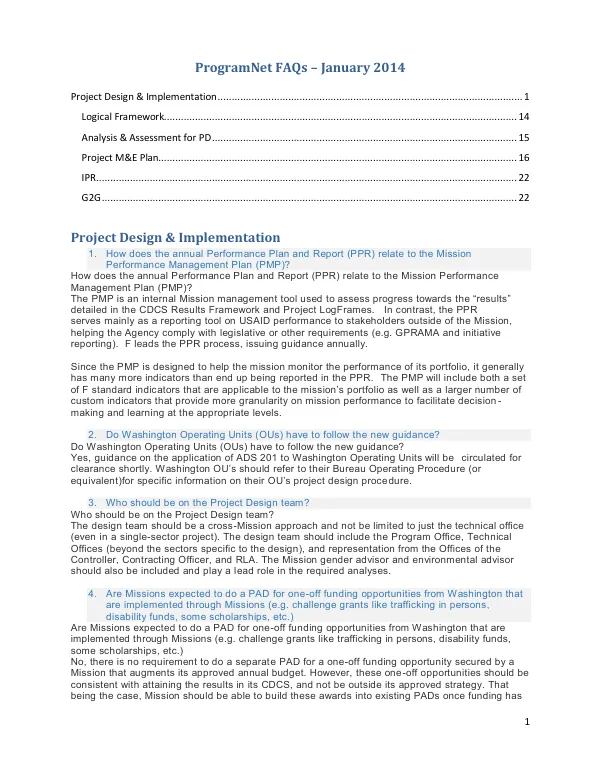
ProgramNet FAQs – January 2014
The ProgramNet FAQs document, released in January 2014, provides guidance on various aspects of project design and implementation for USAID missions.
2014 · 23 pages
Sign in to readA free account is required to download.
Abstract
The document is divided into nine sections, each addressing a specific question or topic. Project Design and Implementation is a critical component of USAID's mission, and the document emphasizes the importance of a cross-Mission approach to project design. The design team should include representatives from various offices, including the Program Office, Technical Offices, and Offices of the Controller, Contracting Officer, and RLA. The Mission gender advisor and environmental advisor should also be included and play a lead role in required analyses. The document highlights the distinction between the Mission Performance Management Plan (PMP) and the annual Performance Plan and Report (PPR). The PMP is an internal management tool used to assess progress towards the "results" detailed in the CDCS Results Framework and Project LogFrames, while the PPR serves mainly as a reporting tool on USAID performance to stakeholders outside of the Mission. Inclusive growth diagnostics are emphasized as a key tool for USAID missions. These diagnostics provide an evidence-based foundation for Country Development Cooperation Strategies (CDCSs) and serve as a key underpinning for the Results Framework (RF) and the development hypotheses that the RF embodies. Inclusive growth diagnostics involve an objective, cross-cutting review of potential constraints to growth, with analysis of available data to determine which constraints are most binding. The document also addresses the importance of monitoring and evaluation (M&E) costs in project budgets. Missions should include a line item for M&E in the project budget to ensure adequate resources are allocated for M&E within eventual implementing mechanisms or for project-level evaluations and monitoring. Implementing partners are not allowed to evaluate their own projects, as evaluations undertaken to meet the "large project" or "pilot activity" requirements of the Evaluation Policy must be external. However, USAID technical officers are encouraged to include funding for implementing partners to engage in evaluative work for institutional learning and management decision-making. The document provides guidance on how to obtain feedback on a Project Design Document (PAD) and emphasizes the importance of including necessary M&E costs in implementing mechanisms. Overall, the ProgramNet FAQs document provides valuable guidance for USAID missions on project design and implementation, inclusive growth diagnostics, and M&E costs.