USAID. MISSION TO INDONESIA
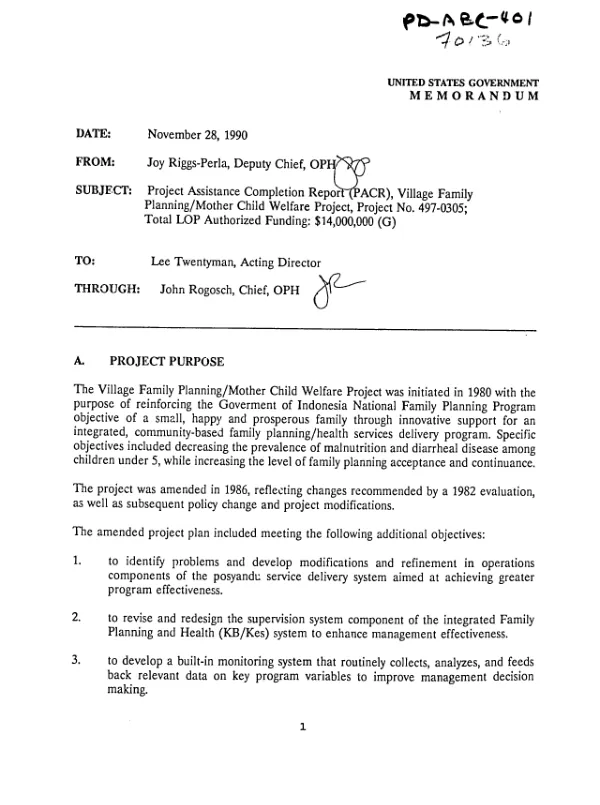
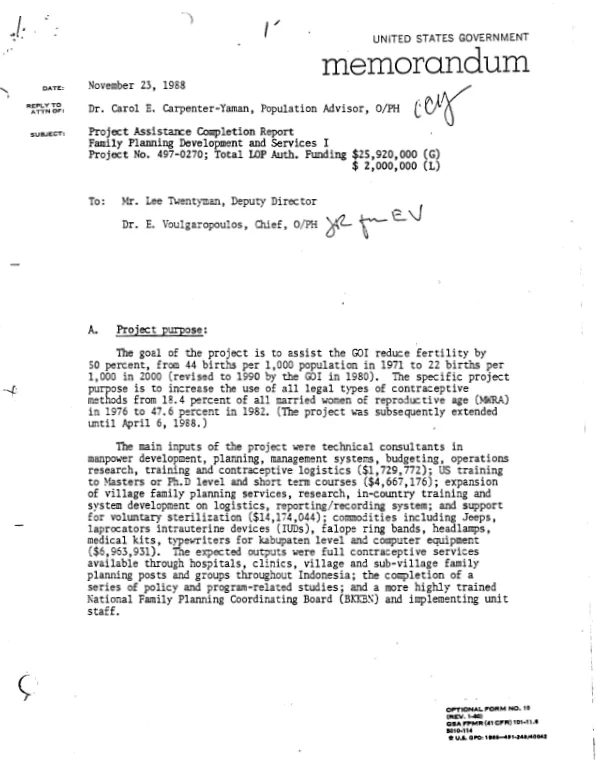
Project assistance completion report : family planning development and services I
PACR of a project (1978-4/88) to increase contraceptive use and expand village family planning (FP) services in Indonesia by providing TA, U.S.
1988
Sign in to readA free account is required to download.
Abstract
training, and commodities. Project targets for increased contraceptive use were met. By 3/88, 68% of married reproductive-age women were using FP services, compared with 24.6% in 3/78, according to the National Family Planning Coordinating Board (BKKBN). An independent survey indicated that 47.8% were contraceptive users by the end of 1987. The fertility rate also declined from 5.6 in 1971 to 3.3 for the 1984-87 period. The crude birth rate declined from 44 in 1971 to about 28 in 1987. To reach Indonesia's large rural population (75% of the total), the project assisted the BKKBN in shifting its strategy from a clinic-based approach to one of village-based services. FP activities were expanded first in Java and Bali, and then in 10 and other selected less densely populated areas in the outer islands. The number of FP facilities increased from 3,670 clinics and 36,000 contraceptive distribution centers in 1978 to 18,878 clinics and 70,459 centers in 1988. However, the project was far less successful in the sparsely populated outer islands than in Java and Bali, mainly due to the rugged topography, poor transportation and communications, large administrative areas, lack of field and other supervisory staff, and heterogeneous populations. A new strategy may be needed, possibly one which would emphasize placement and quality of services rather than absolute number of service points. Progress on Java and Bali was less evident in urban than in rural areas, due to urban population diversity, lack of tightly knit community structures, and a limited distribution system. More attention and resources for work in this area have been built into the follow-on project. The project was successful in strenthening the BKKBN's institutional capacity in 5 areas: (1) program planning, (2) procurement and production of oral contraceptives, (3) nationwide logistics for contraceptives and other commodities, (4) collection of contraceptive data, and (5) personnel development. A major lesson learned was that the flexibility and responsiveness of the local cost programming mechanism used for the project were key factors supporting innovation, learning, local adaptation, and effective implementation of priority initiatives. Also, since surveys show that a large percentage of Indonesian women want no more children, more attention should be paid to improving access to voluntary sterilization.
Related documents
Documents in this collection
 1991
1991USAID DEC
Final evaluation of the Pakistan population welfare planning project no. 391-0469
Open record 1992
1992USAID DEC