USAID DEC
Project assistance completion report for farming systems research project (696-0110)
Sign inUSAID. MISSION TO RWANDA
Project assistance completion report for farming systems research project (696-0110)
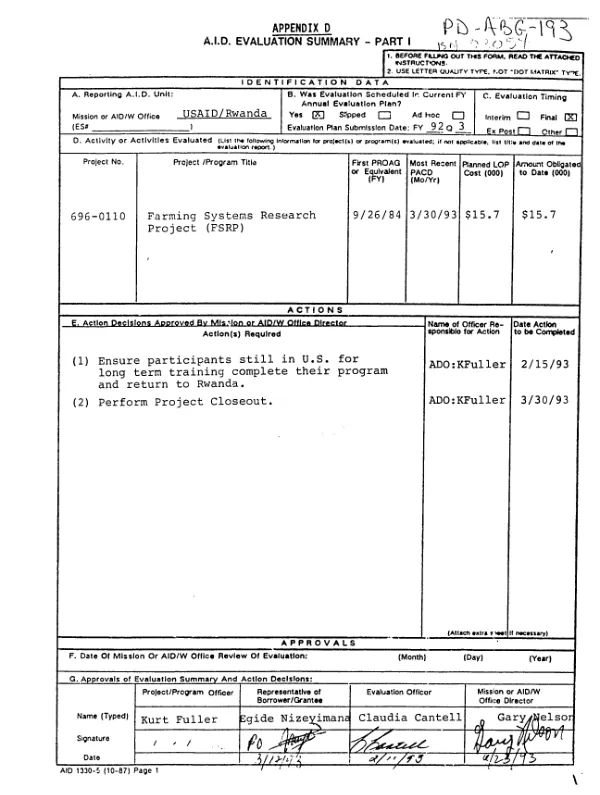
PACR of a project (8/84-3/93) to help the Government of Rwanda (GOR) develop an integrated farming systems approach to research and extension (FSR/E).
1994
Sign in to readA free account is required to download.
Abstract
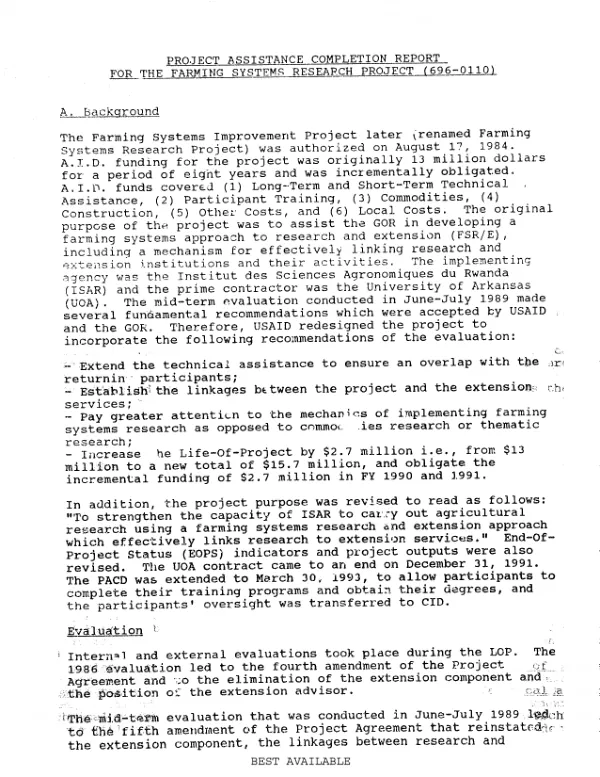
Results were less than expected. Project attempts to diffuse the FSR/E approach among personnel of the Institut des Sciences Agronomiques du Rwanda (ISAR) and the Ministry of Agriculture (MINAGRI) had only limited success, due to the unfamiliarity of the University of Arkansas (UOA) TA team with FSR methodology. Due to an reorganization of ISAR's structure, FSR is now conducted under programs funded by many donors. On the positive side, UOA did assist ISAR in conducting research to adapt food crops to high altitudes. Crops which adapted well were distributed as seed to farmers. Further, agricultural inputs such as lime were used to improve soil fertility. Adaptive research on livestock was never undertaken. Project research was conducted at the Rwerere research station, constructed with the help of project funds. Unfortunately, the War of October 1990 had very adverse effects on the station: expatriate advisors were relocated to Kigali between 11/90 and 11/91, leaving research in the hands of Rwandans newly graduated from U.S. universities. The station was attacked by both the Rwandan Patriotic Front (RPF) and the Rwandan Army during 1992, and was severely damaged in February 1993, when the whole area was occupied by the RPF, stopping all project activities. In the extension component, UOA developed a parallel extension service which served ISAR researchers well, though lacking close ties with the MINAGRI extension service. After the termination of the UOA contract, the project extensionists were given a competency test and the best were either taken up by Africare for work in the Natural Resource Management Project (6960129) or were absorbed by MINAGRI; those who failed the test were fired. Under the participant training component, 4 Ph.D., 10 M.S., and 8 B.S. candidates studied various agricultural disciplines in U.S. universities. Only 12 of the 21 students who returned to Rwanda after completing their degrees have remained with ISAR, however. Although training was considered the most lasting effect of the project, it is likely that the increasing capability of ISAR staff to perform adaptive research is due less to project training, than to hands-on training by the German Society for Technical Cooperation (GTZ) under its current FSR programs. Under an OPG, Africare implemented a rural infrastructure component composed of training centers, water supply systems and spring capping, and the improvement of rural access roads. One 10 km road in Butaro was not improved due to civil unrest. Funds intended for the road improvement were used to construct a large bridge in Nyarutovu commune, as suggested by local authorities. The project taught that the selection of a prime TA contractor is critical to project implementation. The contractor must have a proven capability to execute a project as required by the scope of work and must provide qualified and competent long- and short-term experts. The project also taught the importance of monitoring by the Mission, especially in the first years of implementation.