USAID DEC
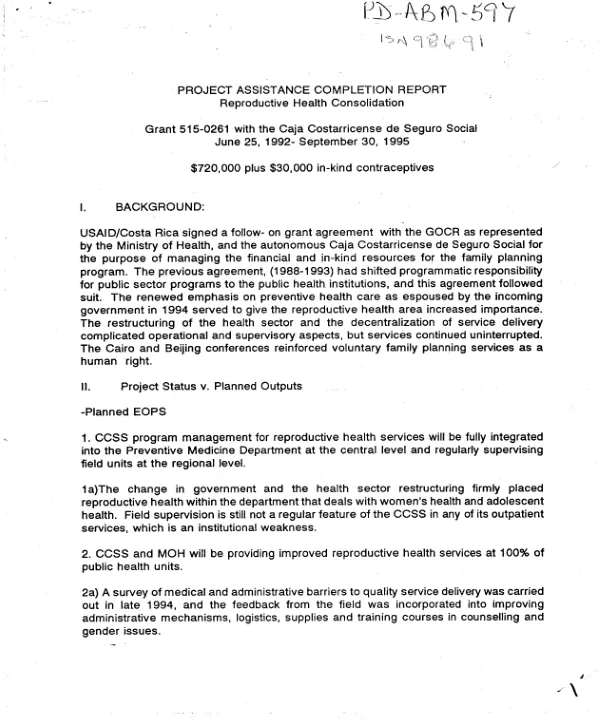
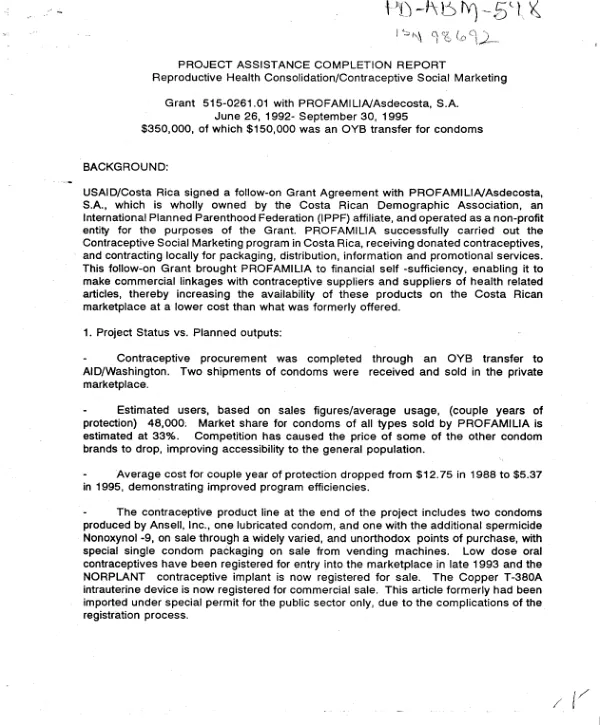
Project assistance completion report : reproductive health consolidation/contraceptive social marketing -- grant 515-0261.01 with PROFAMILIA/Asdecosta, S.A. -- June 26, 1992-September 30, 1995
Sign inUSAID. MISSION TO COSTA RICA
Project assistance completion report : reproductive health consolidation/contraceptive social marketing -- grant 515-0261.01 with PROFAMILIA/Asdecosta, S.A. -- June 26, 1992-September 30, 1995
PACR of a grant (6/92-9/95) provided to PROFAMILIA under the Reproductive Health Sector Consolidation Project to implement a contraceptive social marketing program in Costa Rica.
1995
Sign in to readA free account is required to download.
Abstract
PROFAMILIA has effectively and efficiently increased contraceptive availability, thereby facilitating voluntary family planning. Further, through innovative marketing techniques that bring condoms into the public eye without offending cultural sensitivities, it has offered low-cost, convenient alternatives to public sector family planning services. By holding a firm share of the market, and keeping prices as low as feasible, PROFAMILIA is carrying out its mission, and is likely to continue in the same manner, as its governing board and management are committed to the program. The grant brought PROFAMILIA to financial self-sufficiency, enabling it to make commercial linkages with contraceptive and health product suppliers, increasing the availability of these products at a lower cost than was previously the case. PROFAMILIA's market share is estimated at 33% and number of users at 48,000. Competition from PROFAMILIA has caused the price of some other condom brands to drop, and the average cost per couple-year of protection dropped from $12.75 in 1988 to $5.37 in 1995. PROFAMILIA's contraceptive product line includes a lubricated condom and one with the spermicide Nonoxynol -9, for sale through widely varied and unorthodox points of purchase (single packs are for sale from vending machines). Low-dose orals, NORPLANT, and the Copper T-380A IUD are all now registered for commercial sale. PROFAMILIA has effectively used the income it generates to increase its product line and ensure the availability of low-cost contraceptives through commercial channels. PROFAMILIA is also marketing a condom product for gays, a pap exam kit, rubber gloves, infant training cups, and medical instruments. It dominates the market for latex gloves. Sale of these products allows a cross-subsidy for low-priced condoms. The following lessons were learned. (1) Hiring an effective manager was the most important factor. Second in importance was allowing that manager to innovate and break ground in untried terrain. (2) The level of education in Costa Rica, the inroads of mass communications, and the advent of AIDS/HIV prevention needs propelled the family planning program into a search for additional sources of goods and services, and the contraceptive social marketing program began to fill that niche. (3) The double purpose of providing low-cost contraceptives, and making the program self-sufficient required creativity, flexibility, and a lot of accountability, which may not be the case in most of the countries where USAID works. It is working in Costa Rica.
Related documents
Documents in this collection
 1993
1993USAID DEC
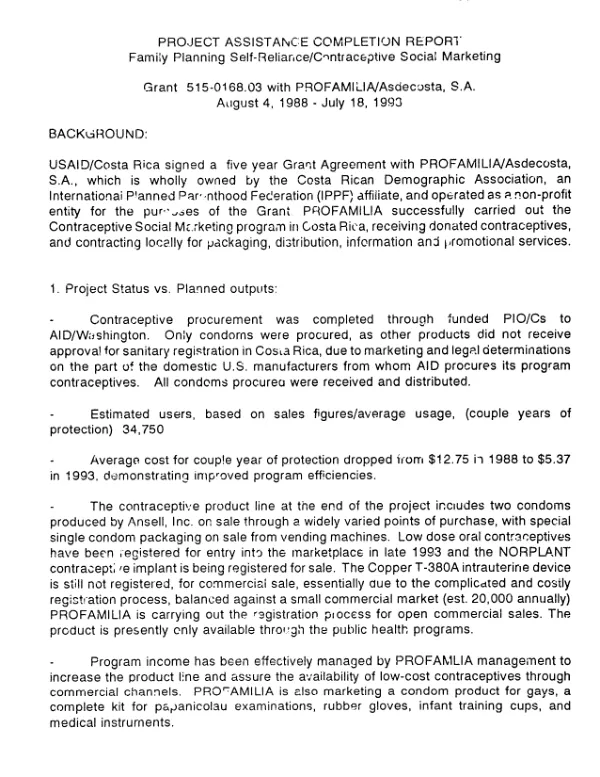
Project assistance completion report : family planning self-reliance/contraceptive social marketing -- grant 515-0168.03 with PROFAMILIA/Asdecosta, S.A., August 4, 1988-July 18, 1993
Open record 1992
1992USAID DEC