MWANGAZA
Projet Résilience et Croissance Économique au Sahel - Résilience Renforcée
The agricultural development initiative in Niger and Burkina Faso, known as Projet Résilience et Croissance Économique au Sahel - Résilience Renforcée (USAID|REGIS-ER), aims to alleviate food insecurity and enhance the resilience of populations in the region.
2014 · 38 pages
Sign in to readA free account is required to download.
Abstract
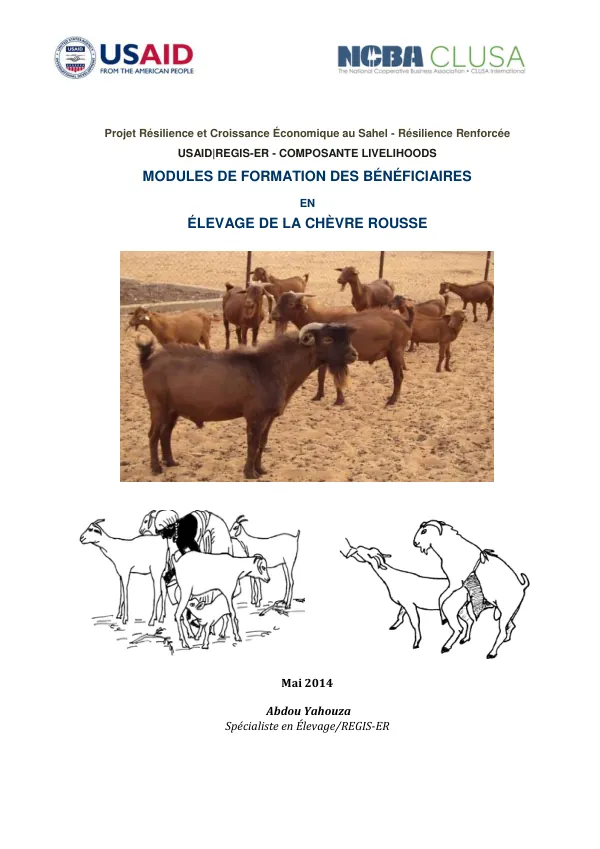
The project, initiated with the support of the United States Agency for International Development (USAID), focuses on intensifying and diversifying economic activities, improving governance and resource management, enhancing health and nutrition, and promoting the involvement of women and youth. The livestock sector is a crucial component of the project's Livelihoods component, which seeks to improve the well-being of households through the intensification and diversification of economic activities. The project's livestock activities aim to enhance the capacity of producers and producers' organizations in animal nutrition and health, promote the breeding of small ruminants and poultry, and connect them to microfinance institutions, markets, and service providers. One of the key initiatives of the project is the habbanayé program, which provides capital to vulnerable women to acquire livestock. The program involves providing three goats and one male goat to each eligible woman, who will repay the loan after 15 to 18 months by transferring three offspring goats and the male goat to another woman. The women will also receive technical and organizational support to ensure the successful breeding and management of the livestock. The habbanayé program is designed to improve the economic well-being of women and reduce their vulnerability. The program's objectives include increasing the income and productivity of women, improving their living conditions, and enhancing their access to resources and services. The program also aims to promote the involvement of women in decision-making processes and to improve their social status. The manual of habbanayé in Niger and Burkina Faso is a training module for formators of women beneficiaries of habbanayé and other promoters of livestock production. The module provides information on the importance of livestock production, the characteristics of the Maradi goat breed, and the best practices for breeding and managing the animals. The module also covers topics such as animal nutrition, health, and reproduction, as well as the importance of regular veterinary care and the need to mitigate the negative impacts of livestock production on the environment. The Maradi goat breed is a key component of the habbanayé program, and the manual provides detailed information on its characteristics, including its physical characteristics, potential performances, and environmental requirements. The manual also provides guidance on the best practices for breeding and managing the Maradi goat, including the importance of providing adequate nutrition, health care, and shelter. Overall, the habbanayé program and the manual of habbanayé in Niger and Burkina Faso are critical components of the USAID|REGIS-ER project, which aims to improve the livelihoods of women and enhance the resilience of populations in the region. The program's focus on livestock production and the provision of technical and organizational support to women beneficiaries are key strategies for achieving the project's objectives.