USAID DEC
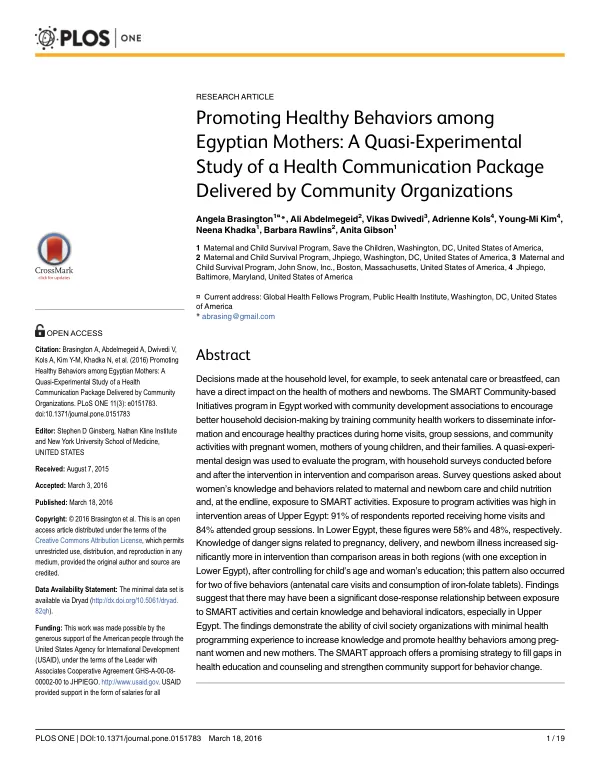
Promoting Healthy Behaviors among Egyptian Mothers: A Quasi-Experimental Study of a Health Communication Package Delivered by Community Organizations
Sign inJHPIEGO
Promoting Healthy Behaviors among Egyptian Mothers: A Quasi-Experimental Study of a Health Communication Package Delivered by Community Organizations
The SMART Community-based Initiatives program in Egypt aimed to improve maternal and newborn health outcomes by encouraging healthy behaviors and appropriate utilization of health services.
2016 · 19 pages
Sign in to readA free account is required to download.
Abstract
The program worked with community development associations to conduct community health outreach and communication activities in both Upper and Lower Egypt. Household surveys were conducted before and after the intervention in intervention and comparison areas to evaluate the program's impact. The surveys revealed that exposure to program activities was high in intervention areas of Upper Egypt, with 91% of respondents reporting receiving home visits and 84% attending group sessions. In Lower Egypt, these figures were 58% and 48%, respectively. Knowledge of danger signs related to pregnancy, delivery, and newborn illness increased significantly more in intervention than comparison areas in both regions, after controlling for child's age and woman's education. This pattern also occurred for two of five behaviors, antenatal care visits and consumption of iron-folate tablets. The findings suggest that there may have been a significant dose-response relationship between exposure to SMART activities and certain knowledge and behavioral indicators, especially in Upper Egypt. The analysis also revealed that mothers' knowledge and behaviors on maternal and newborn care and child nutrition improved significantly in intervention areas, with greater improvement in intervention than comparison areas. The SMART approach offers a promising strategy to fill gaps in health education and counseling and strengthen community support for behavior change. The program's success in improving knowledge and promoting healthy behaviors among pregnant women and new mothers demonstrates the ability of civil society organizations with minimal health programming experience to make a positive impact on maternal and newborn health outcomes. The study's results have implications for the design and implementation of community-based interventions aimed at improving maternal and newborn health. The findings suggest that such interventions should focus on both individual women and the influencers of their decisions, and that community-based approaches can be an effective way to reduce morbidity and mortality. The SMART program's emphasis on community health outreach and communication activities highlights the importance of engaging with local communities and building their capacity to promote healthy behaviors. The study's methodology involved a quasi-experimental design, with household surveys conducted before and after the intervention in intervention and comparison areas. The sampling scheme involved selecting six of Egypt's 27 governorates to implement the SMART intervention, with four located in Upper Egypt and two in Lower Egypt. The evaluation was designed to assess the impact of the program separately in Upper and Lower Egypt, taking into account regional differences in Egypt. The study's results have been published in a peer-reviewed journal and are available for public access. The data set is available via Dryad, and the study was funded by the United States Agency for International Development (USAID) through the Leader with Associates Cooperative Agreement GHS-A-00-08-00002-00 to JHPIEGO.