USAID DEC
Postpartum Family Planning During Sociopolitical Transition: Findings from an Integrated Community-Based Program in Egypt
Sign inJHPIEGO
Postpartum Family Planning During Sociopolitical Transition: Findings from an Integrated Community-Based Program in Egypt
Postpartum family planning during sociopolitical transition is a critical area of concern in countries experiencing significant changes in their social and political environments.
2016 · 2 pages
Sign in to readA free account is required to download.
Abstract
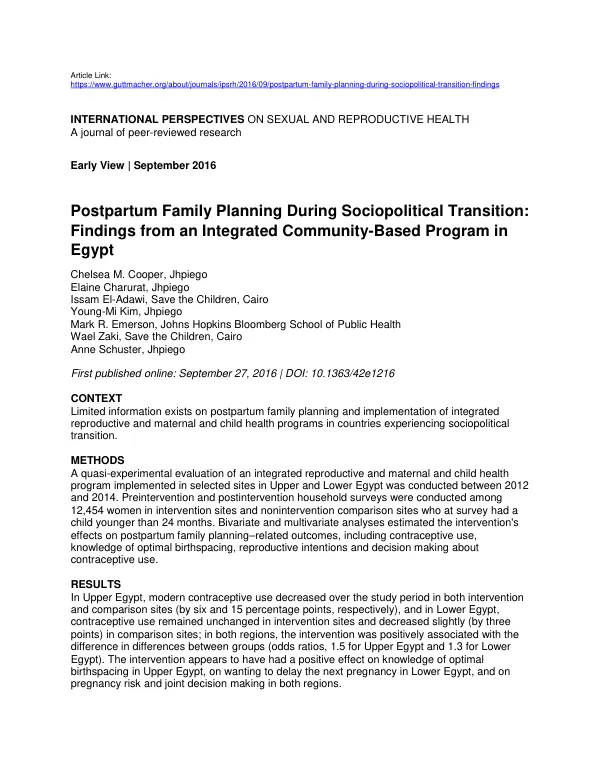
In Egypt, where sociopolitical transition has been underway since the early 2010s, limited information exists on the implementation of integrated reproductive and maternal and child health programs, particularly in the context of postpartum family planning. A quasi-experimental evaluation of an integrated reproductive and maternal and child health program was conducted in selected sites in Upper and Lower Egypt between 2012 and 2014. The program aimed to improve reproductive and maternal health outcomes among women of childbearing age. Preintervention and postintervention household surveys were conducted among 12,454 women in intervention sites and nonintervention comparison sites who had a child younger than 24 months. The surveys collected data on postpartum family planning–related outcomes, including contraceptive use, knowledge of optimal birthspacing, reproductive intentions, and decision making about contraceptive use. The results of the evaluation showed that in Upper Egypt, modern contraceptive use decreased over the study period in both intervention and comparison sites. However, the intervention was positively associated with the difference in differences between groups, indicating a potential positive effect on contraceptive use. In Lower Egypt, contraceptive use remained unchanged in intervention sites and decreased slightly in comparison sites. The intervention was also associated with a positive effect on knowledge of optimal birthspacing in Upper Egypt, on wanting to delay the next pregnancy in Lower Egypt, and on pregnancy risk and joint decision making in both regions. The study findings demonstrate the feasibility and effectiveness of an integrated reproductive and maternal and child health program implemented in a changing sociopolitical context. The results suggest that such programs can have a positive impact on postpartum family planning outcomes, including contraceptive use, knowledge of optimal birthspacing, and reproductive intentions. The findings also highlight the need for revitalized efforts to bolster family planning within the country to avert further losses and spark a return to positive trends.