USAID DEC
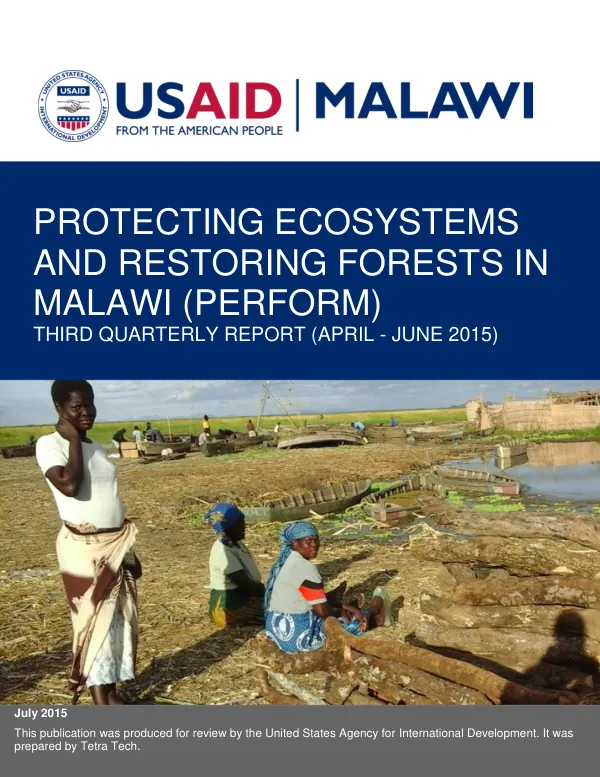
Protecting Ecosystems and Restoring Forests in Malawi (PERFORM): Restoration Opportunities Assessment Report—Liwonde Forest Reserve Landscape
Sign inTETRA TECH
Protecting Ecosystems and Restoring Forests in Malawi (PERFORM): Restoration Opportunities Assessment Report—Liwonde Forest Reserve Landscape
Protecting Ecosystems and Restoring Forests in Malawi (PERFORM) is a five-year project funded by USAID/Malawi and implemented by Tetra Tech ARD.
2016 · 73 pages
Sign in to readA free account is required to download.
Abstract
The project is a core component of environment programming under USAID's Development Objective Assistance Agreement with the Government of Malawi (GoM), and is the flagship implementation vehicle for the low-emissions partnership between the U.S. and the GoM. PERFORM was designed to align with Malawi's mid-term Growth and Development Strategy and to promote forest conservation and green growth. The objectives of the PERFORM project are: advance REDD+ (Reducing Emissions from Deforestation and Degradation) readiness, increase low-emissions land use opportunities in targeted geographies, improve low-emissions development capacities, institute pathways for sustainability, and advance CDCS (Country Development and Cooperation Strategy) priorities of integration and institutional strengthening. The World Resources Institute (WRI) provides short-term technical assistance to PERFORM and GoM partners in support of Objective 2. The pilot application of the Restoration Opportunities Assessment Methodology (ROAM) in the Liwonde Forest Reserve Landscape was carried out between October 2015 and February 2016 by Katie Reytar (GIS Analyst) and Bob Winterbottom (Forest Restoration/Natural Resource Management Specialist), part of WRI’s Global Restoration Initiative Team. The pilot application of ROAM in the Liwonde landscape employed stakeholder consultation, geospatial analysis, and an assessment of enabling conditions to achieve the following objectives: identify the specific land use challenges in the landscape of the Liwonde Forest Reserve that restoration could help to address, identify the scope and extent of major types of restoration opportunities in the landscape, identify the key success factors and barriers to implementing restoration in the Liwonde landscape, and generate actionable recommendations for scaling up restoration. Forest landscape restoration (FLR) is a means to achieving renewed productivity and resilience in degraded landscapes. FLR is defined as a long-term process of regaining ecological function and enhancing human well-being in degraded landscapes. The goal of FLR is a restored, more productive landscape that incorporates diverse land uses based on the context of the landscape and the needs of the community. FLR is a forward-looking approach that aims to strengthen the resilience of landscapes and rural communities, while maintaining a variety of future options for both people and biodiversity. The Liwonde Forest Reserve Landscape is a critical area for forest landscape restoration in Malawi. The landscape is characterized by a mix of natural forests, woodlands, and agricultural areas. The landscape is home to a diverse range of flora and fauna, including several endangered species. The Liwonde Forest Reserve is also an important water catchment area, providing water for irrigation and other uses. The pilot application of ROAM in the Liwonde landscape identified several key land use challenges that restoration could help to address. These challenges include soil degradation, deforestation, and land fragmentation. The pilot application also identified several major types of restoration opportunities in the landscape, including agroforestry, farmer-managed natural regeneration, conservation agriculture, village forest areas and woodlots, natural forest management, river/stream-bank planting, and soil and water conservation. The pilot application of ROAM also identified several key success factors and barriers to implementing restoration in the Liwonde landscape. The key success factors include stakeholder engagement, community participation, and the availability of resources and support. The barriers to implementing restoration include lack of funding, limited technical capacity, and conflicting land use priorities. The results of the pilot application of ROAM in the Liwonde landscape provide actionable recommendations for scaling up restoration. These recommendations include increasing stakeholder engagement and community participation, providing training and technical support to local communities, and increasing funding and resources for restoration activities. The recommendations also include developing a comprehensive restoration plan that takes into account the needs and priorities of local communities and stakeholders. The results of