USAID DEC
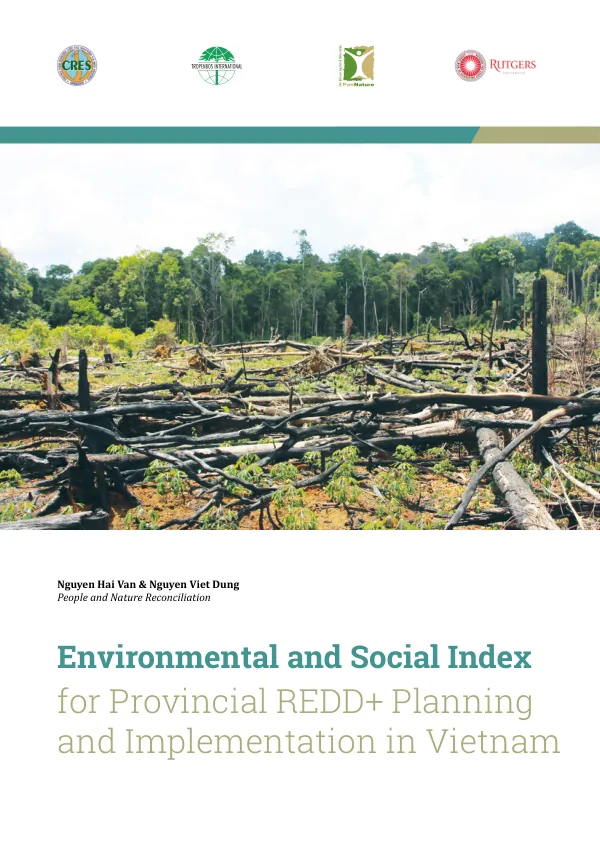
Provincial REDD+ Environmental and Social Index for Provincial REDD+ Planning and Implementation in Vietnam
Sign inUSAID DEC
Provincial REDD+ Environmental and Social Index for Provincial REDD+ Planning and Implementation in Vietnam
The Provincial REDD+ Environmental and Social Index (RESI) is a tool designed to assess local readiness for REDD+ implementation in Vietnam.
2015 · 12 pages
Sign in to readA free account is required to download.
Abstract
Developed by People and Nature Reconciliation in collaboration with the Center for Natural Resources and Environmental Studies and Tropenbos International, the RESI measures environmental and social conditions, highlighting advantages and potential risks for REDD+ implementation at the provincial level. The RESI includes four components: legislation and policy, institutional setting, environmental condition, and social condition. These components are assessed using 21 criteria, 72 indicators, and an assessment tool with 149 questions. Each answer is given a value between 0 and 100, and the final score reflects the average of all answer values. The local readiness for REDD+ implementation is categorized into one of three groups: ready, partially ready, or not ready. The RESI was tested in Lam Dong province and piloted in four provinces: Dien Bien, Kon Tum, Son La, and Kien Giang. The assessment results reveal that all four provinces rank very low at partial ready or nearly not ready for effective REDD+ implementation due to multiple limitations and potential risks. The biggest advantage of these provinces for REDD+ implementation is the abundance of natural forests, with significant forest cover in each province. The detailed assessment points out various strengths and weaknesses for each of the provinces. However, the most significant challenges for REDD+ implementation for all of the provinces include the weak role of the forest economy, incomplete forest monitoring system, lack of transparency in information sharing and accountability, unclear and complicated system of rights to own, access, and benefit from the forest resource, and issues with full and meaningful participation of all stakeholders. The RESI assessment results are presented in a graphical format, showing the final score for each province. The results indicate that Dien Bien, Son La, Kon Tum, and Kien Giang have final scores of 20, 40, 20, and 60, respectively. These scores categorize the provinces as partially ready or nearly not ready for effective REDD+ implementation. The RESI is a useful tool for investors, governments, and non-governmental organizations to survey and determine the best locations for REDD+ implementation, develop and integrate safeguards to reduce risks, and assess future impacts of REDD+ interventions in Vietnam. The tool provides an accurate overview of local environmental, social, legal, and institutional conditions, and identifies advantages, challenges, and risks for REDD+ implementation in specific contexts.
Related documents