USAID DEC
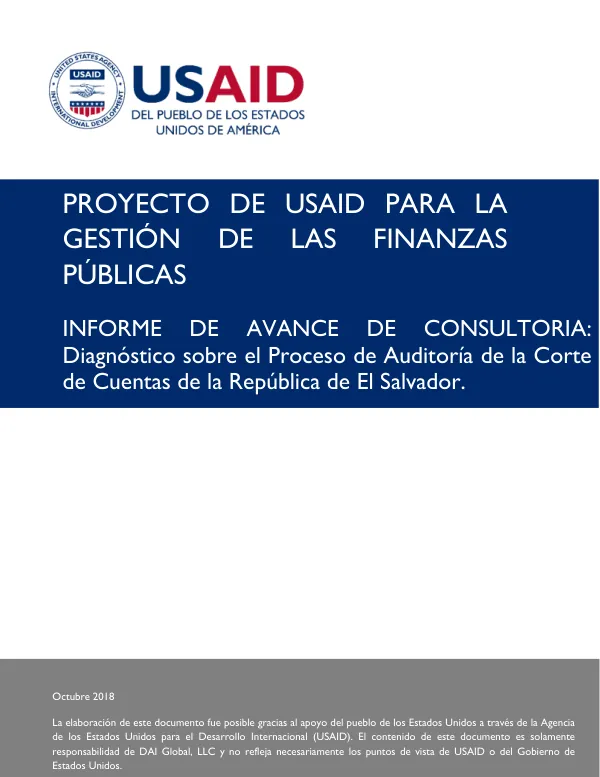
Proyecto de USAID para la Gestión de las Finanzas Públicas: Informe de Avance de Consultoría
Sign inDAI GLOBAL, LLC
Proyecto de USAID para la Gestión de las Finanzas Públicas: Informe de Avance de Consultoría
The Proyecto de USAID para la Gestión de las Finanzas Públicas is a project aimed at improving the financial management of the government of El Salvador.
2018 · 98 pages
Sign in to readA free account is required to download.
Abstract
The project is funded by the United States Agency for International Development (USAID) and is implemented by DAI Global, LLC. The project's objective is to strengthen the capacity of the Corte de Cuentas de la República (CCR) to conduct effective audits and provide high-quality financial information to the government and the public. To achieve this objective, the project has conducted a diagnostic study on the CCR's audit process, which is based on the International Standards of Supreme Audit Institutions (ISSAI). The diagnostic study was conducted between August 13 and 24, 2018, and October 17 and 28, 2018. The study aimed to identify the strengths and weaknesses of the CCR's audit process, as well as the challenges and opportunities for improvement. The study found that the CCR has a well-defined legal framework, which provides a solid foundation for its audit activities. However, the CCR faces several challenges, including a lack of resources, inadequate infrastructure, and limited capacity to conduct audits. The study also identified several areas for improvement, including the need to strengthen the CCR's planning and budgeting processes, improve the quality of its audit reports, and enhance its capacity to conduct audits in a timely and efficient manner. To address these challenges and opportunities, the project has developed a set of recommendations for the CCR, which include: 1. Strengthening the CCR's planning and budgeting processes to ensure that it has the necessary resources to conduct audits. 2. Improving the quality of the CCR's audit reports to ensure that they are accurate, complete, and timely. 3. Enhancing the CCR's capacity to conduct audits in a timely and efficient manner. 4. Developing a system of internal control to ensure that the CCR's audit activities are conducted in accordance with the ISSAI. 5. Establishing a system of quality control to ensure that the CCR's audit reports meet the required standards. The project has also developed a set of indicators to measure the CCR's progress in implementing the recommendations and achieving the project's objectives. The CCR's audit process is divided into several stages, including planning, fieldwork, and reporting. The CCR has a well-defined planning process, which includes the identification of audit objectives, the development of an audit plan, and the allocation of resources. The CCR's fieldwork process involves the collection of evidence, the analysis of data, and the identification of audit findings. The CCR has a well-defined system of internal control, which ensures that its audit activities are conducted in accordance with the ISSAI. The CCR's reporting process involves the preparation of audit reports, which are submitted to the government and the public. The CCR has a well-defined system of quality control, which ensures that its audit reports meet the required standards. The project has also developed a set of recommendations for the CCR to improve its system of internal control and quality control. These recommendations include: 3. Improving the CCR's capacity to conduct audits in a timely and efficient manner. 4. Enhancing the CCR's capacity to analyze and report on audit findings. 5. Developing a system of performance measurement to ensure that the CCR's audit activities are conducted in accordance with the ISSAI. 1. The number of audit reports submitted to the government and the public. 2. The quality of the CCR's audit reports. 3. The timeliness of the CCR's audit reports. The project has also developed a set of recommendations for the CCR to improve its system of performance measurement. These recommendations include: 2. Establishing a system of performance indicators to measure the CCR's progress in implementing the recommendations and achieving the project's objectives. 3. Improving the CCR's capacity to analyze and report on performance data. 4. Enhancing the CCR's capacity to use performance data to inform its audit activities. 5. Developing a system of accountability to ensure that the CCR's audit activities are conducted in accordance with the ISSAI.
Related documents