USAID DEC
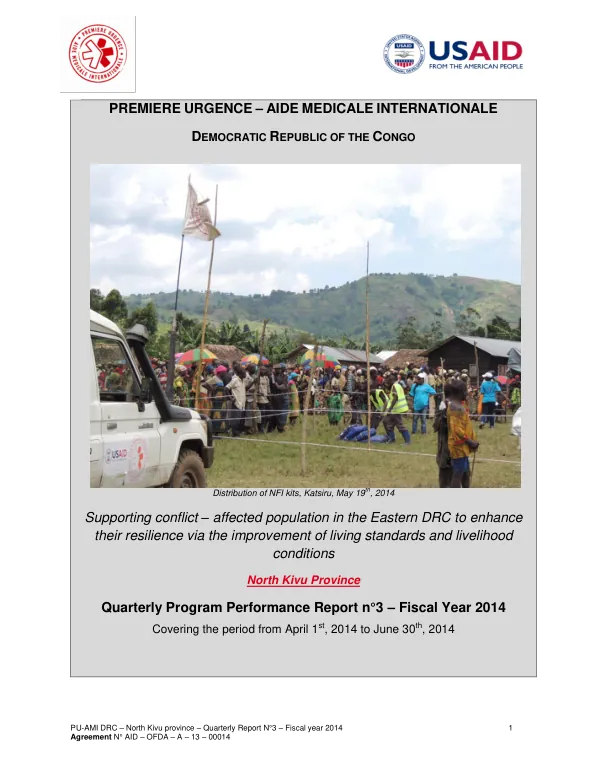
PU-AMI DRC – North Kivu and Katanga provinces – Quarterly Report N°2 – Fiscal year 2014
Sign inUSAID DEC
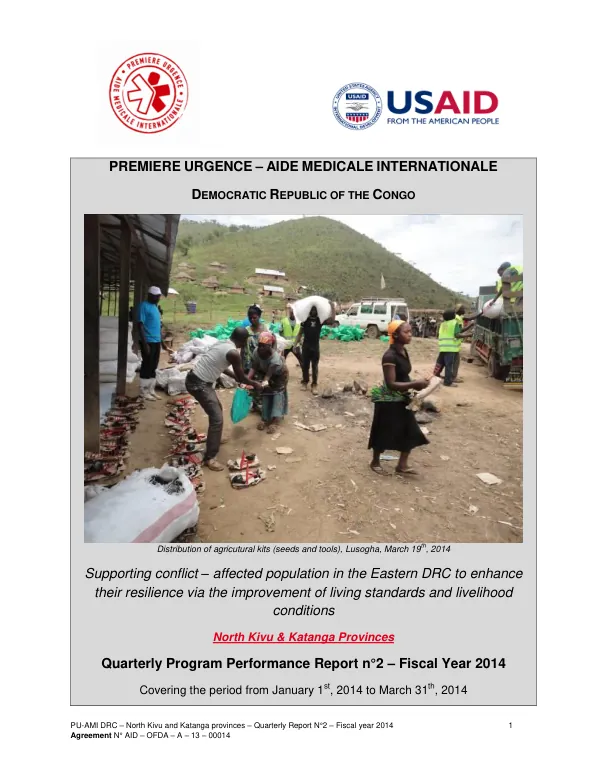
PU-AMI DRC – North Kivu and Katanga provinces – Quarterly Report N°2 – Fiscal year 2014
The agricultural development initiative in North Kivu and Katanga provinces of the Democratic Republic of the Congo aims to restore livelihoods and basic living conditions of conflict-affected populations.
2014 · 8 pages
Sign in to readA free account is required to download.
Abstract
The program, funded by USAID's Food Security Program, targets 127,500 beneficiaries across 22,500 households. The geographic focus includes North Kivu Province, specifically Masisi and Rutshuru territories, and Katanga Province, with a focus on Tanganyika District and Manono Territory. The program's main objective is to contribute to the restoration of food security to displaced and returnee households through agricultural activities. In the reporting period, 36,000 beneficiaries received agricultural kits, consisting of seeds and tools, with a focus on food crop certified seeds and gardening seeds. Training sessions were conducted for beneficiaries, with a focus on agricultural techniques and plot preparation. Implementation of the program has been ongoing, with a focus on three main sectors: Agriculture and Food Security, Economic Recovery and Market Systems (ERMS), and Logistic Support and Relief Commodities. The Agriculture and Food Security sector has seen significant progress, with the distribution of agricultural kits and training sessions for beneficiaries. The ERMS sector has also made progress, with the distribution of cash grants to vulnerable households. The Logistic Support and Relief Commodities sector has focused on the distribution of Non-Food Items (NFIs) to newly displaced and returned households. The program has made significant progress in reaching its target beneficiaries, with 107,673 beneficiaries reached in the reporting period. The cumulative period has seen 138,557 beneficiaries reached. The program has also made progress in terms of livelihood restoration, with 17,673 beneficiaries reached in the reporting period. The cumulative period has seen 48,557 beneficiaries reached. The program has also made progress in terms of cash grants, with 200,000 USD channeled into the program area through sub-sector activities in the reporting period. The cumulative period has seen 741,960 USD channeled into the program area. The program has also made progress in terms of beneficiary targeting, with a focus on vulnerable households. The program has conducted a baseline survey to assess the needs of vulnerable households, with a focus on food consumption scores, agricultural inputs, and NFIs. The program has also conducted a door-to-door census to identify priority areas and crisis-affected villages. The program has also made progress in terms of community-based targeting, with a focus on introducing community-based targeting to localities.